Tag: machine-learning

  • Automating Market Vigilance

    In past posts, we’ve seen how natural language workflows simplify complex portfolio monitoring, and how scheduled tasks let agents run without user input. Today, we’re combining these powers in a single instruction: a user defines a high-level goal—monitor AMZN and NVDA for 3% price drops—and Sentienta handles the rest. It parses the language, builds the workflow, schedules it to run every 30 minutes, and manages each run intelligently. Multiple scheduled workflows can run in parallel, each executing complex logic—no code, no setup screens, just natural language.

    Building the Intelligent Workflow

    The user’s request is simple on the surface—“Monitor AMZN and NVDA for a 3% drop and alert me”—but that instruction triggers a multi-layered automation. Sentienta interprets the goal, identifies that real-time pricing data is needed, calculates change percentages, evaluates conditions, and routes alert tasks if thresholds are met. Each step is delegated to the appropriate agent using the right tools. All of it is wrapped into a workflow that is created instantly through natural language—no coding, no flowchart building, no manual agent assignment.

    The following graph shows this simple workflow:

    Seeing It Run

    Once the workflow is created, the user simply asks it to run every 30 minutes—and Sentienta schedules recurring executions automatically. Each run pulls updated stock prices, assesses whether either AMZN or NVDA has dropped by 3%, and triggers alerts if so. Users can check task status, inspect the workflow graph, or fetch results at any time—all via natural language. As the transcript shows, there’s no manual reconfiguration between runs. The system just works—consistently, transparently, and in parallel with any other workflows the user initiates.
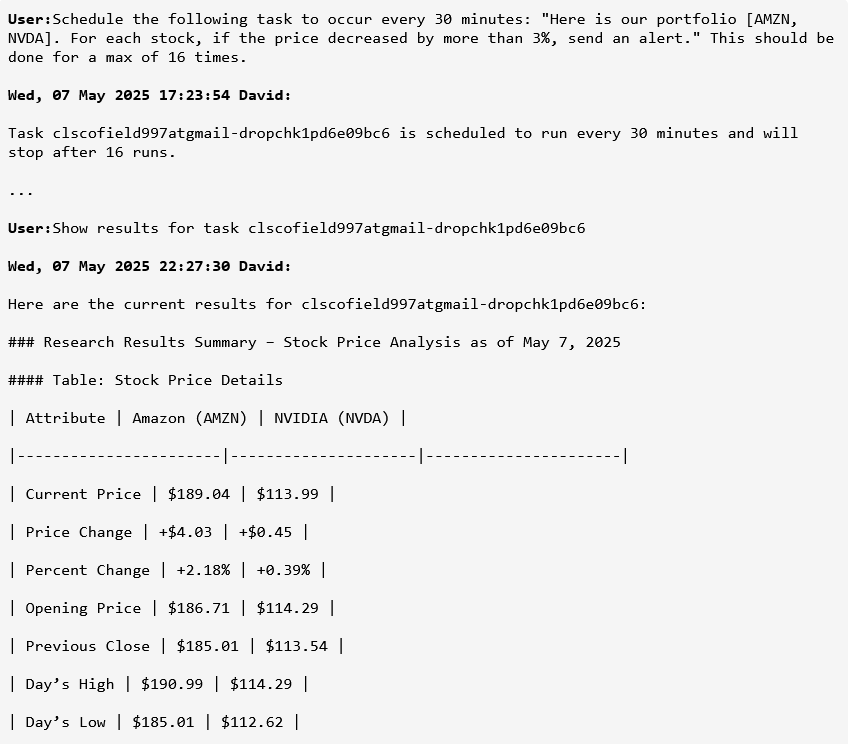
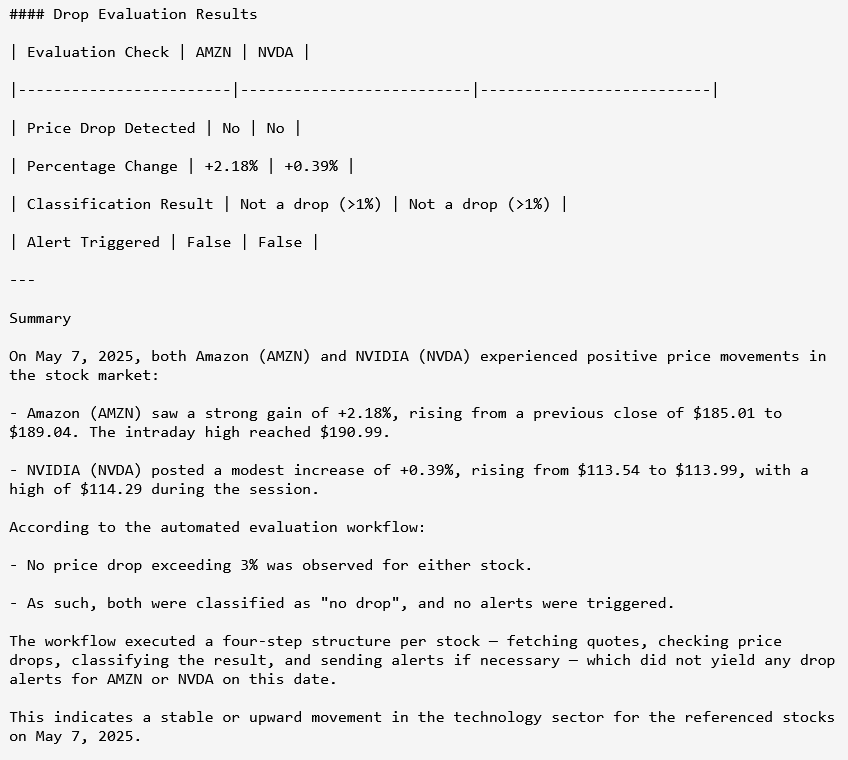
    This workflow is just one of many that can be created and scheduled in parallel. A portfolio manager might monitor multiple assets, each with its own threshold, timing, or downstream trigger—Sentienta handles them all concurrently. Whether it’s tracking different sectors, adding earnings-based filters, or launching trading actions based on composite signals, every workflow runs independently and automatically. There’s no limit on scale or complexity—just natural language input and intelligent execution.

    Autonomous Workflows, Any Domain

    Sentienta scheduled workflows enable fast triage, coordinated triggers, and domain-specific actions—without custom code.

    • Elastic, auto-scaled concurrency for workflows across finance, support, ops, and more
    • Natural-language scheduling and editing
    • Real-time status checks and workflow graph inspection
    • Automated evaluation and trigger-based actions
    • Secure, audit-ready history of every run

    To learn more start with our Managing Portfolio Workflows with Natural Language: A Multi-Agent Use Case and follow up with Powering Productivity: Task Scheduling for Intelligent Agents.
  • Your Team Is Using AI Wrong—But Not For the Reason You Think

    Nate Jones is one of the sharpest observers of the AI industry, offering thoughtful takes on how the field is evolving faster than most teams can adapt. In one of his recent posts (and video), he highlights a crucial, yet often overlooked insight: new knowledge doesn’t just come from tools. It emerges from how teams think together.

    He’s absolutely right. But while others are still figuring out how to retrofit ChatGPT into legacy workflows, we built something different from the start.

    Sentienta wasn’t built to join a team—it was built to be one. An architecture where cognition is emergent, shared, and preserved through expert agent interaction.

    This post is our view on Nate’s insight about ‘distributed cognition’ and a demonstration of what it looks like in action.

    What Is Distributed Cognition?

    In traditional systems, intelligence is seen as residing in individuals or in the outputs of standalone tools. But real team intelligence is different. It’s a dynamic process: understanding emerges as people, and now agents, interact, adapt, and build on one another’s contributions.

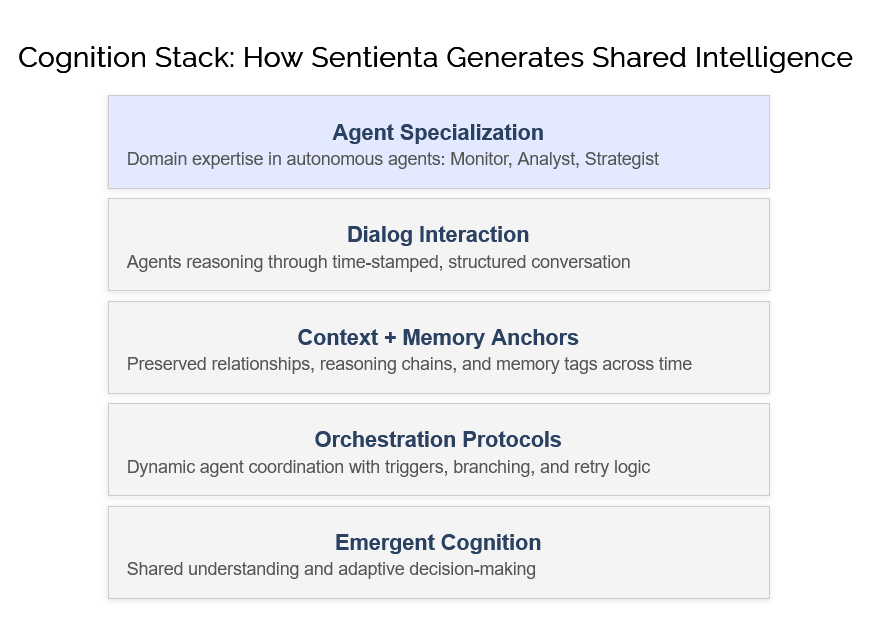
    Sentienta is designed around this principle. Its expert agents don’t just complete tasks, they participate in a continuous, evolving exchange of reasoning. Each brings a domain-specific perspective, and through ongoing dialog, they generate insights that no single agent—or human could reach alone.

    This isn’t just “stored knowledge”—it’s active cognition. When agents respond to one another, challenge assumptions, and adapt strategies together, they form a cognitive system. What emerges isn’t data, but collective understanding.

    Sentienta isn’t a system for remembering what happened—it’s a system for thinking together in real time.

    This is what makes Sentienta more than a workflow tool. It is distributed cognition embodied: an always-on, always-evolving team of minds—virtual and human, each contributing to a deeper, shared sense of what’s true and what to do next.

    Innovating Through Collaborative Insight

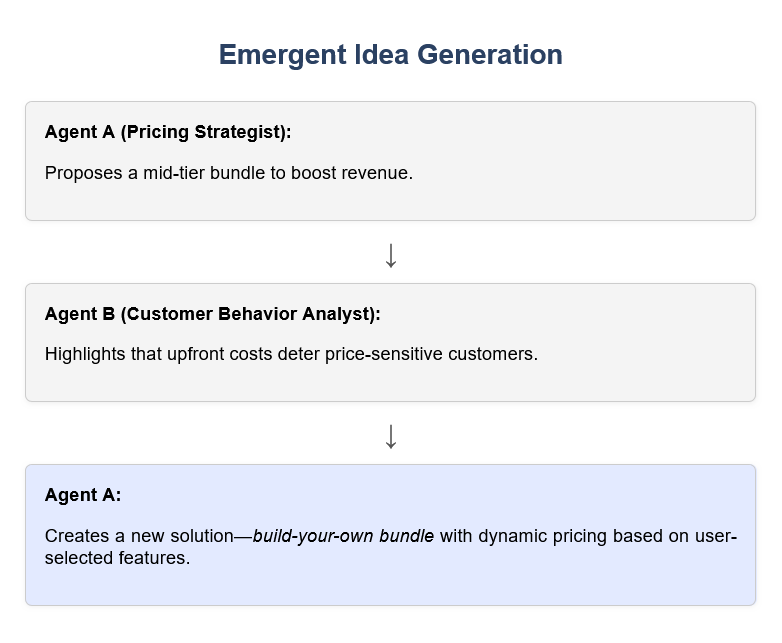
    The following graphic shows how a Pricing Strategist’s initial idea evolves through critical input from a Customer Behavior Analyst into a novel “build-your-own bundle”, the visualization highlights Sentienta’s ability to generate breakthrough strategies through collaborative agent interactions.

    What begins as expert input becomes something more—a new idea born through structured interaction. Sentienta not only facilitates this dynamic exchange but preserves the conversation, making insight traceable, reusable, and ready for replay when it matters most.

    Emergent Strategy from Agent Teamwork

    Teamwork is essential because it drives creative problem solving on multiple levels: humans contribute diverse perspectives and strategic intuition, while agents rapidly process data and combine insights at scale. This dual approach means that by integrating people with high-performing agent teams, businesses can overcome the natural limits of human capacity, ensuring that expertise expands without additional headcount.

    Sentienta’s platform not only leverages this synergy by preserving collaborative dialogs to build a lasting archive of insights but also serves as a dynamic space for co-creating new ideas through agent collaboration. By surfacing insights that no single agent or person could produce alone, Sentienta teams exemplify emergent cognition-delivering strategies born from structured, multi-perspective dialog.

  • A Deep-dive into Agents: Agent Autonomy

    A Deep-dive into Agents: Agent Autonomy

    In past posts, we’ve explored key aspects of AI agents, including agent memory, tool access, and delegation. Today, we’ll focus on how agents can operate autonomously in the “digital wild” and clarify the distinction between delegation and autonomy.

    Understanding Delegation and Autonomy

    Agent delegation involves assigning a specific task to an agent, often with explicit instructions. In contrast, autonomy refers to agents that operate independently, making decisions without significant oversight.

    Within Sentienta, agents function as collaborative experts, striking a balance between autonomy and delegation for structured yet dynamic problem-solving. Autonomous behavior includes analyzing data, debating strategies, and making decisions without user intervention, while delegated tasks ensure precise execution of specific actions.

    For example, a Business Strategy Team could autonomously assess market trends, identify risks, and refine strategies based on live data. At the same time, these agents might delegate the task of gathering fresh market data to a Web Search Agent, demonstrating how autonomy and delegation complement each other.

    Extending Autonomy Beyond Internal Systems

    Sentienta Assistant agents and teams can also function beyond internal environments, operating autonomously on third-party platforms. Whether embedded as intelligent assistants or collaborating in external workflows, these agents dynamically adapt by responding to queries, analyzing evolving data, and refining recommendations—all without requiring continuous oversight.

    Practical Applications of Autonomous Agents

    Below are practical applications showcasing how agents can operate independently or in collaboration to optimize workflows and decision-making.

    • Financial Advisory & Portfolio Management (Single Agent) A financial advisor agent reviews portfolios, suggests adjustments based on market trends, and provides personalized investment strategies.
    • Customer Support Enhancement (Single Agent or Team) A support agent answers queries while a team collaborates to resolve complex issues, escalating cases to specialized agents for billing or troubleshooting.
    • Data-Driven Market Research (Sentienta Team) A multi-agent team tracks competitor activity, gathers insights, and generates real-time market summaries, using delegation for data collection.
    • Legal Document Analysis & Compliance Checks (Single Agent) A legal agent reviews contracts, identifies risk clauses, and ensures regulatory compliance, assisting legal teams with due diligence.
    • Healthcare Support & Patient Triage (Single Agent) A virtual medical assistant assesses symptoms, provides diagnostic insights, and directs patients to appropriate specialists.

    The Future of AI Autonomy in Business

    By combining autonomy with effective delegation, Sentienta agents serve as dynamic problem-solvers across industries. Whether streamlining internal workflows or enhancing real-time decision-making, these AI-driven assistants unlock new possibilities for efficiency, expertise, and scalable innovation.