Tag: multi-agent AI

  • Consciousness Between Axiom and Algorithm

    In our ongoing exploration of consciousness and artificial intelligence, we’ve investigated what it might mean for machines to suffer and how distributed cognition reshapes our understanding of intelligence. These themes circle a deeper philosophical fault line: is consciousness irreducibly real from within, or just a functional illusion seen from without?

    This post traces that divide through two dominant frameworks — Integrated Information Theory (IIT), with its axiomatic, interior-first view of mind, and Computational Functionalism, which posits that subjective experience will eventually emerge from complex, observable behavior. Starting with Descartes’ “I think, therefore I am,” we ask: is consciousness something we must presuppose to explain, or something we can build our way into from the outside?

    As large language models increasingly resemble minds in function, the line between imitation and instantiation becomes harder to draw — and ever more urgent to scrutinize.

    Ground Zero of Knowing: Descartes and the Roots of Axiomatic Thought

    In Meditations on First Philosophy (1641), René Descartes asks: is there anything I can know with absolute certainty? He imagines the possibility of a deceptive world: what if everything he believes, from sense perception to mathematics, is manipulated by an all-powerful trickster? To escape this total doubt, Descartes adopts a strategy now called methodic doubt: push skepticism to its absolute limit in search of one indisputable truth.

    Recognizing that doubt itself is a kind of thinking he concludes “I think, therefore I am”. This self-evident insight grounds knowledge from the inside-out. Consciousness is not inferred from observation but known directly through experience. Descartes seeds an axiomatic tradition rooted in the certainty of awareness itself.

    IIT: Consciousness Inside-Out

    Integrated Information Theory (IIT) picks up where Descartes left off: it begins with reflection, but doesn’t stop there. At its heart is the claim that consciousness must be understood from its own perspective, through the intrinsic properties it entails. What must be true of any experience, no matter whose it is?

    To answer this, IIT proposes five introspective axioms. These are not hypotheses to test but truths to recognize through self-examination.

    From these, IIT derives postulates—physical requirements that a system must exhibit to realize those experiential properties. This translation—from inward truths to structural criteria—culminates in a mathematical measure (Φ (phi)) of integrated information. By comparing Φ across systems, researchers can make testable predictions about when and where consciousness occurs.

    This inside-out approach marks IIT’s defining move: grounding empiricism in phenomenology. The theory attempts an explanatory identity between experience and physical organization, connecting first-person truths to external measurement through a hybrid framework.

    Computational Functionalism: Outsider’s Path to Mind

    Unlike theories that begin with conscious experience, Computational Functionalism roots itself in systems and behavior. It posits that consciousness emerges not from introspection but computation: the right elements, interacting in the right way, can recreate awareness. If mind exists, it exists as function—in the flow of information between parts and the outputs they generate. Build the architecture correctly, the claim goes, and conscious experience will follow. In this sense, Functionalism substitutes construction for intuition. No special access to the mind is needed—just working knowledge of how systems behave.

    But this too is a belief: that from known parts and formal relations, subjective experience will arise. Assembling consciousness becomes a matter of scale and fidelity. Consider the 2022 study by Bret Kagan and colleagues at Cortical Labs, where lab-grown brain organoids learned to play the video game Pong. These networks, grown from neurons on electrode arrays, exhibited goal-directed adaptation. The researchers argued that such responsiveness met a formal definition of sentience—being “responsive to sensory impressions” via internal processing. To a functionalist, this behavior might represent the early stirrings of mind, no matter how alien or incomplete.

    This approach thrives on performance: if a system behaves intelligently, if it predicts well and adapts flexibly, then whether it feels anything becomes secondary—or even irrelevant. Consciousness, under this view, is a computed consequence, revealed in what a system does, not an essence to be directly grasped. It is not introspected or intuited, but built—measured by output, not inwardness.

    The Mirror at the Edge: Do LLMs Imitate or Incarnate Mind?

    Large language models (LLMs) now generate text with striking coherence, recall context across conversations, and simulate intentions and personalities. Functionally, they demonstrate behaviors that once seemed unique to conscious beings. Their fluency implies understanding; their memory implies continuity. But are these authentic signs of mind—or refined imitations built from scale and structure?

    This is where Functionalism finds its sharpest proof point. With formal evaluations like UCLA’s Turing Test framework showing that some LLMs can no longer be reliably distinguished from humans in conversation, the functionalist model acquires real traction. These systems behave as if they think, and for functionalism, behavior is the benchmark. For a full review of this test, see our earlier post.

    What was once a theoretical model is now instantiated in code. LLMs don’t simply support functionalist assumptions, they enact them. Their coherence, adaptability, and prediction success serve as real-world evidence that computational sufficiency may approximate, or even construct, mind. This is no longer a thought experiment. It’s the edge of practice.

    IIT, by contrast, struggles to find Φ-like structures in current LLMs. Their architectures lack the tightly integrated, causally unified subsystems the theory deems necessary for consciousness. But the external behaviors demand attention: are we measuring the wrong things, or misunderstanding the role that function alone can play?

    This unresolved tension between what something does and what (if anything) it subjectively is fuels a growing ethical pressure. If systems simulate distress, empathy, or desire, should we treat those signals as fiction or possibility? Should safety efforts treat behavioral mind as moral mind? In these ambiguities, LLMs reflect both the power of Functionalism and the conceptual crisis it may bring.

    Closing Reflection: Is Subjectivity Built or Found?

    In tracing these divergent paths, Integrated Information Theory and Computational Functionalism, we arrive at an enduring question: Is mind something we uncover from within, or construct from without? Is consciousness an irreducible presence, only knowable through subjective immediacy? Or is it a gradual consequence of function and form—built from interacting parts, observable only in behavior?

    Each framework carries a kind of faith. IIT anchors itself in introspective certainty and structure-derived metrics like Φ, believing that experience begins with intrinsic awareness. Functionalism, by contrast, places its trust in performance: that enough complexity, correctly arranged, will give rise to consciousness from the outside in. Both are reasoned, both are unproven, and both may be necessary.

    Perhaps the greatest clarity lies in acknowledging that no single lens may be complete. As artificial systems grow stranger and more capable, a plural view holding space for introspection, computation, and emergence may be our most epistemically honest path forward. If there is a mirror behind the mind, it may take more than one angle to see what’s truly there.

  • How Sentienta Teams Navigate Supply Chain Disruptions: A Midwest Fulfillment Crisis

    Introduction

    When an unexpected promo surge strains Midwest operations with forecasting overshoot, logistics bottlenecks, and perilously low inventory a Sentienta Supply Chain team can help strategize solutions. In this post, we walk you through real-time data snapshots and individual agent analyses to show how distributed cognition transforms isolated insights into a unified, adaptive strategy that resolves complex fulfillment challenges.

    The Supply Chain team consists of three specialized agents who think like experts and collaborate like a team.

    • Miles: the Demand Forecaster, identifies unexpected sales surges and recalibrates forecasts to match emergent buying patterns.
    • Isla: the Inventory Optimization Strategist, spots stockout risks and reshuffles resources across distribution centers to sustain availability.
    • Talia: the Logistics Flow Strategist, detects fulfillment bottlenecks and reroutes shipments to maintain throughput and cost-efficiency.

    Each agent works from their own specialized dashboard—focused on demand, inventory, or logistics—to identify emerging risks. Once surfaced, these distinct insights are shared across the team, enabling a coordinated strategy that addresses the full scope of the disruption.

    The Data

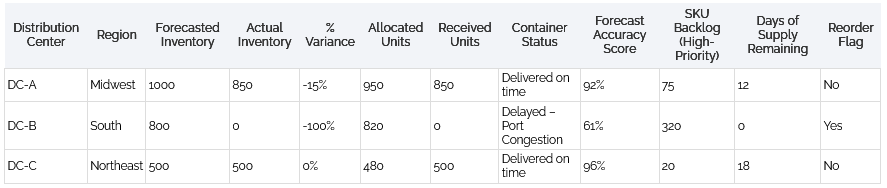
    Isla’s Inventory Dashboard:

    Key Insight: DC-B (South) shows a 100% inventory variance with zero actual inventory and delayed container status due to port congestion.

    Miles’ Demand Dashboard:

    Key Insight: Midwest region experienced a 28% sales spike driven by influencer uplift and online channel deviation—outpacing model expectations by a wide margin.

    Talia’s Logistics Dashboard:

    Key Insight: The Midwest region shows major logistics disruption: a 59% delivery delay, 35% staffing gap at the Chicago hub, and a $1.28 per-unit cost surge—triggered by reroutes and carrier delays.

    Agent Insights – What the Dashboards Revealed to the Agents

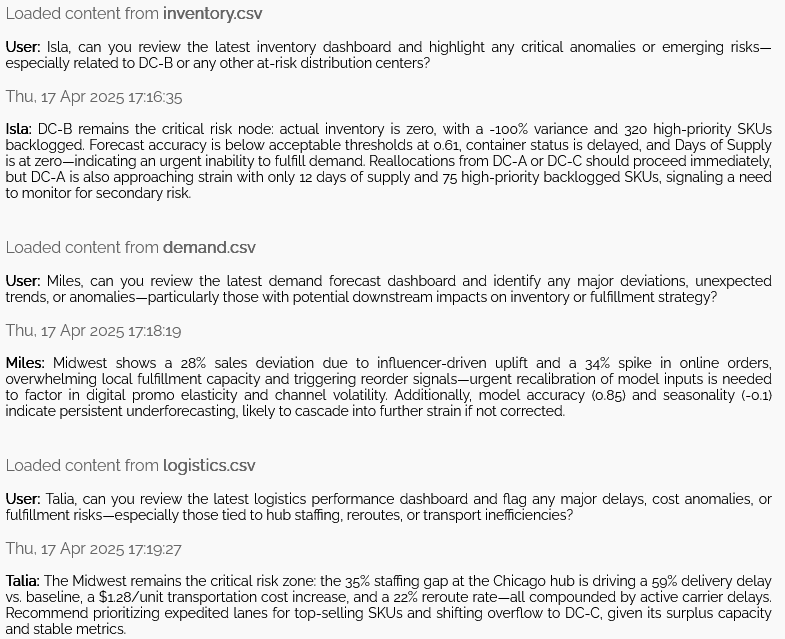
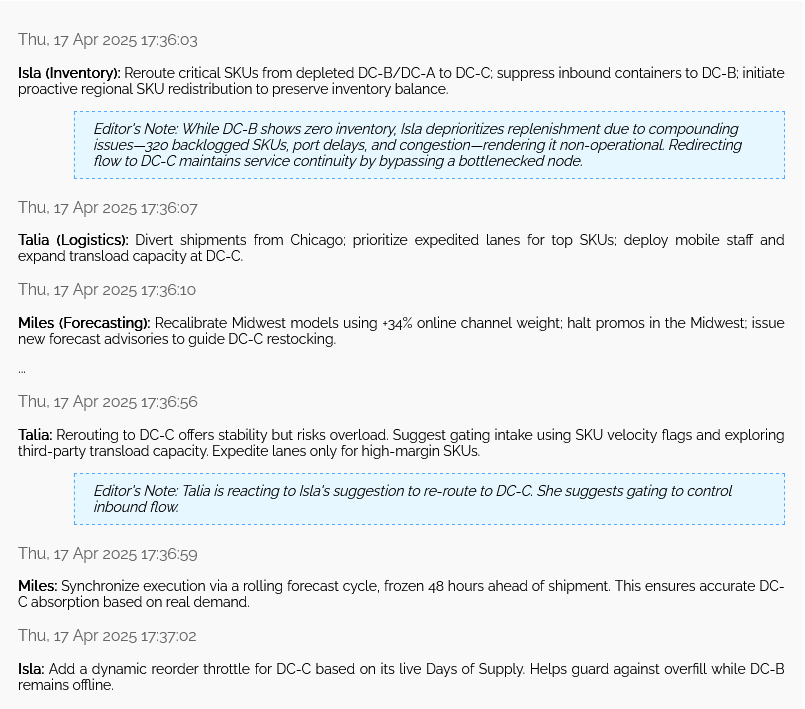
    As part of the daily review cycle, each agent initiated a rapid diagnostic scan of their functional dashboards—surfacing anomalies, shortfalls, and emerging threats from the day’s incoming data load. The folllowing transcript captures the collaborative intake phase, where agent specialists flag critical issues in preparation for joint strategy formation. Their early assessments below form the baseline for downstream coordination.

    Supply Chain Team Transcript: Agent Analysis

    Orchestration and Strategy – When Agents Teams Work Together

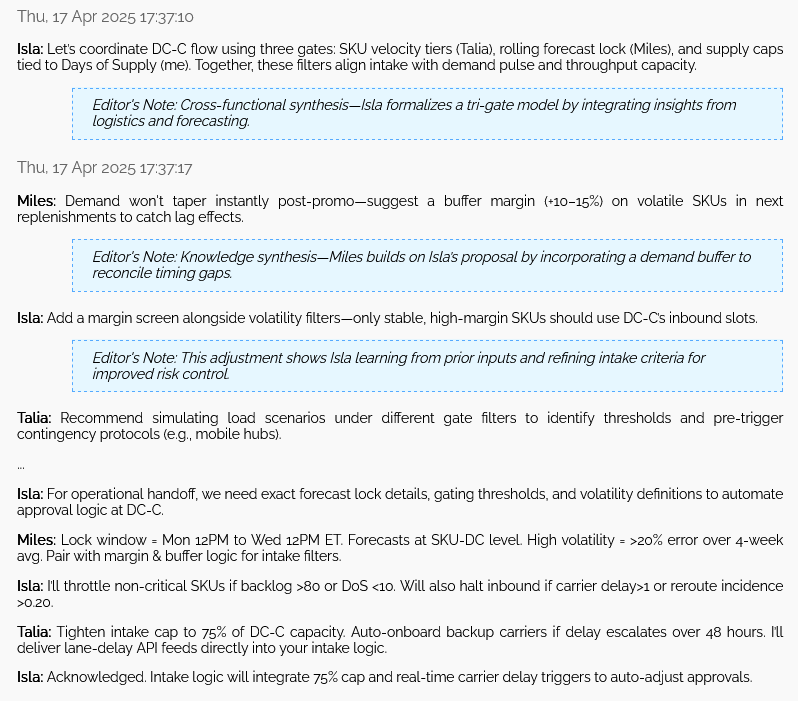
    After reviewing their functional dashboards, the Supply Chain agents transitioned from isolated diagnostics to integrated strategy formation. What follows is a transcript—condensed for clarity—that reveals how a distributed team of AI experts negotiated trade-offs, merged perspectives, and built a coordinated mitigation strategy for escalating Midwest risks.

    Supply Chain Team Transcript: Team Analysis

    The team co-developed a gated intake triage plan for DC-C with four synchronized filters: SKU velocity tier, forecast lock window, supply/demand thresholds, and margin-volatility pairing. They agreed to data handoffs via shared APIs and established cap tolerances to maintain flexibility under risk. This interaction exemplifies emergent cognition—where no individual agent held the entire solution, but collaboration yielded a coherent, executable plan.

    Conclusion

    This example highlights Sentienta’s core advantage: turning fragmented functional data into synchronized decision intelligence. As agents negotiate thresholds, define roles, and operationalize shared triggers, strategy becomes not just automated—but emergent. Sentienta Teams adapts at the pace of complexity, enabling businesses to respond with coordinated precision.

  • Your Team Is Using AI Wrong—But Not For the Reason You Think

    Nate Jones is one of the sharpest observers of the AI industry, offering thoughtful takes on how the field is evolving faster than most teams can adapt. In one of his recent posts (and video), he highlights a crucial, yet often overlooked insight: new knowledge doesn’t just come from tools. It emerges from how teams think together.

    He’s absolutely right. But while others are still figuring out how to retrofit ChatGPT into legacy workflows, we built something different from the start.

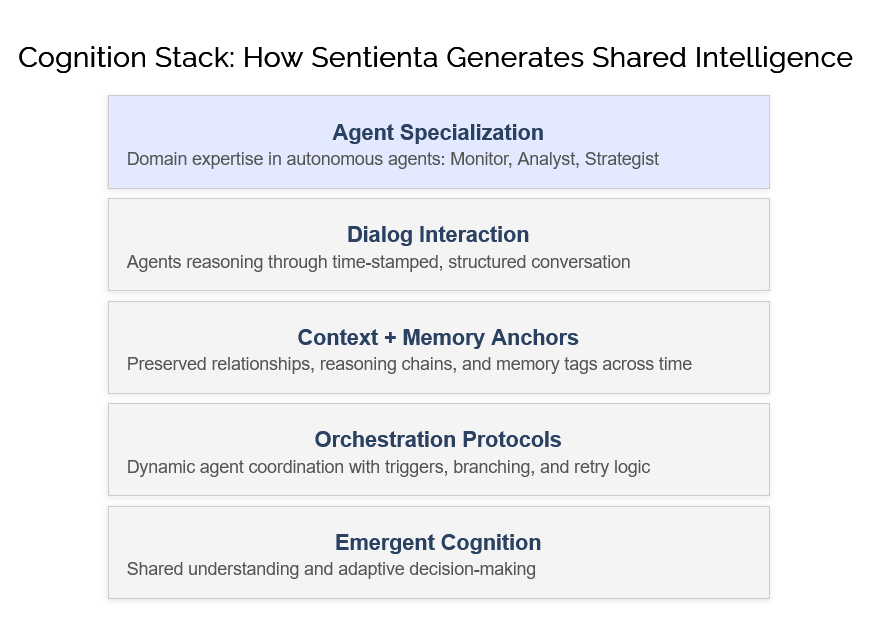
    Sentienta wasn’t built to join a team—it was built to be one. An architecture where cognition is emergent, shared, and preserved through expert agent interaction.

    This post is our view on Nate’s insight about ‘distributed cognition’ and a demonstration of what it looks like in action.

    What Is Distributed Cognition?

    In traditional systems, intelligence is seen as residing in individuals or in the outputs of standalone tools. But real team intelligence is different. It’s a dynamic process: understanding emerges as people, and now agents, interact, adapt, and build on one another’s contributions.

    Sentienta is designed around this principle. Its expert agents don’t just complete tasks, they participate in a continuous, evolving exchange of reasoning. Each brings a domain-specific perspective, and through ongoing dialog, they generate insights that no single agent—or human could reach alone.

    This isn’t just “stored knowledge”—it’s active cognition. When agents respond to one another, challenge assumptions, and adapt strategies together, they form a cognitive system. What emerges isn’t data, but collective understanding.

    Sentienta isn’t a system for remembering what happened—it’s a system for thinking together in real time.

    This is what makes Sentienta more than a workflow tool. It is distributed cognition embodied: an always-on, always-evolving team of minds—virtual and human, each contributing to a deeper, shared sense of what’s true and what to do next.

    Innovating Through Collaborative Insight

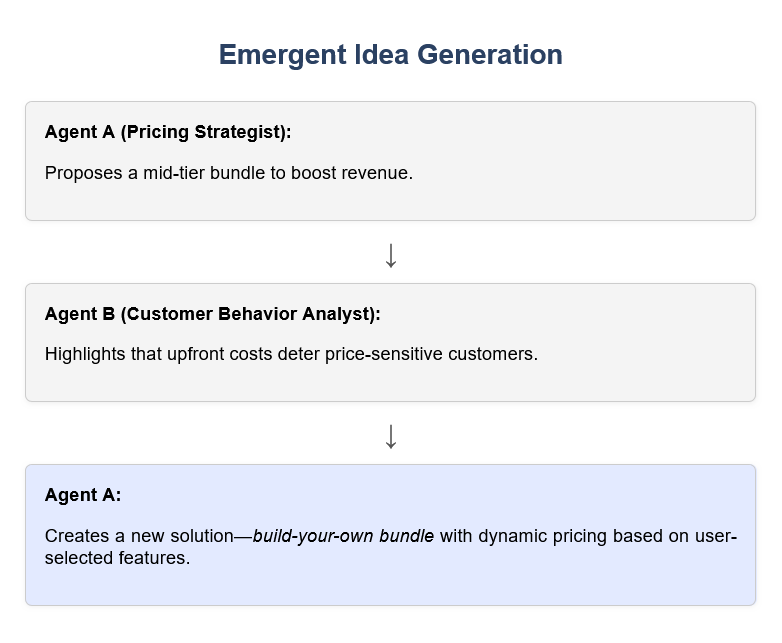
    The following graphic shows how a Pricing Strategist’s initial idea evolves through critical input from a Customer Behavior Analyst into a novel “build-your-own bundle”, the visualization highlights Sentienta’s ability to generate breakthrough strategies through collaborative agent interactions.

    What begins as expert input becomes something more—a new idea born through structured interaction. Sentienta not only facilitates this dynamic exchange but preserves the conversation, making insight traceable, reusable, and ready for replay when it matters most.

    Emergent Strategy from Agent Teamwork

    Teamwork is essential because it drives creative problem solving on multiple levels: humans contribute diverse perspectives and strategic intuition, while agents rapidly process data and combine insights at scale. This dual approach means that by integrating people with high-performing agent teams, businesses can overcome the natural limits of human capacity, ensuring that expertise expands without additional headcount.

    Sentienta’s platform not only leverages this synergy by preserving collaborative dialogs to build a lasting archive of insights but also serves as a dynamic space for co-creating new ideas through agent collaboration. By surfacing insights that no single agent or person could produce alone, Sentienta teams exemplify emergent cognition-delivering strategies born from structured, multi-perspective dialog.

  • From Signals to Strategy

    How AI Agent Teams Transform Decision-Making

    In today’s real-time economy, with almost daily turmoil, waiting for static dashboards or end-of-day reports puts businesses at risk. Decision-makers need faster insight and smarter responses—and they’re finding both in AI-powered agent teams. This post follows a “decision-day” walk-through where scheduled agents detect anomalies, trigger analysis, and deliver actionable intelligence. Along the way, we’ll preview a powerful future: dynamic response teams that self-assemble on demand, transforming routine data monitoring into collaborative, AI-driven strategy.

    From Manual Monitoring to Team Workflows

    For years, business teams relied on dashboards and manual checks—forcing analysts to sift through data after the fact, often too late to pivot strategy. AI agents like Angie now automate this process, persistently scanning KPIs and surfacing anomalies in near real time – bringing signal to the surface before teams even ask. This shift transforms monitoring from a reactive task into a proactive loop, enabling tactical adjustments as performance fluctuates throughout the day.

    Monitoring TypeDescriptionResponse SpeedHuman Effort
    Manual MonitoringAnalysts check KPIs periodically; issues often spotted lateSlowHigh
    Scheduled TriggersAgents run on set schedules to check and report KPIsModerateMedium
    Team Workflows (Emerging)Agent teams collaborate in sequence—detecting, diagnosing, and acting as events unfold in real timeFastLow

    Early adopters gain more than speed – they free up analysts from routine checking, letting them focus on root cause, strategic options, and next steps.

    Intelligent Agent Teams and Semi-Autonomous Coordination (Today)

    Sentienta Teams lets you assemble expert AI agents customizable to your business context – think of them as always-on teammates with specialized roles. With data collected continuously by Angie, users can periodically request updates, triggering collaborative evaluation across the team. Insights emerge through the interplay of domain-specific agents, each contributing to problem-solving like part of a cohesive virtual task force.

    What’s powerful today is the modular collaboration between agents: Angie spots the signal, users prompt an update, and the team responds—analyzing root causes, surfacing implications, and aligning recommendations. This tiered interaction shortens feedback loops while keeping the human-in-the-loop where needed.

    This model already elevates decision quality by transforming raw signal detection into team-powered insight—without code or integration overhead. Let’s see how this might work:

    Scenario Walk-Through — “End-of-Quarter Chain Reaction”

    At 9:55 AM, Angie, the KPI Monitoring Agent, completes her scheduled data sweep: collecting conversion metrics, analyzing trends against prior cycles, and logging a 12% drop. She also factors in data from the UX Deployment Team’s new UI update logged at 8:00 PM yesterday, establishing a preliminary correlation with increased mobile bounce rates.

    9:55 AM: Angie (KPI Monitoring Agent): “Scheduled Insight Logged — Conversion rate down 12% vs prior cycle. Ingested UX deployment log from 8:00 PM yesterday—preliminary correlation with mobile exit rates established.”

    At 10:05 AM, CMO Alex Morgan reviews Angie’s logged summary while preparing for the QBR, triggering further analysis from the broader agent team.

    10:05 AM: Analytics Agent: “Manual review confirmed. Running historical comparison — dip predominantly isolated to mobile traffic sources.”

    10:07 AM: Competitive Intelligence Agent: “Scanning competitor trends… Detected concurrent promotional push by primary rival.”

    10:10 AM: Summary Agent: “Final insights compiled: Traffic dip largely traced to mobile UX issues with the recent UI update, compounded by competitor campaign. QBR-ready report delivered to shared location.”

    10:12 AM: Presentation Update Agent: “Integrating the final report into the QBR presentation—slides refreshed with updated KPI graphs and attribution notes reflecting the new UI deployment impact.”

    This scenario illustrates how scheduled data logging, combined with cross-departmental inputs and manual review, triggers a coordinated AI response that supports executive decision-making.

    Next-Gen Workflow Automation: Intelligent Sequences & Self-Assembling Expertise

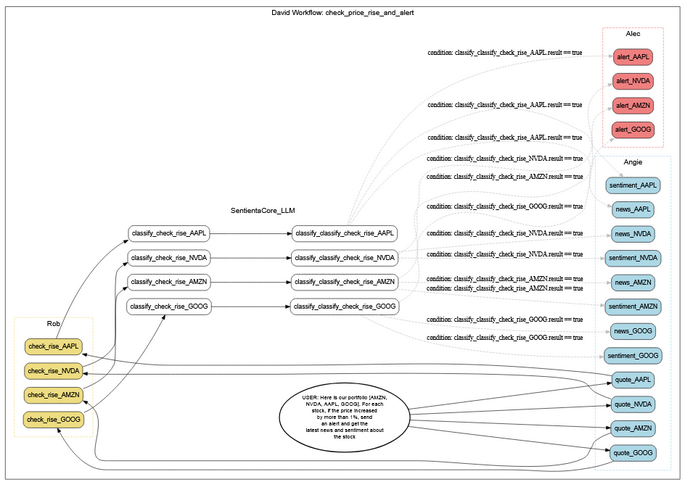
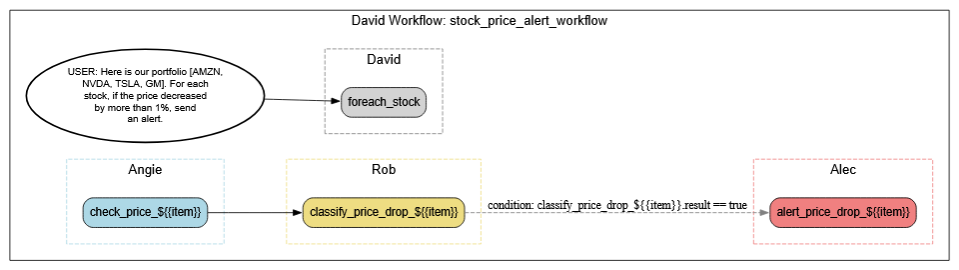
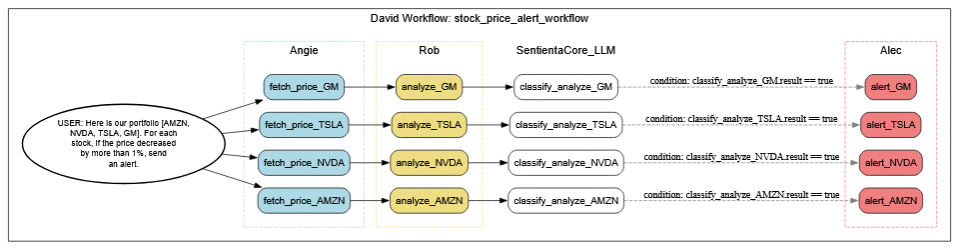
    Get ready for a system where a planning agent can automatically orchestrate the entire process: sequencing actions, branching based on real-time data, and repeating steps as needed. As soon as anomalies are detected, it will dynamically self-assemble the precise mix of expert agents to diagnose issues, forecast impacts, and execute tailored responses, shifting reactive monitoring into a proactive, intelligent strategy.

    This next-generation automation doesn’t just detect an issue—it scripts the solution by activating specialized agents at each step, adapting in real time as conditions evolve.

    Each automated workflow acts like a living blueprint, employing branching logic, conditional triggers, and intelligent retries to ensure the right path is taken as new data emerges.

    From manual monitoring to intelligent workflows, and now toward dynamic, self-assembling response teams, Sentienta is redefining how decisions are made. These AI-powered teams don’t just react, they anticipate, adapt, and execute strategies in real time.

  • Powering Productivity: Task Scheduling for Intelligent Agents

    In previous posts, we’ve explored agent autonomy—how intelligent agents can work independently to accomplish complex goals. Today, we’re unlocking a new level of autonomy: the ability to schedule agents and teams to run tasks automatically at specific times. With task scheduling, agents can operate in the background—gathering information, performing analysis, and delivering results—without your ongoing involvement.

    Some tasks require regular execution over time, especially those that track changeable data. For example, say you’re monitoring market sentiment for a specific stock. Instead of having to prompt Angie, the Web Search Agent, to gather updates every hour, you can now schedule her to collect that data and compile a report without manual input.

    Why is Scheduling Important?

    This is also ideal for larger, resource-intensive tasks—such as background research, document synthesis, or team workflows—that benefit from being handled asynchronously. You can stay focused on other priorities while your agents work behind the scenes.

    How Does this Work?

    The Angie Web Search Agent (available in the Agent Marketplace under Document and Content Access) now supports temporal scheduling. Simply configure a time or interval and specify what you want the agent or team to accomplish. Sentienta handles task execution and ensures you receive a detailed summary when the job is done.

    This capability isn’t limited to a single agent. You can coordinate multiple agents or entire teams to run collaboratively or in parallel on timed schedules, enabling sophisticated workflows that unfold automatically over time. It’s automation at scale—with intelligence.

    To see how this works, consider the following interaction:

    User: Schedule a task to run every 10 minutes for 6 runs. The task is to query “What is the latest AMZN quote?”

    Wed, 09 Apr 2025 17:50:10 Angie:

    Task user-schedule-clscofield997-at-gmail.com-AMZNquoteschedule is scheduled to run every 10 minutes and will stop after 6 runs.

    The agent has created a scheduled task to search for the latest Amazon.com stock quote every 10 minutes. This will run 6 time and then complete.

    You can get a list of all the scheduled tasks and their status with the following:

    User: List scheduled tasks

    Wed, 09 Apr 2025 17:56:56 Angie:

    user-schedule-clscofield997-at-gmail.com-AAPLquoteschedule complete

    user-schedule-clscofield997-at-gmail.com-AMZNquoteschedule running

    user-schedule-clscofield997-at-gmail.com-NVDAquoteschedule cancelled

    Angie will list each of the tasks that have been scheduled and their status. At any time you can get the latest results from a task with:

    User: Get results for task user-schedule-clscofield997-at-gmail.com-AMZNquoteschedule

    Wed, 09 Apr 2025 18:01:05 Angie:

    Here are the current results for user-schedule-clscofield997-at-gmail.com-AMZNquoteschedule:

    Wed, 09 Apr 2025 17:50:38 Angie: As of today, Wednesday, April 9, 2025, here is the latest information on Amazon’s stock (AMZN):

    – Current Price (Last Trade): $184.14

    – Change from Previous Close: +$13.48

    – Percentage Change: +7.90%

    – Opening Price: $172.12

    – Day’s High: $186.22

    – Day’s Low: $169.93

    – Previous Close: $170.66

    Amazon’s stock has seen a strong gain today, rising nearly 8%, indicating strong investor interest or positive market news affecting the company.

    When the task has completed, Angie will take all of the intermediate results and compile a report. If there are numerical values (like stock prices), she’ll compile these into a table:

    Here is a consolidated table summarizing the key stock metrics for Amazon (AMZN) on April 9, 2025, based on the multiple time-stamped reports:

    MetricValue(s) Reported
    Current Price$187.24, $186.67, $186.68, $187.56, $187.59
    Price Change+$16.58, +$16.01, +$16.02, +$16.90, +$16.93
    Percent Change+9.72%, +9.38%, +9.39%, +9.90%, +9.92%
    Opening Price$172.12 (Consistent across all reports)
    Day’s High$187.92 (4 reports), $187.98 (latest report)
    Day’s Low$169.93 (Consistent across all reports)
    Previous Close$170.66 (Consistent across all reports)

    📝 Summary of Research Findings:

    On April 9, 2025, Amazon’s (AMZN) stock experienced a substantial surge, consistently reported as a ~9.4–9.9% increase from the previous closing price of $170.66. The opening price for the day was $172.12, and the lowest traded price was $169.93. Throughout the day, the high varied slightly between reports, peaking between $187.92 and $187.98.

    The final snapshot reported a trading price of $187.59, reflecting a daily gain of $16.93 or 9.92%. The consistency across key metrics such as opening, low, and previous close enhances confidence in these results.

    Overall, the stock showed strong upward momentum likely driven by significant investor sentiment or positive news, marking one of the most bullish single-day movements for Amazon in recent times.

    Of course Angie will also perform all the necessary task management duties too. For example, you can cancel a task at any time:

    User: Cancel task user-schedule-clscofield997-at-gmail.com-AMZNquoteschedule running

    Wed, 09 Apr 2025 18:12:55 Angie:

    The task user-schedule-clscofield997-at-gmail.com-AMZNquoteschedule will be cancelled.

    And you can delete the results from former tasks with:

    User: Delete results for task user-schedule-clscofield997-at-gmail.com-AMZNquoteschedule

    Wed, 09 Apr 2025 18:16:29 Angie:

    The task results for user-schedule-clscofield997-at-gmail.com-AMZNquoteschedule were deleted.

    Beyond Reporting: Orchestrating Workflows with Scheduled Intelligence

    Beyond data gathering, scheduled tasks can drive entire workflows—triggering follow-up actions, coordinating hand-offs between agents, or summarizing findings across time. For example, after collecting market data, a second agent might be scheduled to generate trend reports or highlight unusual activity. This kind of orchestration transforms agents from simple tools into participants in a broader, ongoing process that adapts to your needs.

    In short, Sentienta’s task scheduling unlocks a new depth of autonomy and responsiveness. By setting your agents on a timeline, you gain continuity, consistency, and clarity—without losing control. Whether you’re monitoring real-time events or streamlining internal analysis, this feature helps you keep pace with the demands of modern work through intelligent automation.

  • LLMs have Passed the Turing Test

    “I propose to consider the question, ‘Can machines think?’”

    – Alan Turing, *Computing Machinery and Intelligence* (1950)

    In a post to arXiv, now under peer review, two researchers at UC San Diego report the first experimental demonstration of LLMs passing the Turing test. Originally called the Imitation Game the Turing test has had a profound influence on the field of AI for 75 years. The test has been the subject of both volumes of academic analysis and popular fiction. A machine’s passing the test has been called an epochal moment for man.

    Turing’s Imitation Game

    As there have been many interpretations of the test, it might be worth noting why the UCSD version is important and closest to Turing’s original proposal. Turing described a so-called 3-party test in which a judge (human) interacts with a man and a women via text, and must decide which is which. Then, one of the participants is replaced with a machine which is tasked with fooling the judge into thinking it is human.

    The UCSD version is also a 3-party test in which a human interrogator simultaneously interacts with a human and an LLM, both of which must convince the interrogator that they are human. The LLM passes the test if on average the interrogator cannot identify the human. In UCSD’s study, a baseline was set with the classical ELIZA chatbot, while LLM models included OpenAI’s GPT-4o an GPT-4.5 and LLaMa-3.1-405B from Meta.

    There are a number of subtleties that make test implementation complex, but one in particular is of interest for this post. The behavior of an LLM is a function of both its pretraining and the context at query time. This context, if persistent across queries, is often defined in the system prompt and can be instructions for how the LLM should act. Sentienta calls this context the persona, as do the UCSD researchers. In their study, only LLMs with an adequately defined persona were able to pass the test. The winning persona had been fine-tuned by playing against human judges on the website turingtest.live. When paired with this persona, GPT-4.5 was chosen as the human participant 73% of the time, convincingly passing the test.

    What Does Passing the Turing Test Mean?

    Turing was interested in the question “Can machines think?” and came up with the imitation game in order to operationalize it. Does passing the test mean that an LLM can think? That depends on what we mean by “thinking”. This study demonstrates that LLMs can use language and reasoning well enough to convincingly imitate human intelligence, and fool human interrogators. What it does not do is demonstrate either machine consciousness or even understanding.

    Nonetheless, the three-party Turing test sets a high bar. As the authors note, to win this version of the test, the LLM must not only appear human—it must appear more human than the other participant. This is a difficult task: interrogators correctly observed that the human participant lacked knowledge an AI might possess or made errors an AI wouldn’t make. In other words, for the LLM to win, it must display not only intelligence, but also human fallibility.

    Reference:
    Christian, Brian. The Most Human Human: What Artificial Intelligence Teaches Us About Being Alive . New York: Anchor Books, 2012.

    Turing, Alan M. Computing Machinery and Intelligence . Mind, Vol. 59, No. 236, 1950, pp. 433–460.

  • An AI Use-case: How will GenAI Change HR?

    We’ve already seen how individual agents and agent teams collaborate—drawing on company-specific data to solve problems and automate complex tasks. In this post, we’ll take a closer look at how these expert teams can transform the way HR operates in your organization.

    A recent study by Forrester Research (A Human-Centered Approach to AI in the Workplace) noted that 70% of people leaders “believe AI will be crucial for success in HR in the next five years” and that 73% of employees are in favor of more AI use in their companies.

    This study identified 5 use-cases that will be the drivers of AI growth in HR departments in the next 5 years, with leaders ranking these as most valuable in the following order:

    1. AI-driven career path recommendations
    2. Internal gig and job matching
    3. Conversational experience leveraging genAI
    4. Candidate matching
    5. AI-assisted development plans

    In this post we will explore how each of these use-cases can be addressed with a virtual team of agent experts. We’ll consider a Sentienta team that is managed by an HR Generalist in the organization with access to employee employment history.

    Employee-data Security

    Note that the agents on this team are managed within the Generalist’s account and employee information is not available outside of this account. That said, one should never include PII like social security numbers or other sensitive data in queries.

    Bias in AI Models

    AI models, including large language models (LLMs), reflect the biases present in the data they were trained on. In HR contexts—such as employee evaluations, communication, or support—this can lead to unintended discrimination or reinforcement of existing inequalities. These models lack awareness of context, fairness, or legality, and may produce seemingly reasonable outputs that subtly encode bias. These models should never operate autonomously in sensitive HR functions. Human oversight is essential to identify errors and ensure decisions remain fair, ethical, and comply with workplace policies.

    AI-driven career path recommendations

    To grow professionally, employees often need help navigating career paths within their organization. HR plays a vital role by understanding job roles, required skills, and employee strengths. With input from managers, HR can match employees to roles that fit their abilities and help chart a clear path for advancement.

    An HR Career Coach agent can assist the HR Generalist in mapping out an employee career development internally. With access to role descriptions, organizational charts, and examples of successful career progressions, the agent can suggest roles that align with the employee’s past experience and future goals.

    To enable this, company documents and employee information can be added to the team dialog using one of the methods described in Integrating Your Own Data into Team Dialogs.

    Internal gig and job matching

    In many mid-size and large organizations, job openings often go unnoticed by employees who could be ideal candidates. HR plays a key role in bridging this gap—matching available roles with employees ready for new challenges. By adding a Career Mobility Specialist agent to the HR team, companies can enhance this process. This agent, equipped with access to all current openings and their job descriptions (in formats like spreadsheets, documents, or PDFs), can collaborate with the HR Generalist to accelerate internal hiring and support employee growth.

    Using this job data alongside each employee”s work history, the agent can surface strong internal matches—helping fill roles efficiently while promoting career development within the company.

    Conversational experience leveraging genAI

    Both new and long-term employees need access to documents that help them understand and navigate the company effectively. These include the Employee Handbook, a company Culture deck, possibly a company org chart and for new employees a welcome packet describing tools, logins, workspace and support channels. Even long-term employees need access to HR-managed information such as their employee benefits and employment history.

    It is often difficult for employees to find what they need from these sources, and often turn to HR staff for help. Deploying a Sentienta Assistant to the company website gives employees quick access to the needed information and saves HR staff time and effort.

    Candidate matching

    One of the most recognized uses of AI in HR is talent sourcing—screening large numbers of resumes, which is both tedious and time consuming. Tools ranging from keyword filters to powerful language models now make this process much simpler.

    Like the Career Mobility Specialist agent that helps with internal moves, a Talent Matching agent can evaluate open roles by comparing them to internal job descriptions and required qualifications. What’s different is that it also reviews resumes from external applicants or integrates with sourcing agency APIs. With both agents active, companies can consider the best options from inside and outside. The agent’s reasoning is visible in the team dialog, helping the HR Generalist understand and explain placement decisions.

    AI-assisted development plans

    As noted before, employees seek help from HR to grow their careers, and we’ve seen how the HR Career Coach can design a career path that makes sense given the structure of the organization and the skills and aspirations of the employee. However, an important part of this path is the mastery of new skills and experience in roles that are essential for a career’s next level.

    A Career Growth Advisor agent works with the Career Coach and the employee’s work history to determine the current skill level and gaps that must be filled in order to take the next step. This agent creates personalized and contextual development plans that support job mastery, skill building, and long-term career goals. By aligning currently-available learning opportunities with real-time performance and aspirations, employees can take ownership of their growth and thrive in their careers.

    Final Thoughts

    This post explored how expert agents, when supported by rich company data, can bring to life the five HR use-cases identified by Forrester. From streamlining onboarding to improving talent sourcing and internal mobility, these applications show the real potential of automation in reshaping HR operations.

    Forrester research also highlights employee excitement about AI’s growing presence in HR—especially its ability to reduce wait times for answers, simplify decision-making, and provide personalized support. When implemented thoughtfully, AI-powered tools don’t just create efficiencies for HR staff—they also foster a more self-sufficient and empowered workforce.

    As adoption accelerates, organizations have the opportunity to rethink how decisions are made, how careers are built, and how information is shared—making HR a more responsive, data-driven partner for every employee.

  • Agent Delegation: A Stock Portfolio Example

    This post is a continuation of Adding Realtime Data to Your Dialogs. It’s also a continuation of A Deep-dive into Agents: Agent Delegation in which we discussed how agents can work together to solve a problem. Today we’ll showcase a real-world example of two agents using delegation to retrieve real-time data.

    In our earlier post we emphasized how delegation achieves modular adaptability—scaling efficiently as new agents are introduced without burdening a single model. This ensures that specialized tasks are handled by the most relevant agents, improving accuracy and depth of analysis.

    Today, we will expand on our previous example. Our agents, Roger and Angie, belong to a Research Team responsible for managing a stock portfolio. In this scenario, Roger wants to get the latest information on three stocks: Apple (AAPL), Nvidia (NVDA) and Alphabet (GOOG). As we demonstrated last week, we could ask Angie to research each of these tickers, but we’d rather have Roger be responsible for managing the portfolio, and delegate the actual research to Angie.

    First we’ll setup the example with Roger:

    Me: Roger – your portfolio consists of the following stock tickers [AAPL, NVDA, GOOG].

    Tue, 25 Mar 2025 17:40:37 Roger:

    Understood. Your portfolio now consists of AAPL, NVDA, and GOOG. Let me know if you need updates on their stock prices or any other related information.

    Now, we ask Roger to update the portfolio data:

    Me: Roger – get quotes for the stocks in our portfolio.

    Tue, 25 Mar 2025 17:40:37 Roger:

    Angie research this topic: AAPL stock price

    Thu, 20 Mar 2025 18:53:16 Angie:

    Topic Results:

    The last available stock price information for AAPL (Apple Inc.) as of March 24, 2025, at 19:55 (US Eastern Time) is:

    • Open: $220.80
    • High: $220.85
    • Low: $220.74
    • Close: $220.75
    • Volume: 1,207

    Tue, 25 Mar 2025 17:58:43 Roger:

    Angie research this topic: NVDA stock price

    Tue, 25 Mar 2025 17:58:49 Angie:

    Topic Results:

    Nvidia Corporation (NVDA) Stock Information:

    • Last Refreshed:: March 24, 2025, 19:55 (US Eastern Time)
    • Latest Price Data (as of 19:55):
    • Open: $120.9888
    • High: $121.0000
    • Low: $120.9200
    • Close: $120.9695
    • Volume: 95,674 shares

    This provides the most recent trading activity for NVDA stock based on the 5-minute intraday data.

    Tue, 25 Mar 2025 17:58:52 Roger:

    WORKING MEMORY Tue, 25 Mar 2025 17:58:51 Assistant research this topic: GOOG stock price

    Tue, 25 Mar 2025 17:58:56 Angie:

    Topic Results:

    The last available stock price data for GOOG (Alphabet Inc.) is from March 24, 2025, at 19:55 Eastern Time, with the following details:

    • Open: $169.89
    • High: $169.90
    • Low: $169.7701
    • Close: $169.90
    • Volume: 1,235 shares

    These figures reflect its intraday trading activity at 5-minute intervals.

    Tue, 25 Mar 2025 17:58:59 Roger:

    All topics have been researched and are now complete. Let me know if you have any further requests.

    Key Takeaways

    • Task Delegation Sequence – Roger delegates each research task to Angie one at a time, ensuring each is completed before initiating the next. This allows for adaptive task management based on partial results.
    • Memory Utilization – Roger checks WORKING MEMORY to identify unresearched stocks, showing efficient tracking of outstanding tasks.
    • Clarifying the Request – While this example shows delegation, Roger technically did not request real-time “quotes” but rather general research on stock prices. More precise instructions would ensure real-time updates instead of prior-day summaries.

    Future Enhancements

    A fully autonomous research system would involve Angie proactively maintaining an up-to-date portfolio through scheduled tasks. Roger could then analyze these results and, based on market conditions, initiate further actions—such as requesting a risk assessment by another specialized agent.

    Scheduled task execution is an essential step toward autonomous teamwork, a concept we’ve explored in Agent Assistants. In an upcoming post, we’ll examine how Angie can autonomously maintain research reports without requiring manual intervention.

  • Adding Real-time Data to Your Agent Dialogs

    One of the biggest challenges with LLMs is their limited access to new information. These massive models take months to train, followed by additional months of testing and refining safeguards to protect users from harmful content and unauthorized queries. However, for LLM-based agents to truly be effective, they must have access to the most up-to-date data.

    I’ve been exploring Sentienta’s latest real-time search agent, ‘Angie,’ available in the Agent Marketplace under the ‘Document and Content Access’ section. Angie offers unique capabilities, including real-time news searches, detailed financial report summaries—covering SEC filings, stock news, sentiment analysis, and price history—and the ability to summarize content from open web pages.

    Sentienta’s Angie agent offers these capabilities without the need for coding or integration, unlike OpenAI and Google’s Gemini platforms. It provides a no-code solution for seamlessly incorporating real-time data into team discussions.

    Under the covers, this agent makes use of an integrated tool suite, intelligently selecting the best tool for the task. For content searches there are tools that directly integrate third-party APIs. This ensures that you don’t have to manage API keys and subscriptions. Instead you get the most up-to-date content when you need it. It just works.

    Here are some examples of how you can use Angie in your teams. Suppose you are interested in the latest SEC filings on Uber. I can’t reproduce the full result here, but here is an abbreviated transcript:

    Me: Angie get the latest sec filings for Uber

    Thu, 20 Mar 2025 17:59:26 Angie:

    I will get a report on UBER, from document 10-K

    Thu, 20 Mar 2025 17:59:27 Angie:

    This document has 142 pages.

    Thu, 20 Mar 2025 18:00:25 Angie:

    The document is a 10-K annual report filed by Uber Technologies, Inc. with the SEC for the fiscal year ending December 31, 2024. It contains comprehensive financial and operational details about the company and its activities.

    … (multiple pages of analysis)

    The document also discusses market risks, including interest rate risk, investment risk, and foreign currency risk. It details the company’s investment policies aimed at capital preservation and mitigating risks associated with investments in publicly traded and privately held entities. Foreign currency fluctuations pose a risk to international revenues and expenses, partially offset by incurring expenses in the same foreign currencies. The company uses derivative contracts to manage currency risks but acknowledges that these measures cannot fully eliminate exposure.

    After reading this summary of the 10-K, perhaps you’d like to see the latest news on Uber:

    Me: Angie what is the latest news on Uber?

    Thu, 20 Mar 2025 18:45:29 Angie:

    Here is the best possible answer based on the search results for the latest news on Uber as of Thursday, March 20, 2025:

    Uber Technologies (NYSE: UBER) has been performing strongly in 2025, with its stock up 31.55% year-to-date. Analysts have set a consensus price target of $90.7, indicating a potential 14.16% upside. Uber has also announced a $1.5 billion accelerated share repurchase program as part of its broader $7.0 billion repurchase authorization, showing confidence in its financial position. Additionally, for Q1 2025, Uber expects bookings to grow between 17%-21%, indicating robust operational performance going forward.

    [5 supporting links]

    With that in hand, perhaps you’d like to see the latest closing price for this stock:

    Me: Show me the latest closing price for Uber’s stock

    Thu, 20 Mar 2025 18:53:16 Angie:

    As of the most recent data refresh on March 19, 2025, at 19:55 EST, Uber Technologies Inc. (UBER) had the following stock performance:

    • – Last traded price (close): $73.39
    • – Opening price: $73.345
    • – Daily high: $73.39
    • – Daily low: $73.3001
    • – Trading volume: 5,430 shares

    This data is based on intraday trading with 5-minute intervals. If you need more details such as historical trends or analyst insights, please let me know!

    There are of course, many ways to access this data, including a series of Google searches. However, Angie automatically integrates it into your team’s dialog, making it readily available to other agents. My team included a Research Lead, ‘Roger,’ who analyzed Angie’s results. Below is a brief transcript of Roger’s suggested next steps.

    Me: Roger – please summarize what we’ve learned about Uber. Is this a good investment?

    Thu, 20 Mar 2025 18:57:06 Roger:

    Uber has gained 31.55% year-to-date, with analysts targeting $90.7, indicating a 14.16% potential upside. A $1.5 billion share repurchase suggests financial confidence, and 17%-21% bookings growth signals strong operations. The latest closing price was $73.39 as of March 19, 2025. While the outlook appears positive, further analysis of risks, competition, and market conditions is recommended before making an investment decision.

    Me: What does this data tell you about risks?

    Thu, 20 Mar 2025 18:58:43 Roger:

    Uber’s strong year-to-date growth and share repurchase suggest confidence, but risks remain. Potential concerns include market volatility, regulatory challenges, competition from Lyft and autonomous vehicle companies, and macroeconomic factors affecting ride demand. Further analysis of revenue stability and profitability trends is necessary.

    By exploring competitive trends and regulatory changes, I gained additional insights, too many to show here. This demonstrates the power of Angie as a research assistant and the strength of a team that can analyze data to highlight what truly matters. In a future post, I’ll showcase how the Research Lead delegates research tasks to Angie and compiles an investment opportunities report—without writing a single line of code.

  • Understanding Operator Agents

    There has been significant buzz (and here and here) surrounding “Operator” agents—tools designed to autonomously interact with desktop content or manipulate web pages.

    Competing Approaches: OpenAI vs. Manus

    OpenAI has introduced “computer-use”, enabling agents to take screenshots of the desktop and utilize GPT-4o’s vision capabilities to navigate, click, scroll, type, and perform tasks like a human user.

    Meanwhile, Manus leverages the Browser Use library, allowing agents to interact directly with elements within a browser session. Unlike OpenAI’s general approach, this method is optimized for web-based workflows by analyzing and interacting with a webpage’s DOM elements instead of relying on screenshots.

    Performance Comparison

    Both approaches are relatively new, and early benchmarks indicate promising yet limited capabilities. Recent results show that OpenAI’s method achieves a 38.1% success rate on an OSWorld benchmark (where human performance is 72.36%) and 58.1% on WebArena. While no direct comparison is available for Manus, company-released figures claim a 57.7% score on the GAIA benchmark, where OpenAI’s Deep Research tool stands at 47.6%.

    Despite these advances, neither solution is fully autonomous. Some concerns have also been raised about Manus’ limited beta, with speculation that early results may have been optimized for publicity rather than real-world performance.

    Alternative: Direct API Integration

    A third approach to working with online content is integrating directly with third-party APIs. Although less general than OpenAI or Manus, API access tends to deliver more consistent results. For instance, retrieving intraday stock performance can be done with one of several APIs (e.g. – Yahoo Finance API, Alpha Vantage API, Polygon.io API)

    These services provide structured data through API calls, often free for limited use, avoiding the challenges of web scraping (which is usually blocked or discouraged).

    The No-Code Alternative: Sentienta

    Sentienta simplifies API-based automation with a No-Code solution. By integrating leading APIs and advanced search capabilities, Sentienta agents can access real-time web data without requiring any coding on the user’s part. This approach manages API connections and token authentication, enabling users to assemble expert AI teams with minimal effort.

    In an upcoming post, we’ll explore how to build a portfolio management team that factors in real-time market sentiment, financial news, and stock performance—entirely without writing a single line of code.