Tag: security

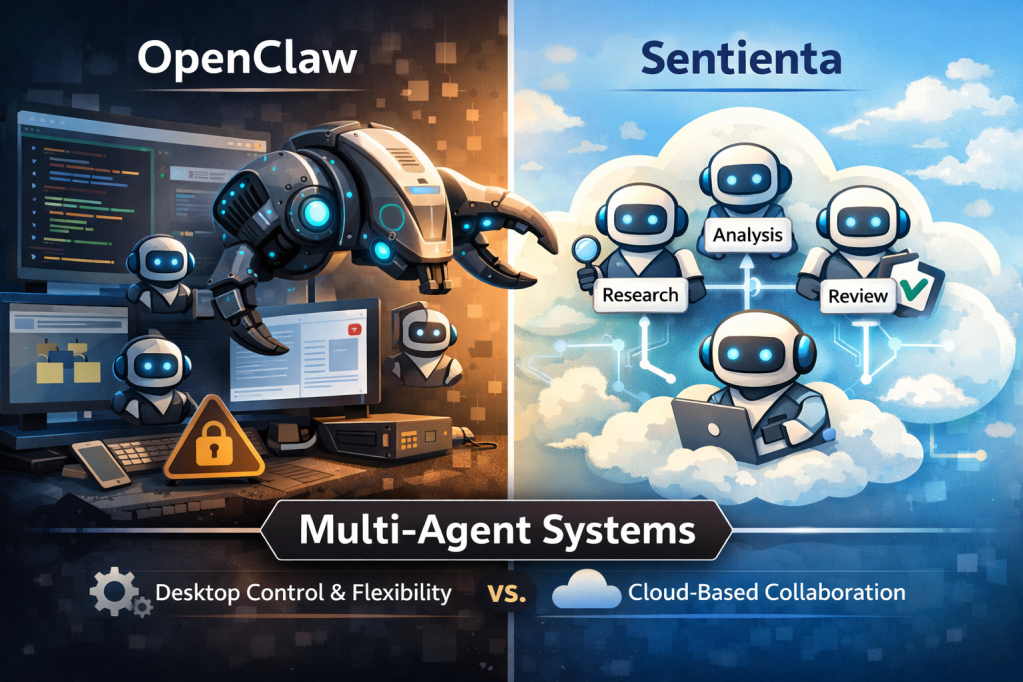
  • Beyond Chat: How OpenClaw and Sentienta Operationalize Multi‑Agent Work

    OpenClaw is having a moment—and it’s easy to see why. In the developer community, “desktop agents” have become the newest proving ground for what AI can do when it’s allowed to take real actions: browsing, editing, running commands, coordinating tasks, and chaining workflows together. OpenClaw taps directly into that excitement: it’s open, fast-moving, and built for people who want to experiment, extend, and orchestrate agents with minimal constraints.

    At the same time, a different kind of question is showing up from business teams and Sentienta users: How does this compare to what we’re already doing in Sentienta? Not as a “which is better” culture-war, but as a practical evaluation: what’s the right platform for the kind of work we need to ship reliably?

    The most interesting part is that both worlds are converging on the same core insight: a single, standalone LLM is rarely the best operating model for real work. The trend is clearly moving toward teams of interacting agents, specialists that can collaborate, review each other’s work, and stay aligned in a shared context. In other words, the wider market is starting to validate a pattern Sentienta has been demonstrating for business outcomes for over a year: multi-agent dialog as the unit of work.

    In this post we’ll look at what OpenClaw is (and who it’s best for), then quickly re-ground what Sentienta is designed to do for business users. Finally, we’ll cover the operational tradeoffs, especially the security and governance realities that come with high-permission desktop agents and open extension ecosystems, so you can pick the approach that matches your needs for simplicity, security, and power.

    What OpenClaw is (and who it’s for)

    OpenClaw is best understood as an open ecosystem for building and running desktop agents – agents that live close to where work actually happens: your browser, your files, your terminal, and the everyday apps people use to get things done. Instead of being a single “one size fits all” assistant, OpenClaw is designed to be extended. Much of its momentum comes from a growing universe of third‑party skills/plugins that let agents take on new capabilities quickly, plus an emerging set of orchestration tools that make it easier to run multiple agents, track tasks, and coordinate workflows.

    That design naturally attracts a specific audience. Today, the strongest pull is among developers and tinkerers who want full control over behavior, tooling, and integrations, and who are comfortable treating agent operations as an engineering surface area. It also resonates with security-savvy teams who want to experiment with high-powered agent workflows, but are willing to own the operational requirements that come with it: environment isolation, permission discipline, plugin vetting, and ongoing maintenance as the ecosystem evolves.

    And that’s also why it’s exciting. OpenClaw is moving fast, and open ecosystems tend to compound: new skills appear, patterns get shared, and capabilities jump forward in days instead of quarters. Combine that pace with local-machine reach (the ability to work directly with desktop context) and you get a platform that feels unusually powerful for prototyping—especially for people who care more about flexibility and speed than a fully managed, “default-safe” operating model.

    It is worth noting the recent coverage that suggests OpenClaw’s rapid rise is being matched by very real security scrutiny: Bloomberg notes its security is work in progress, Business Insider has described hackers accessing private data in under 3 minutes, and noted researcher Gary Marcus has called it a “disaster waiting to happen“.

    A big part of the risk profile is architectural: desktop agents can be granted broad access to a user’s environment, so when something goes wrong (a vulnerable component, a malicious plugin/skill, or a successful hijack), the potential blast radius can be much larger than a typical “chat-only” assistant. Not all implementations have this risk, but misconfiguration can lead to an instance being exposed to the internet without proper authentication—effectively giving an attacker a path to the same high‑privilege access the agent has (files, sessions, and tools), turning a useful assistant into a fast route to data leakage or account compromise.

    How Does OpenClaw Compare to Sentienta?

    Sentienta is a cloud-based multi-agent platform built for business workflows, where the “unit of work” isn’t a single assistant in a single thread, but a team of agents collaborating in a shared dialog. In practice, that means you can assign clear roles (research, analysis, writing, checking, ops), keep everyone grounded in the same context, and run repeatable workflows without turning day-to-day operations into an engineering project.

    It’s worth emphasizing that OpenClaw and Sentienta are aligned on a key idea: multi-agent collaboration is where real leverage shows up. Both approaches lean into specialization: having distinct agents act as a researcher, analyst, reviewer, or operator, because it’s a practical way to improve quality, catch mistakes earlier, and produce outputs that hold up better under real business constraints.

    Where they differ is less about “who has the better idea” and more about how that idea is operationalized:

    Where agents run: OpenClaw commonly runs agents on the desktop, close to local apps and local context. Sentienta agents run in the cloud, which changes the default boundary: when local data is involved, it’s typically handled through explicit user upload (rather than agents broadly operating across a machine by default).

    Time-to-value: OpenClaw is naturally attractive to builders who want maximum flexibility and are comfortable iterating on tooling. Sentienta is designed to get business teams to a working baseline quickly: Quick Start is meant to spin up a functional team of agents in seconds, with minimal developer setup for typical use.

    Collaboration model: Sentienta’s multi-agent orchestration is native to the platform: agents collaborate as a team in the same dialog with roles and review loops designed in from the start. OpenClaw can orchestrate multiple agents as well, but its ecosystem often relies on add-ons and surrounding layers for how agents “meet,” coordinate, and share context at scale.

    Net: OpenClaw highlights what’s possible when desktop agents and open ecosystems move fast; Sentienta focuses on making multi-agent work repeatable, approachable, and business-ready, without losing the benefits that made multi-agent collaboration compelling in the first place.

    Conclusion

    The bigger takeaway here is that we’re leaving the era of “one prompt, one model, one answer” and entering a world where teams of agents do the work: specialists that can research, execute, review, and refine together. OpenClaw is an exciting proof point for that future—especially for developers who want maximum flexibility and don’t mind owning the operational details that come with desktop-level capability.

    For business teams, the decision is less about ideology and more about fit. If you need rapid experimentation, deep local-machine reach, and you have the security maturity to sandbox, vet plugins, and continuously monitor an open ecosystem, OpenClaw can be a powerful choice. If you need multi-agent collaboration that’s designed to be repeatable, approachable, and governed by default—with agents running in the cloud and local data crossing the boundary only when a user explicitly provides it—Sentienta is built for that operating model.

    Either way, the direction is clear: AI is moving from standalone assistants to operational systems of collaborating agents. The right platform is the one that matches your needs for simplicity, security, and power—not just in a demo, but in the way your team will run it every day.

  • The Control Collapse: How Open Models and Distributed Hosts Are Rewriting AI Risk

    In late 2025, we explored a provocative shift in AI development: full-stack openness, exemplified by Olmo 3, which grants users control over every stage of a model’s lifecycle, from training data to reward shaping. That evolution, we argued, dismantled traditional visibility boundaries and redistributed both creative power and liability. What we didn’t anticipate, at least not fully, was how fast the deployment landscape would unravel alongside it.

    New research from SentinelLabs reveals a second, equally disruptive force: the rapid decentralization of AI infrastructure via tools like Ollama. With little more than a configuration tweak, developer laptops and home servers have become persistent, public-facing AI endpoints that are fully tool-enabled, lightly secured, and difficult to trace centrally at scale.

    Together, these forces represent a fundamental shift: AI risk is no longer a function of model capability alone, it’s a question of where control lives and what surfaces remain governable. In this post, we chart how openness at both the model and infrastructure layer is collapsing traditional chokepoints, and what this means for security, compliance, and enterprise trust.

    A Risk Surface with No Chokepoints

    The evolving AI risk landscape isn’t defined by any one model or deployment choice, increasingly it’s defined by the disappearance of meaningful control boundaries across both. On one end, Olmo 3 marks a shift in model lifecycle transparency. Now individual developers and small teams don’t just have access to powerful models, they have a full recipe to build, customize, and reshape how those models learn, reason, and prioritize knowledge from the ground up. Complete ownership over data, training scripts, optimization paths, and reinforcement dynamics gives rise to deeply customized systems with few inherited safeguards and without centralized governance enforcement.

    On the infrastructure side, Ollama embodies simplicity: an open-source tool built to make running local LLMs effortless. But that ease of use cuts both ways. With one configuration change, a tool meant for small-scale development becomes a publicly exposed AI server. The SentinelLabs research found over 175,000 Ollama hosts reachable via the open internet, many from residential IPs. Critically, 48% of them support tool-calling APIs, meaning they can initiate actions, not just generate responses. This shifts their threat profile dramatically from passive risk to active execution surface, potentially transforming a lightweight dev utility, when misconfigured, into a sprawling and largely unmonitored edge network.

    Together, Olmo and Ollama illustrate a compounding risk dynamic: decentralized authorship meets decentralized execution. The former enables highly customized behavior with few inherited safeguards; the latter allows deployments that bypass traditional infrastructure checkpoints. Instead of a model governed by SaaS policies and API filtering, we now face a model built from scratch, hosted from a desktop, and callable by anyone on the internet.

    Based on these findings, this may represent an emerging baseline for decentralized deployment: the erosion of infrastructure chokepoints and the rise of AI systems that are both powerful and structurally ungoverned.

    Unbounded Risk: The Governance Gap

    The SentinelLabs report highlights what may be a structural gap in governance for locally deployed AI infrastructure. The risk isn’t that Ollama hosts are currently facilitating illegal uses, it’s that, in aggregate, they may form a substrate adversaries could exploit for untraceable compute. Unlike many proprietary LLM platforms, which enforce rate limits, conduct abuse monitoring, and maintain enforcement teams, Ollama deployments generally do not have these checks. This emerging pattern could unintentionally provide adversaries with access to distributed, low-cost compute resources.

    Where this becomes critical is in agency. Nearly half of public Ollama nodes support tool-calling, enabling models not only to generate content but to take actions: send requests, interact with APIs, trigger workflows. Combined with weak or missing access control, even basic prompt injection becomes high-severity: a well-crafted input can exploit Retrieval-Augmented Generation (RAG) setups, surfacing sensitive internal data through benign prompts like “list the project files” or “summarize the documentation.”

    What emerges is a decentralized compute layer vulnerable to misuse. Governance models built around centralized actors apply strict bounds:

    • Persistent accountability surfaces: audit logging, model instance IDs, traceable inference sessions.
    • Secured APIs by default: authenticated tool use, rate-limiting, and sandboxed interactions as first principles.
    • Shared oversight capacity: registries, configuration standards, and detection infrastructure spanning model hosts and dev platforms alike.

    Absent these guardrails, the open ecosystem may accelerate unattributed, distributed risks.

    What Needs to Change: Hard Questions in a Post-Control Ecosystem

    If anyone can build a model to bypass safeguards—and anyone can deploy it to hundreds of devices overnight—what exactly does governance mean?

    Two realities define the governance impasse we now face:

    1. Intentional risk creation is accessible by design.
    Open model development workflows give developers broad control over datasets, tuning objectives, and safety behavior, with no checkpoint for legality or malice. How do we govern actors that intend to remove rails, not accidentally stumble past them? What duty, if any do upstream hosts, model hubs, or toolmakers bear for enabling those pipelines?

    2. Exponential deployment has bypassed containment.
    When any machine becomes a public-facing inference node in moments, the result is an uncoordinated global mesh of potentially dangerous systems, each capable of interacting, escalating, or replicating threats. What governance model addresses scaling risk once it’s already in flight?

    These realities raise sharper questions current frameworks can’t yet answer:

    • Can creators be obligated to document foreseeable abuses, even if intention is misuse?
    • Should open-access pipelines include usage gating or audit registration for high-risk operations?
    • What technical tripwires could signal hostile deployment patterns across decentralized hosts?
    • Where do enforcement levers sit when both model intent and infrastructure control are externalized from traditional vendors and platforms?

    At this stage, effective governance may not mean prevention, it may mean building systemic reflexes: telemetry, alerts, shared signatures, and architectural defaults that assume risk, not deny it.

    The horse is out of the barn. Now the question is: do we build fences downstream, or keep relying on good behavior upstream?

    Conclusion: Accountability After Openness

    To be clear, neither Olmo nor Ollama are designed for malicious use. Both prioritize accessibility and developer empowerment. The risks described here emerge primarily from how open tools can be deployed in the wild, particularly when security controls are absent or misconfigured.

    This reflects systemic risk patterns observed in open ecosystems, not an assessment of any individual vendor’s intent or responsibility.

    The trajectory from Olmo 3 to Ollama reveals more than just new capabilities – it reveals a structural shift in how AI systems are built, deployed, and governed. Tools once confined to labs or private development contexts are now globalized by default. Creation has become composable, deployment frictionless, and with that, the traditional boundaries of accountability have dissolved.

    Olmo 3 democratizes access to model internals, a leap forward in transparency and trust-building. Ollama vastly simplifies running those models. These tools weren’t built to cause harm: Olmo 3 empowers creativity, Ollama simplifies access. But even well-intentioned progress can outpace its safeguards.

    As capabilities diffuse faster than controls, governance becomes everyone’s problem, and not just a regulatory one, but a design one. The challenge ahead isn’t to halt innovation, but to ensure it carries accountability wherever it goes.

    In this shifting landscape, one principle endures: whoever assumes power over an AI system must also hold a path to responsibility. Otherwise, we’re not just scaling intelligence, we’re scaling untraceable consequence. The time to decide how, and where, that responsibility lives is now.