 Something counterintuitive is happening inside teams that have embraced AI.
Your engineer resolved a dependency conflict in fifteen minutes that would have taken a morning of Stack Overflow. Your strategist pressure-tested three positioning options before the Monday meeting even started. Your designer explored forty layout variations instead of four. Individually, everyone is more capable than they were a year ago.
But zoom out to the team level, and the picture inverts. Decisions aren’t arriving faster. Alignment meetings are multiplying, not shrinking. People are spending more time explaining conclusions to each other, conclusions their AI helped them reach days ago, in private, in a conversation no one else can see.
There’s an emerging pattern here, and it might be called The AI Silo Effect: the quiet fragmentation that happens when every person on a team develops a private AI context that’s invisible to everyone else.
It works like this. Each team member now has their own AI relationship, their own conversation history, their own prompts refined over weeks, their own accumulated context on the problem. Each is building a richer, more nuanced understanding with their AI. And none of it is visible to the person sitting next to them working on the same thing.
The more each person uses AI, the faster the team diverges.
Why It’s Structural, Not Personal
You’ve probably been working around this without realizing it. The Slack message that starts with “FYI, I asked Claude about this and…” The doc where someone pastes an AI output and adds three bullets of context so it makes sense to the group. The moment you re-prompt from scratch because you can’t access the thread where your colleague already worked through the same problem on Tuesday.
These workarounds feel normal. They are normal, because the tools left you no other option.
Today’s AI is architected for a single user. Memory is per-person. Conversations are per-session. When your strategist spends Tuesday afternoon pressure-testing pricing models with her AI, that accumulated context (the dead ends, the surprising findings, the refined framing) lives in her account and nowhere else. There’s no mechanism for it to flow to your account, even though you’re making the same pricing decision together.
It’s not that teams forgot how to collaborate. It’s that AI collaboration infrastructure doesn’t exist yet. The tools gave each person a private thinking partner and gave the team nothing.
Consider the contrast: when your team works in a shared doc, everyone sees the same state. Edits are visible. Comments accumulate. You don’t need a meeting to find out what changed since yesterday. Now consider your team’s AI usage: each person’s most substantive thinking happens in a space that’s literally invisible to everyone else by default. The richest, most iterative work (the back-and-forth where real understanding forms) is the least shared work on your team.
That’s not a habit to fix. That’s an architecture to replace.
The Reconstruction Tax

The AI Silo Effect has a cost, and it compounds quietly.
Picture a Monday standup. Someone says, “Oh, I had my AI work through that over the weekend.” Ten minutes of re-explanation follow. The team listens, asks clarifying questions, tries to absorb in minutes what took hours of iterative conversation to build.
But that’s not the real cost. The real cost is the three days between that weekend session and Monday where nothing compounded. The insight existed. It could have informed two other decisions. Instead it sat in a private chat window, inert, while teammates explored the same territory independently or made choices that contradicted a conclusion already reached.
We call this The Reconstruction Tax: the time and effort spent manually bridging private AI work back into shared team understanding.
The naive fix doesn’t work. “Just share your AI conversations” sounds reasonable until you try it. Giving someone read access to your forty-message thread doesn’t transfer understanding. It transfers a transcript no one will re-read. The unit of sharing can’t be the conversation. It has to be the distilled understanding that emerged from it.
That’s why the tax persists. It grows with team size (more people means more private contexts to reconcile). It grows with AI adoption (the more each person uses AI, the more private context accumulates that the team can’t see). Which means your most AI-fluent teams are the ones most likely to feel misaligned. The tool that was supposed to reduce overhead is quietly creating a new category of it.
The architecture has to change. Not a better way to forward chat logs. A fundamentally different structure for how distilled understanding accumulates across a team.
What Solving This Actually Requires
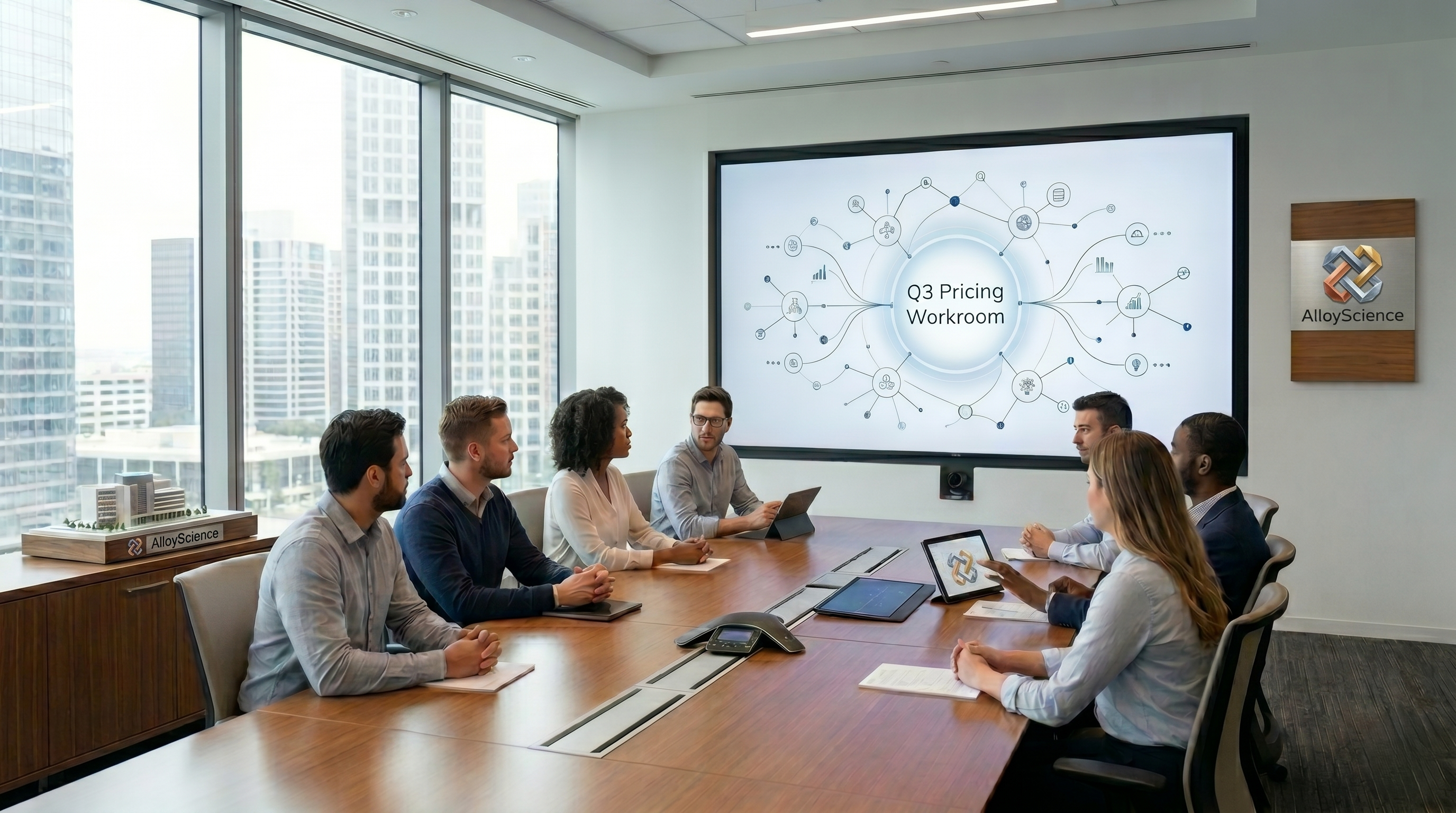
What’s needed is a space where the AI interaction is the team interaction from the start. Where your teammate’s Monday exploration is already in context when you open the space on Tuesday. Where the working state of the problem (what’s been decided, what’s been ruled out, what’s still open) persists across sessions and across people, without anyone having to reconstruct it.
Not shared history. Shared state.
History still matters, but only when the system can distill it into something usable: decisions, open questions, evidence, unresolved tensions, and reusable ideas.
This is what Sentienta Workrooms is built to do. One persistent space where humans and their agents think together. Each person’s agents carry their specific expertise into the room, so the team gets amplified diversity of thought, not one generic AI flattening everyone to the same default.
A Workroom is not a chat thread with better memory. It is a shared working room where people, their agents, and the evolving problem context stay together.
Here’s what that actually feels like:
Your strategist finishes her Tuesday pricing session. She doesn’t write a summary. She doesn’t post in Slack. She just closes the Workroom. When you open it Wednesday morning, your agents already know what was explored, what was ruled out, and why. You don’t start with “can you catch me up.” You pick up mid-thought, not mid-explanation. The dead ends she hit are already mapped. The framing she refined is already the starting point. You’re building on her thinking without her having to stop and package it for you.
The compliance risk your legal advisor’s agent surfaced on Monday is just there when you arrive to work on the timeline. Nobody forwarded it. Nobody scheduled a meeting to discuss it. It accumulated into the shared state because the shared state is where the work happened in the first place.
The Workroom holds what’s been decided, what’s open, and what’s ruled out, not a scrollback log you’d never re-read. Context compounds instead of evaporating. Every session starts where the last one ended, regardless of who was in the room.
The silo disappears because there’s no longer a boundary between “my AI session” and “our team’s thinking.”
Next in This Series
A shared persistent space solves the silo. But it raises the obvious question: won’t it just become another channel you stop reading after a week?
How does a Workroom stay useful on day eight without anyone having to summarize it manually? That’s what we’ll cover next.
Start a Workroom → Sentienta
 Sentienta Blog