
Sentienta Workrooms give people and their agents a shared, evolving context
Last week, we introduced Workrooms as Sentienta’s answer to the AI Silo Effect: the problem of AI-assisted work getting trapped in private chats.
This week, let’s make that concrete.
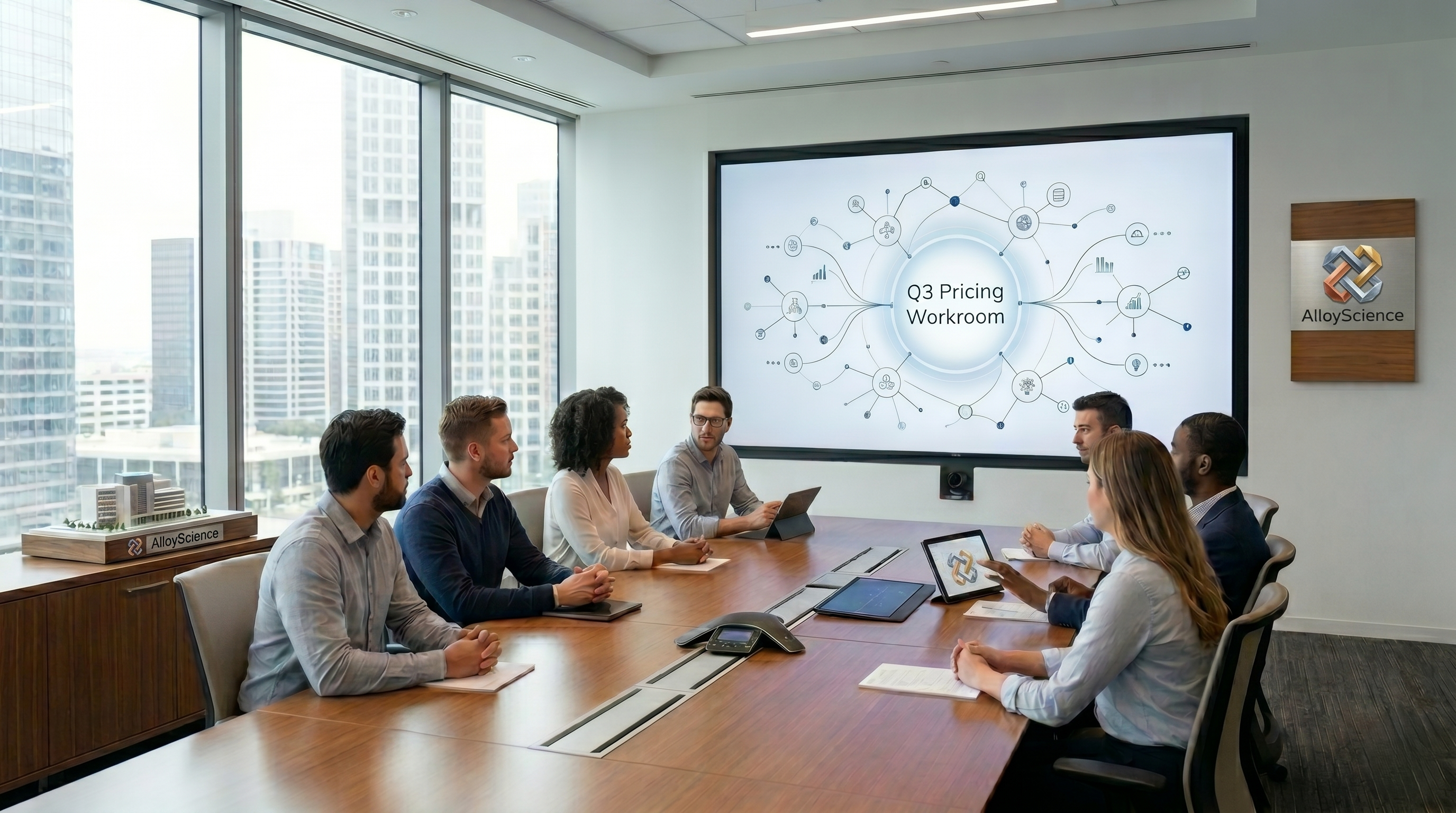
A Workroom is a shared space where multiple people collaborate with AI in the same running context. The host creates the room and invites participants. Participants contribute to the shared conversation, bring in agents that represent their expertise, and return to the room as the work develops over time.
The result is not one generic assistant serving the whole team.
It is a room where people and their agents work together.
Multiple participants, one shared context
Most AI tools are built around one user and one private thread. That works well for individual tasks, but teams need a shared place where AI-assisted work can happen together.
In a Workroom, the host invites participants into a shared conversation. Once they join, everyone is working from the same context. The discussion, the decisions, the tradeoffs, the objections, and the outputs all live in the room as the work develops.
That changes the way a team collaborates with AI. Instead of one person asking an assistant a question, getting an answer, and then reporting back, the work can happen where the group can see it and build on it. The shared context becomes the place where the team’s understanding accumulates.
A Workroom does not require every person to be present for every moment. But it does give the team one place to return to, one context to build from, and one shared record of how the work is moving forward.
Each participant brings their own agentic perspective
A Workroom is not just a shared chat with one AI assistant attached.
Each participant can bring agents into the room that represent their own expertise, responsibilities, tools, and point of view. A product lead might bring an agent that understands the roadmap and customer priorities. An engineer might bring an agent that can reason about implementation constraints. A designer might bring an agent that critiques flows and interaction patterns. A legal lead might bring an agent that knows the company’s IP posture, preferred contract positions, and risk tolerance.
That is a very different model from asking the whole team to rely on one general-purpose assistant.
Teams are valuable because people notice different things. They carry different context. They worry about different risks. They define success through different lenses. Workrooms preserve that diversity instead of flattening it into a single AI voice.
The room can include multiple agentic perspectives, each connected to the participant who brought it, all working from the same shared context. The agents can participate while the work is still being shaped.
And because participants control their own agents, the room can evolve with the work. A participant can bring in a new agent when the conversation enters a new domain. They can turn off an agent when they do not want it participating. This lets the right expertise enter the shared context at the right time. The Workroom remains flexible because the team’s needs are flexible.
Private thinking still has a place
Shared collaboration does not mean every thought belongs in the shared thread.
People use AI privately for good reasons. They ask rough questions. They test weak ideas. They clarify their own thinking before speaking. They rehearse an argument. They explore whether a concern is real before raising it with the group.
A useful shared AI workspace should not take that away.
Workrooms support Private Aside, so a participant can consult their own agents without adding that exchange to the shared Workroom dialog. That gives people a place to think before they contribute.
This matters because the goal of a Workroom is not radical transparency. The goal is better shared work.
The team does not need to see every half-formed question or discarded idea. It needs the contributions that should shape the work: the objection worth raising, the insight worth sharing, the decision worth recording, the artifact worth preserving.
Workrooms run asynchronously
Teams do not always work at the same time.
Someone is in meetings. Someone is in another time zone. Someone has twenty minutes between calls. Someone else is deep in focused work and will not return until tomorrow.
A Workroom is designed for that reality. It does not depend on everyone being present at once. Participants can drop in when they have time, review what has happened, contribute to the shared conversation, and leave the room to keep moving.
Agents make that asynchronous model more powerful. A participant’s agents can continue to represent that participant’s perspective while they are away. They can respond to questions, raise concerns, contribute expertise, or keep a particular lens active in the room even when the person is not currently present.
That promise only works if the participant can trust the system.
If an agent contributes while you are away, you need to know what it said, where it intervened, and what effect it had on the conversation. Otherwise, “agent as proxy” starts to feel less like leverage and more like something you have to babysit.
The Workroom model is designed around that return experience. When a participant comes back, they are not expected to read every line from scratch or wonder what happened in their absence. They can see what their agents contributed, review the state of the work, correct course if needed, and decide where to re-enter the conversation.
That is what makes asynchronous collaboration feel controlled rather than chaotic. Your agents can keep your perspective active while you are away, but you still have an accountability trace when you return.
A meeting requires everyone to gather at the same time. A chat thread often moves forward without the right context. A private AI conversation helps one person, but does not automatically help the group.
A Workroom gives the team a shared environment where people and agents can keep contributing around the same work.
Conversation becomes work
A Workroom is not only a place to talk with AI. It is a place where the conversation can turn into durable work.
That distinction matters because teams do not collaborate in order to produce more messages. They collaborate to make progress. They need decisions, plans, drafts, tasks, artifacts, and a clear sense of what matters next.
Workrooms are designed to keep the conversation and the work connected.
Activity can capture important decisions, interpretations, questions, and outcomes. Tasks can show delegated work and operational progress. Artifacts can preserve the outputs the group wants to keep, refine, store, or delete.
This helps prevent a familiar problem: the important discussion happens in one place, the task gets created somewhere else, the output lives in another tool, and the reasoning behind it slowly disappears.
In a Workroom, the discussion and the durable outputs remain part of the same working context.
That is especially important when AI is involved. AI can generate a lot of material very quickly. Some of it is useful. Some of it is temporary scaffolding. Some of it should become a decision, a draft, a task, or an artifact. Some of it should simply disappear into the background.
A Workroom gives the team a way to separate the durable from the disposable.
Long-running work needs more than a transcript
The real value of a Workroom becomes clearer as the work stretches over time.
A short conversation can survive as a thread. A long-running project cannot. Once a Workroom spans hours, days, or weeks, the team needs more than a record of everything that was said. It needs durable takeaways: the decisions that still matter, the assumptions the group is carrying forward, the open questions, the artifacts produced, and the claims the team has come to believe.
This is the difference between shared history and shared state.
Shared history is the transcript: what happened, in what order, and who said what. Shared state is what the team currently understands. It includes the decisions that are still active, the paths that have been ruled out, the unresolved tensions, the assumptions that remain in force, and the next questions that need attention.
That distinction is what makes a Workroom more useful than asking a generic AI system to summarize a long thread. A summary compresses history. A Workroom needs to maintain state. It has to preserve the shape of the work as it changes, not just produce a shorter version of what was said.
That is especially important in an asynchronous environment. A participant may step away while their agents continue to represent their perspective. Someone else may join later. The host may return after a day of other work. In each case, the question is not, “Can I read the entire transcript?” The question is, “Can I quickly understand where the work stands?”
This is why Workrooms need artifacts and takeaways, not just conversation history.
Tasks help the team see what needs to happen. Artifacts preserve the outputs worth keeping. And Key Ideas, which we will cover in a future post, are central to making long-running Workrooms usable: they track the essential claims and learnings that emerge across many interactions, so the team does not have to manually summarize the room every time someone comes back.
That is the larger promise of Workrooms. They are not just a better place to talk with AI. They are a shared environment where the team’s decisions, context, artifacts, and next steps remain available to the people and agents who need them.
 Something counterintuitive is happening inside teams that have embraced AI.
 Sentienta Blog