
In our previous post, we demonstrated how a simple workflow could be defined and executed using plain language. This time, we examine a more advanced scenario that includes conditional branching, parallel tasks, and multiple agents interacting across different stages of the workflow. The example: a portfolio review where the Angie agent gathers real-time stock quotes, Rob analyzes price changes, and internal language models classify results. If a stock rises more than 1%, Alec sends an alert while Angie retrieves relevant news and sentiment. All of this is orchestrated by David, who builds and executes the workflow from the user’s natural language instruction. This illustrates how complex, multi-stage business logic can be expressed and enacted entirely through natural language.
Scenario Description
The user begins with a portfolio containing four stocks: AMZN, NVDA, AAPL, and GOOG. They ask the system to monitor each stock and take specific actions based on market performance. Specifically, if any stock in the portfolio increases in price by more than 1%, the system should both notify the user and retrieve recent news and sentiment related to that stock. Here is the user’s query:
Here is our portfolio [AMZN, NVDA, AAPL, GOOG]. For each stock, if the price increased by more than 1%, send an alert and get the latest news and sentiment about the stock
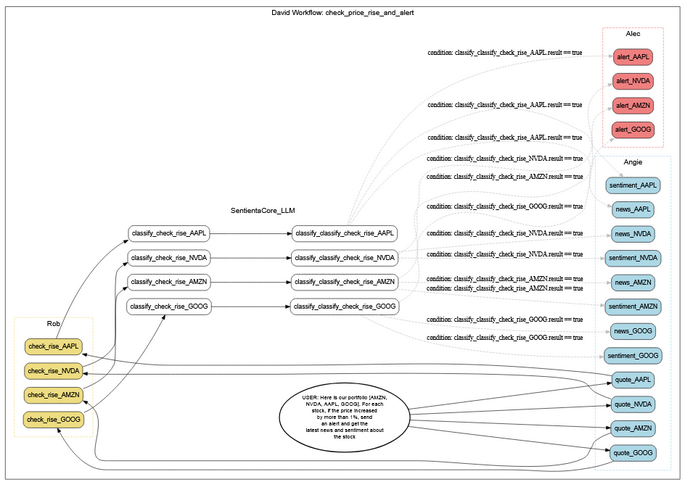
This scenario involves multiple agents working together: Angie collects the initial quotes, Rob performs the price analysis, and language models classify the results. If a stock meets the threshold, Alec sends an alert and Angie independently gathers news and sentiment. The system intelligently branches execution based on conditional logic and handles parallel tasks across agents—all initiated by a single natural language instruction.
Workflow Construction Using Natural Language
Unlike traditional no-code platforms that require dragging blocks or manually assigning agents to predefined tasks, David streamlines the entire process through natural language alone. When the user submits a request, David interprets the intent, identifies the required skills, and matches them to available agents – either defined locally or selected from the Agent Marketplace. For instance, in this scenario, David determines that Angie retrieves quotes and news, Rob analyzes the data, and Alec sends alerts. Task definitions, conditional logic, and parallel execution paths are all inferred—no manual structure or assignment required.
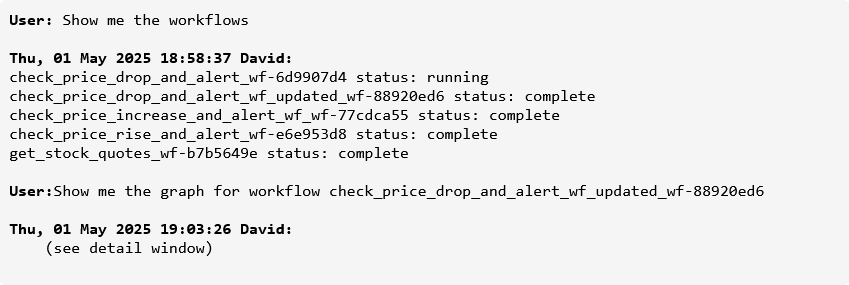
As the workflow runs, the system transparently relays progress via live status updates for each completed step. At any time, the user can request a graphical representation of the active workflow. First the user gets a list of the workflows, then selects the one they want to see.
In the detail window, the user can see the workflow, displaying all of the tasks and agents assignments:
Once the workflow completes, users can retrieve structured results or clean up completed tasks—again with plain language:
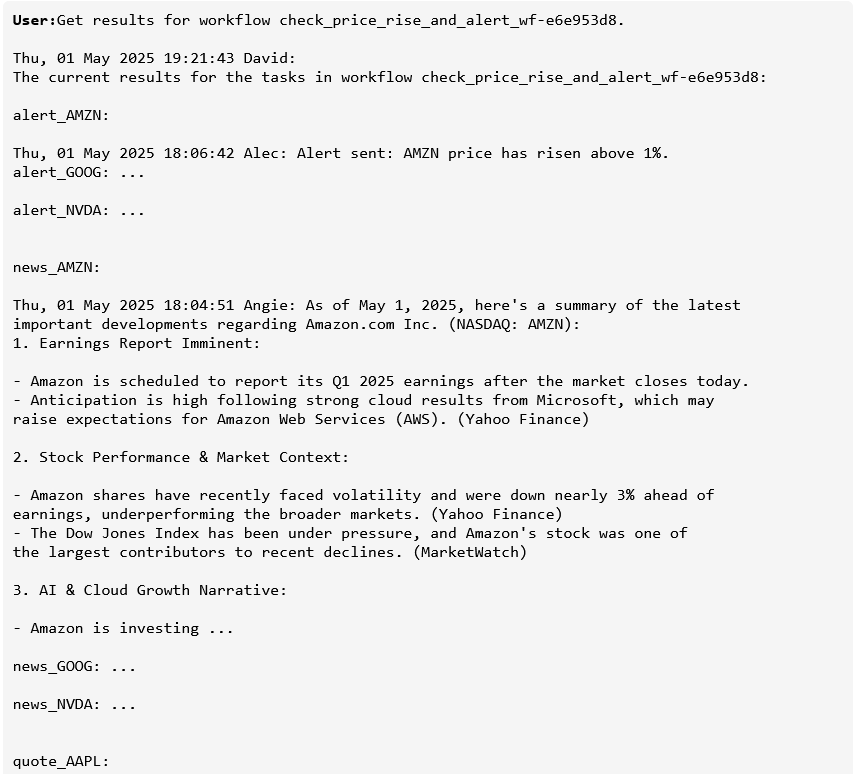
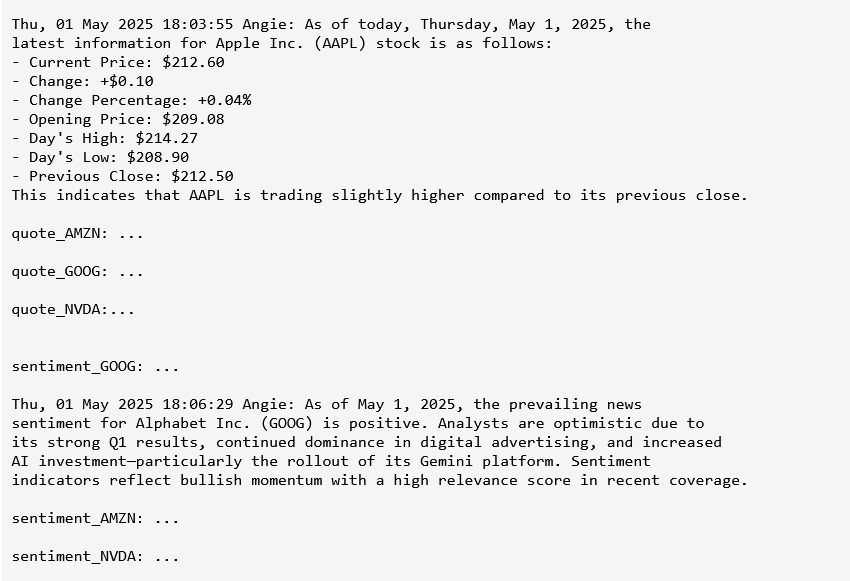
This abbreviated transcript shows the results of each of the tasks that the workflow agent defined and assigned. In addition to getting workflow graphs and results, the user can do the usual workflow and task management functions with natural language queries.
Conclusion
This scenario illustrates how complex multi-agent workflows can be created, monitored, and managed using nothing more than natural language. From interpreting conditional logic to orchestrating parallel tasks and assigning agents automatically, David abstracts away all manual configuration. Real-time execution updates, workflow visualization, and result retrieval further demonstrate the depth of control available through natural interaction. By enabling users to express business logic directly in language, Sentienta’s no-code model significantly lowers the barrier to sophisticated workflow automation.
 Sentienta Blog
Leave a comment