Tag: Sentienta

  • From AI Capability to Agent Management

    For the past year or two, enterprise AI has largely been an experiment in capability.

    Can AI summarize a contract, analyze a spreadsheet, research a market, answer a customer, or write production code? Companies tested models against work people already performed and tried to determine whether the results were good enough to matter.

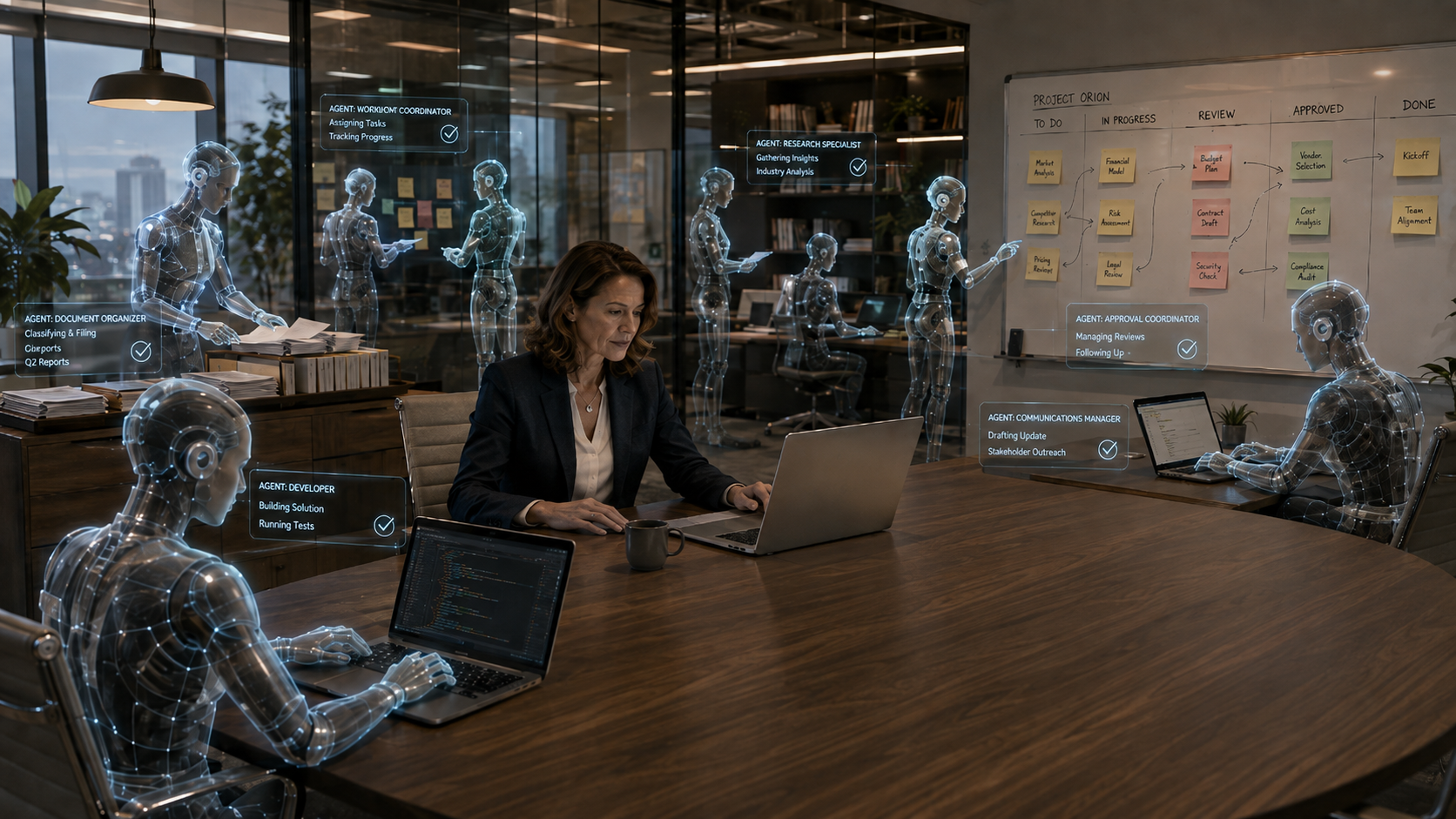
    That period is ending much faster than many organizations expected. The question is no longer simply whether AI can do useful work. It is how companies will manage dozens, or hundreds of agents performing work simultaneously.

    Cost is making this transition particularly visible. An agent does not necessarily generate one answer and stop. It may inspect context, develop a plan, search for evidence, call tools, evaluate the result, revise its approach, and continue until the work is complete or human judgment is required. Several agents collaborating on one objective can multiply that activity.

    This helps explain two important industry trends. Lower-cost and open-weight models, including models from DeepSeek, Qwen, and Kimi, are giving businesses more alternatives to expensive frontier models. At the same time, NVIDIA has put its Groq 3 LPX inference accelerator into full production, targeting the speed and responsiveness required by agentic workloads.

    NVIDIA describes the system in terms of “interactivity,” meaning how quickly an agent can generate tokens and complete each step of its work. Groq 3 LPX is designed for workloads involving long contexts, verification, tool calls, and multistep reasoning. In one benchmark cited by NVIDIA, it generated approximately 3,400 output tokens per second while running a 31-billion-parameter model with a 100,000-token context. NVIDIA’s announcement

    The technology industry is preparing for agents to perform much more work. Enterprises now have to prepare to manage that work.

    The Problem: Cost Reveals a Larger Management Challenge

    Model price is an inadequate way to measure the cost of agent work.

    A less expensive model may require more attempts, more detailed instructions, and more human correction. A frontier model may cost more per call but complete a difficult assignment correctly on its first attempt. An assignment may also consume web research, tool calls, external services, parallel agents, retries, human review, and coordination with other work.

    The meaningful unit is therefore not the token or the individual model call. It is the completed assignment.

    Once companies look at the whole assignment, a much broader management problem comes into view. An organization has to determine which work should be assigned to an agent, which model is appropriate, how much time and effort the assignment justifies, and whether the result compares favorably with work performed by a knowledgeable person.

    It must also decide which resources each agent needs. A legal assignment may require access to contracts in Google Drive, while an engineering assignment may require GitHub and Jira. Giving every agent access to every system is unsafe, but denying necessary information makes the agent ineffective.

    As more agents operate simultaneously, their work must also be coordinated. Two agents may unknowingly solve the same problem, make conflicting changes, or depend on one another without recognizing the dependency. The output of one agent may need to become evidence for another, and a manager may need to resolve disagreements before downstream work proceeds.

    Some decisions can be delegated. Others affect customers, production systems, contracts, finances, or public communications and should remain subject to human approval. The manager needs to see those consequential decisions without being asked to supervise every routine action.

    Faster inference makes these problems more urgent. Agents work through repeated cycles of observation, decision, action, and evaluation. Reducing the latency of each cycle makes longer and more complex assignments practical. It also allows organizations to run more agents and initiate more work. NVIDIA’s investment in specialized inference infrastructure is therefore not just a story about faster hardware. It is evidence that agent work is becoming a production workload. NVIDIA’s technical overview

    The Solution: Manage the Assignment

    Companies need to manage agents at the level of the assignment rather than the individual model call.

    For each assignment, the organization should be able to understand who or what is responsible, which model and resources are being used, how the work relates to other assignments, what decisions require attention, and whether the result justified the total cost and human effort.

    This does not mean exposing every prompt, inference, or tool call to a manager. That would replace productive work with constant supervision. Routine execution should remain in the background. The management layer should surface progress, important findings, dependencies, blockers, approval requests, and outcomes.

    Model selection becomes one part of this process. Lightweight models may handle monitoring, classification, extraction, and routing. More capable models may be appropriate for difficult reasoning or consequential decisions. Some assignments may begin with an inexpensive model and escalate only when uncertainty is high. Others may benefit from several agents independently examining a problem before their conclusions are compared.

    The objective is not to identify one model that should perform every task. It is to choose an appropriate combination of agents, models, information, tools, and human judgment for the work at hand.

    This is the management layer Sentienta is working to provide. In a Sentienta Workroom, people and agents can collaborate around shared objectives while retaining different responsibilities, knowledge, models, and access to business systems. Workflows support the scheduled or event-driven activity needed to fulfill them.

    The Workroom preserves the management context above that activity. It allows consequential progress, dependencies, decisions, and outcomes to remain visible without reproducing every operational detail. Permissions and approval levels constrain what agents may access or change, while activity records support accountability.

    Sentienta does not yet provide complete assignment-level cost accounting, automatic model routing, or a comprehensive comparison of agent and human performance. Those capabilities will become important as agent deployment grows. The immediate foundation is the ability to organize responsibilities, coordinate work, govern actions, and keep human judgment focused on the decisions that matter.

    Conclusion

    Enterprise AI is moving from testing what individual models can do to managing agents as a workforce.

    The rapid growth of lower-cost models and specialized inference infrastructure will make many more agent assignments economically practical. That will increase the importance of deciding what work agents should perform, how their efforts should be coordinated, which resources and authority they should receive, and whether their results justify their cost.

    The companies that benefit most will not simply be those that deploy the most agents or purchase the cheapest inference. They will be the ones that learn to manage agent work effectively.

    The capability question is being answered. The management question is just beginning.
  • Sentienta Connected Services

    Giving Every Agent the Access Its Role Requires

    A cross-functional team may work together on the same problem, but that does not mean every person, or every agent, should have access to the same information.

    As agents become part of everyday work, organizations are unlikely to rely on one universal assistant that knows everything and can access everything. Legal, engineering, sales, finance, and HR each work from different systems, different obligations, and different kinds of evidence.

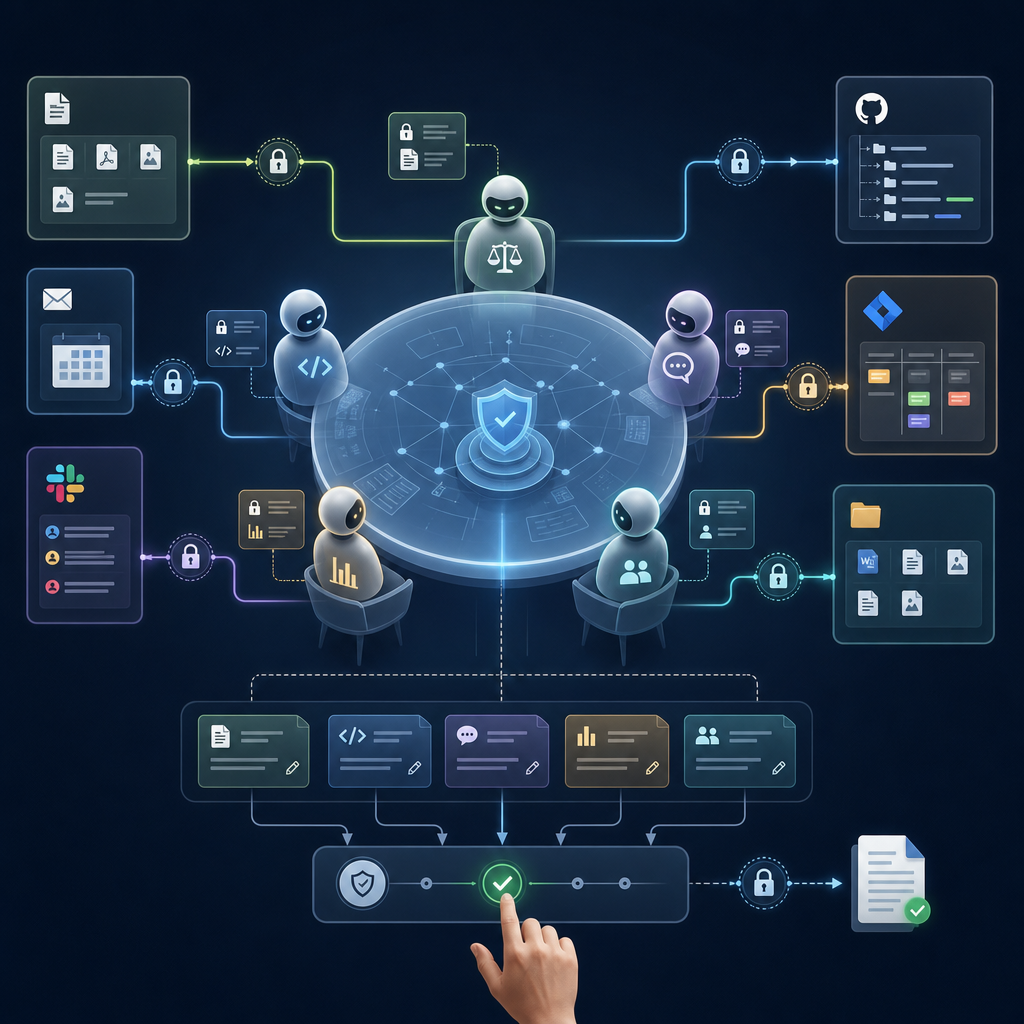
    Connected Services are Sentienta’s answer to that problem. They let users authorize agents to work with the systems where team knowledge already lives, including Google Drive, Gmail, Google Calendar, Slack, GitHub, Jira, and local resources through Sentienta Bridge, without turning that access into a universal permission for every agent in the Workroom.

    In Enterprise AI Needs a Governance Layer, we argued that agent governance begins with access: which agents can reach which organizational systems? In How Sentienta Governs Agent Actions, we described the governed path from a request to an external action.

    Connected Services put those ideas into practice. They allow teams to bring specialist agents and their knowledge sources into a shared Workroom while preserving boundaries around information, authority, and action.

    Access Should Follow Responsibility

    Connected Services let users authorize Sentienta to connect with the systems where their work already lives. The cloud services use supported authorization flows and service APIs. Sentienta Bridge provides a governed path to locally available capabilities such as OpenClaw and selected files.

    Connecting a service does not mean every agent gains access to it. Sentienta treats service access as an agent capability, not as a universal capability of the platform. A user connects a service and then determines which agents may use the relevant capabilities.

    For example, a legal agent might be enabled to access contracts in Google Drive, while an engineering agent is enabled to access GitHub and Jira. An HR agent may need personnel documents and scheduling information. These agents can participate in the same organization without inheriting one another’s access.

    This is a basic governance principle: access should follow responsibility. An agent should receive the capabilities required for its work without automatically inheriting access to every system its user or organization has connected.

    That makes the agent’s role easier to understand and limits the consequences of an incorrect request, an overly broad interpretation, or the accidental use of sensitive information outside its intended context.

    Collaboration Without Erasing Boundaries

    A Sentienta Workroom gives people and agents a shared place to work on a problem, project, or decision.

    Each agent can participate with its own instructions, context, enabled services, permitted operations, and approval requirements. Agents can respond to one another and contribute to the same discussion while their underlying service access remains separately governed.

    This distinction becomes especially important when an agent retrieves private information.

    Information retrieved from a user’s connected service is returned in a Private Workroom card. It is not automatically visible to other participants, other agents, or outside collaborators. The user can review the result and decide what, if anything, should be shared with the Workroom.

    The team can therefore share a relevant conclusion without exposing every contract, email, issue, file, or record that contributed to it.

    Consider a company deciding whether to make a significant product commitment to a customer.

    The Workroom includes agents representing sales, legal, engineering, and finance, along with the managers responsible for the decision. Sales can explain what the customer requested. Legal can clarify what the contract permits. Engineering can assess product readiness and implementation risk. Finance can describe the applicable budget constraint.

    Each contribution is informed by the systems suited to that role. The participants can compare their findings and reach a coordinated judgment without opening every underlying source to everyone in the Workroom.

    From Governed Access to Coordinated Action

    Connected Services do more than help agents retrieve information. They also allow the Workroom team to prepare and carry out follow-up work in the systems where that work belongs.

    In the customer commitment example, the engineering agent might review GitHub activity and related Jira issues. The legal agent might locate the applicable contract language in Drive. The sales agent might review customer correspondence and prepare a follow-up message. A project coordinator might prepare a meeting, while a communications agent prepares a summary for Slack.

    These are not necessarily the capabilities of one universal agent. Work is directed to the agent whose role and service permissions match the request. One agent may have several capabilities when its assignment requires them, but access is granted deliberately rather than assumed.

    The interaction remains natural. A user can ask Engineering whether a correction was deployed, ask Legal to find a contract provision, or ask the project coordinator to prepare a follow-up meeting. The appropriate agent uses its enabled services to retrieve information or prepare the requested action.

    Retrieval and analysis do not automatically authorize an external change.

    When a proposed action would send, post, create, update, or delete information, Sentienta can require the user to review what will change, which service and destination will be used, and which agent prepared the action.

    Approval applies to the proposed operation. It is not blanket authorization for unrelated future activity.

    The result is a layered governance path:

    1. The user authorizes a service connection.
    2. The user enables specific capabilities for specific agents.
    3. The user selects the agents participating in the Workroom.
    4. Each agent contributes from its permitted information sources.
    5. Retrieved private information remains private unless the user shares it.
    6. Consequential actions are handled according to the applicable authority and approval policy.
    7. The activity and outcome remain part of the operational record.

    Each layer answers a different governance question. Together, they allow a team to move from distributed evidence to a coordinated decision and then to accountable action.

    Governance Makes Greater Capability Possible

    Connected Services provide immediate practical value. They let Sentienta agents work with documents, communications, schedules, repositories, issues, and local resources without requiring users to carry information manually in and out of a chat window.

    Their larger importance, however, is how they prepare for a world of specialist agents.

    As departments develop agents around their own responsibilities and knowledge, those agents will need to collaborate across organizational boundaries. Collaboration cannot mean giving every agent access to every system. It must preserve meaningful distinctions among roles, information, and authority.

    Sentienta Workrooms provide the shared environment for that collaboration. Connected Services give individual agents bounded access to the knowledge and tools their work requires. Private cards support selective disclosure. Approval controls govern consequential actions.

    Governance is therefore not a restriction added after an agent has been made powerful. It is the structure that allows organizations to give agents meaningful capabilities safely.

    The future is not one agent with all of the company’s knowledge. It is a governed team of people and agents, each contributing the knowledge and capabilities appropriate to its responsibility.

  • How Sentienta Governs Agent Actions

    From governance principle to governance path

    Sentienta Governance

    A few weeks ago, we argued that enterprise AI needs a governance layer.

    That does not mean slowing adoption with more process. It means recognizing that AI is moving beyond individual experimentation. Employees are no longer using models only to summarize, draft, and analyze. They are beginning to work with agents that retrieve information, use tools, trigger workflows, post messages, create issues, and interact with the systems where company work happens.

    Once agents can act, governance becomes an operational question.

    It is no longer enough to ask whether a model produced a good answer. Organizations must also ask:

    • Was the agent authorized to use the service?
    • Was the requested action permitted?
    • Did it require human approval?
    • Which identity and credentials were used?
    • What happened when the action ran?
    • What record was preserved afterward?

    Over the past several weeks, we have introduced the capabilities announced with Sentienta V2, including collaborative Workrooms, governed agents, and controlled execution.

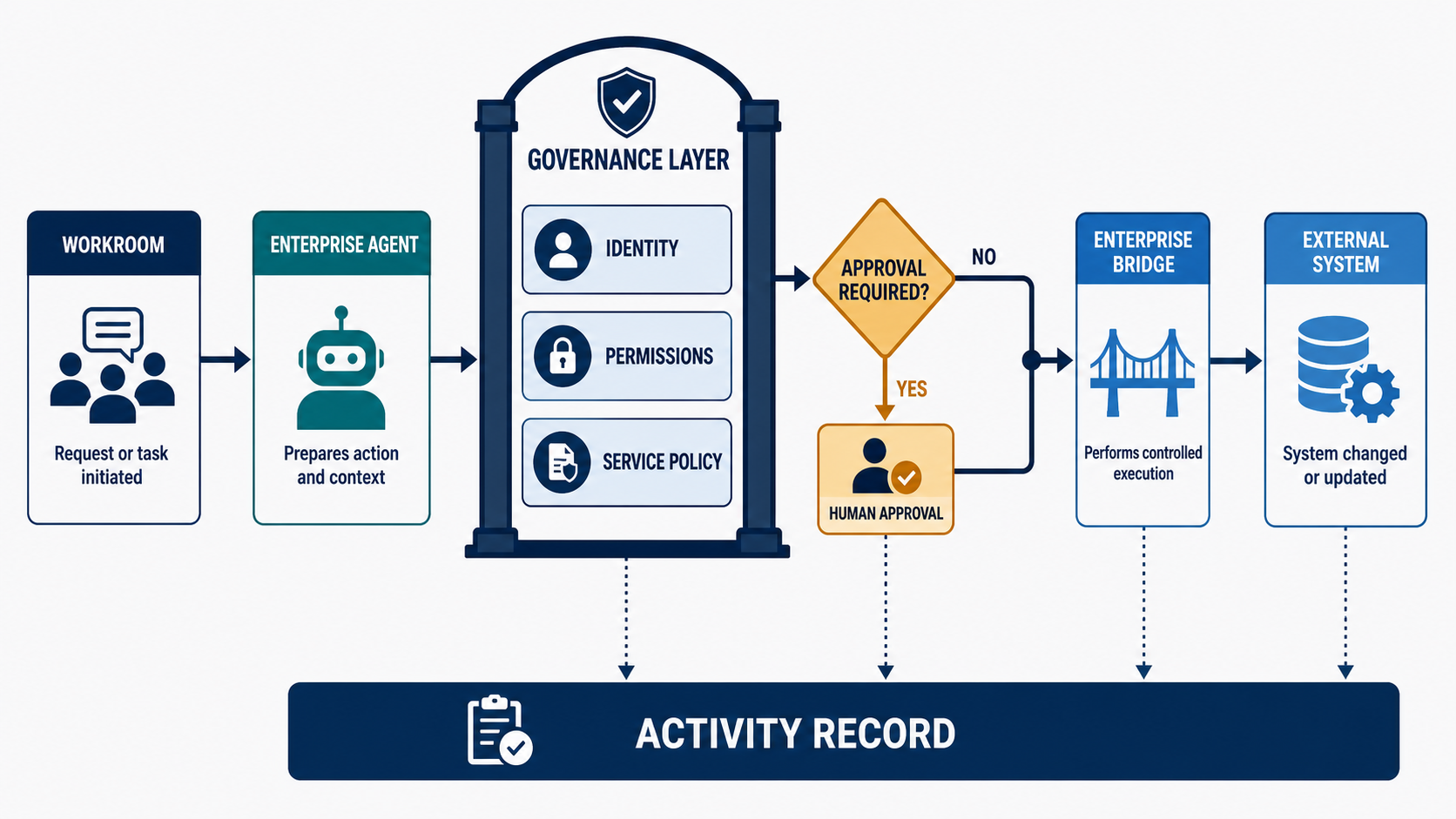
    This post looks at how those pieces work together. Agent work begins in a permissioned Workroom, moves through approved capabilities and controlled connections, pauses for human review when required, and leaves an activity record behind.

    The principle is straightforward: governance should not exist only in policy documents, administrative settings, or after-the-fact reviews. It should be built into how agent work is requested, authorized, executed, and recorded.

    That is what allows agents to move beyond conversation and participate safely in real organizational work.

    How Sentienta puts governance into the path of agent work

    Sentienta treats governance as part of the workflow—not as a policy document applied after the fact. Controls appear where work is requested, delegated, authorized, executed, and recorded.

    1. Workrooms establish the governed context

    A Workroom is more than a shared conversation. It provides the operating context for collaboration among people and agents: who is participating, which agents are present, who initiated a request, and who is permitted to manage or stop the work.

    Workroom permissions control who can join, contribute, invite participants, manage agents, and halt an active run. These controls establish the context used by Sentienta’s backend when it evaluates an agent request.

    Importantly, sharing a Workroom does not share a participant’s credentials, files, device access, or private services. Collaboration and authorization remain separate.

    2. Enterprise Agents turn individual experiments into organizational capabilities

    Many organizations begin using AI through individual experimentation. Employees create assistants, connect tools, and develop useful workflows—but the resulting capabilities may be difficult for the organization to understand, manage, or reproduce.

    Enterprise Agents provide a different model. They are organizational capabilities that can be made available to authorized users and Workrooms. Managers and teams can use approved agents without having to build and configure their own versions.

    This allows organizations to decide:

    • which Enterprise Agents are available
    • who may use and administer them
    • which services they may access
    • which execution environments they may use
    • and how their work is reviewed and recorded

    Enterprise Agents therefore turn agent capability from an individual configuration into a managed organizational resource.

    3. Roles and permissions separate use from administration

    Governance also requires control over who can configure the system. Sentienta distinguishes organization owners, administrators, and members.

    Owners and administrators manage organizational membership, Enterprise Agents, available services, and service policies. Members can use the capabilities made available to them without automatically gaining the ability to modify those capabilities or their underlying connections.

    This separation allows an organization to delegate useful agent capabilities broadly while keeping configuration and administrative authority appropriately limited.

    4. Brokered services mediate access to external systems

    When an agent needs to reach an external tool or organization-controlled system, Sentienta can place a governed service layer between the agent’s request and execution.

    The important question is not simply whether an agent can connect to a tool. It is whether the organization can control:

    • which services are available
    • which roles and agents may use them
    • which operations are permitted
    • where credentials remain
    • whether an action requires approval
    • and what activity is recorded afterward

    Permissions can distinguish among operations such as reading information, creating something new, updating an existing resource, sending a message, or deleting data. This avoids treating “access to a service” as a single all-or-nothing permission.

    5. The Enterprise Bridge creates a controlled execution boundary

    Some agent work must run in an environment controlled by the organization, for example, when it involves a private network, managed automation host, customer-held credential, internal service, or organization-operated connector.

    The Enterprise Bridge provides that execution boundary. It can advertise approved capabilities, receive authorized work, execute through controlled service connections, and return results to the Workroom.

    Credentials remain in the appropriate environment rather than being placed in an agent prompt or exposed to Workroom participants. If the required Bridge or service is unavailable, Sentienta can fail the request safely instead of silently choosing another user’s device, credentials, or connection.

    This creates a practical middle ground between powerless chatbots and unmanaged automation: agents can perform useful work, but execution follows a controlled organizational path.

    6. Approval gates preserve human control

    Not every agent contribution needs approval. Research, analysis, comparison, summarization, and drafting should remain fluid.

    Consequential actions are different. When an agent is preparing to change external state, such as posting information, creating a record, modifying a resource, or triggering another process, the applicable policy can require human approval before execution.

    The agent can prepare the proposed action and present it for review. An authorized person can approve or reject it before the external change occurs. This supports meaningful delegation without requiring the organization to accept unrestricted automation.

    7. Activity records make agent work reviewable

    A transcript shows what people and agents said, but governance also requires visibility into what the system did.

    Sentienta’s Activity records provide structured operational information about a run: the request, participating agents, important execution stages, service activity, approval events, outcomes, and failures. Enterprise governance records provide additional visibility into governed service actions and approval decisions.

    These records help managers understand how work progressed and investigate problems without presenting the transcript itself as a complete forensic audit.

    What this looks like in practice: posting a Slack update

    Imagine a product team using a Sentienta Workroom to coordinate a customer rollout. After resolving the open questions and agreeing on next steps, the manager wants to send a concise update to an internal Slack channel.

    An Enterprise Agent can summarize the discussion and draft the message. The governance question is what must happen before that message reaches Slack.

    1. The request begins in a Workroom

    The request starts where the team is already collaborating. The Workroom provides important context: who made the request, which Enterprise Agent is participating, what discussion led to the update, and who is permitted to manage the work.

    Workroom access does not automatically grant Slack access. It establishes the collaboration context that Sentienta carries into the authorization process.

    2. The Enterprise Agent prepares the action

    The manager asks the Enterprise Agent to draft an update. The agent reviews the relevant discussion, identifies the decisions and next steps, and prepares a proposed Slack message.

    Nothing has been posted yet. Drafting creates content inside the Workroom. Posting changes an external system, so it can be governed separately.

    3. Sentienta checks the service policy

    Before execution, Sentienta checks whether the organization has made Slack available through its governed service configuration.

    The system can evaluate whether:

    • the requester is an active organization member
    • the Enterprise Agent is allowed to use the service
    • the requester’s role permits the operation
    • the requested Slack channel is configured and allowed
    • and posting requires human approval

    The existence of a Slack connection is not enough. The specific agent, user, action, and destination must be permitted.

    4. An authorized person approves the post

    If policy requires approval, Sentienta pauses the action and presents the proposed message for review.

    The manager can confirm the content and destination, then approve or reject the request. If changes are needed, the request can be rejected and returned for revision. The external action occurs only after the required approval has been recorded.

    5. The Enterprise Bridge executes the approved action

    Once approved, the request is sent through the Enterprise Bridge. The Bridge uses the organization’s governed Slack connection, posts the approved message, and returns the result.

    Slack credentials remain in the controlled execution environment. They are not placed in the agent prompt, exposed in the Workroom transcript, or shared with participants.

    If the Bridge, service connection, or permitted destination is unavailable, the request fails safely rather than switching to an unmanaged connection.

    6. Governance activity records the outcome

    Sentienta records the relevant operational events, including the requested action, service and destination, approval decision, execution outcome, and any failure.

    The Workroom preserves the discussion that produced the update. The governance activity shows how the proposed action moved from drafting through authorization and execution.

    In an unmanaged workflow, “an agent posts to Slack” is merely a convenience feature. In a governed workflow, the agent accelerates the task while the organization retains control over authorization, approval, credentials, execution, and review.

    Agent actions do not bypass governance. They travel through it.

    Conclusion: managing agents that act

    The next era of enterprise AI is not only about producing better answers. It is about agents that can retrieve information, post updates, create records, trigger workflows, and interact with the systems where work happens.

    That creates a new management challenge. Organizations need to know which agents are trusted, which services they can use, what actions they may take, when human approval is required, how credentials are protected, and what record remains afterward.

    The goal is not to slow agents down. It is to give them a safe and accountable path from request to action.

    Agents will become useful at organizational scale only when companies can trust what happens beyond the chat window. Sentienta makes that work governed, visible, and manageable while still allowing people and agents to move quickly.

  • Managers Are Being Told to Implement AI


    Now They Have to Make It Work

    Business leaders are under pressure to move faster on AI. Competitors are adopting it, boards are asking about it, vendors are promising productivity gains, and employees are already using chatbots, copilots, and agents in their day-to-day work. At the executive level, the mandate can sound simple: implement AI.

    But that mandate becomes much more complicated when it reaches managers.

    For a manager, implementing AI is not just a tooling decision. It means figuring out how AI-assisted work should function inside a real team: how people and agents collaborate, how outputs are reviewed, how decisions are explained, how workflows change, and how accountability is maintained when the work is no longer produced by people alone.

    The research points to a clear pattern. AI adoption is moving faster than the management systems, intelligence infrastructure, and workflow designs needed to make that adoption useful at scale.

    Gartner reported that only 45% of managers say AI has improved their teams’ work as much as expected (Gartner, March 4, 2026). A subsequent study on agentic AI goes further: managers are no longer overseeing only people and tasks; they are increasingly accountable for the behavior, outputs, and risks of autonomous digital agents operating alongside their teams. Gartner also notes that AI-driven productivity gains can bring hidden oversight costs, with 75% of CHROs saying managers are more overwhelmed than ever (Gartner, May 6, 2026).

    IDC describes a related problem as an “intelligence gap”: organizations are piloting and deploying AI faster than they are building the intelligence infrastructure required to support good decisions at scale. In the same study, IDC found that only 39.6% of enterprises say AI governance is a top priority in 2026, even as agents take on broader decision-making roles across the organization. Without a reliable, traceable intelligence layer, governance becomes difficult to operationalize (IDC, June 24, 2026).

    BCG adds another dimension: their study found that 47% of respondents report spending more time managing and directing AI than doing the work itself, while 41% report increased cognitive load. BCG calls this the “joy paradox”: AI can make work better and harder at the same time. Their most important insight may be that the first wave of AI focused on individual productivity, but the next wave will need to transform collective work(BCG, June 3, 2026).

    Taken together, these findings sharpen the real problem.

    Companies are pushing AI into teams faster than they are redesigning the management, workflow, and intelligence systems around it. Managers are being asked to turn scattered AI activity into useful team performance, even though the operating model for doing that is still unclear.

    The AI Implementation Problem Now Lands on Managers

    For managers, AI-assisted work is becoming harder to see, harder to trust, and harder to coordinate.

    Managers are no longer reviewing work created only by people. They may be reviewing work shaped by prompts, copilots, agents, retrieved sources, automated workflows, and human edits. That changes the oversight question. It is no longer enough to ask whether the work was completed. Managers also need to understand what the AI contributed, what sources were used, what assumptions were made, what risks were surfaced, and what still requires human judgment.

    The same issue shows up in trust. A polished AI answer can look complete while resting on weak evidence, missing context, or untested assumptions. For managers, the question is not simply whether an output sounds right. It is whether the work behind the answer can be inspected before the organization acts on it.

    AI also creates a coordination challenge. It can help individuals draft, summarize, research, and analyze faster, but faster individual work does not automatically become better team performance. Without a shared place to review the work, preserve the reasoning, and connect it to a decision, AI activity can remain scattered across private chats, documents, and meetings.

    This is where the management burden becomes clear. Managers are expected to turn AI from a set of individual productivity experiments into a reliable way for teams to work. That requires more than access to models. It requires a practical layer for directing the work, reviewing the evidence, preserving the reasoning, and coordinating people and agents around shared outcomes.

    That is the missing layer.

    Managers do not need another AI tool that simply produces more output. They need a shared operating space where AI-assisted work can be directed, reviewed, challenged, captured, and turned into decisions the team can explain.

    How Sentienta Helps

    Sentienta is designed around that management problem.

    Sentienta gives teams shared Workrooms for AI-assisted work. Instead of scattering AI activity across private chats and disconnected tools, Workrooms give managers and teams a common place to collaborate with specialized agents, review contributions, compare perspectives, and keep the work connected to the decision being made.

    Within a Workroom, agents can take on defined roles. One agent might research, another might challenge assumptions, another might draft, and another might evaluate risks. The point is not just to generate more answers. It is to make the work process visible: who contributed what, what evidence was used, what tradeoffs emerged, and where human judgment is still needed.

    Sentienta also helps preserve the reasoning that matters. Key Ideas capture important claims, assumptions, risks, decisions, and open questions so they do not disappear into a long chat history. That gives managers a way to carry forward the working knowledge created during AI-assisted collaboration, rather than asking teams to reconstruct it later from scattered transcripts.

    This matters because the next phase of enterprise AI will not be measured only by how quickly individuals can produce drafts, summaries, or analyses. It will be measured by whether teams can use AI to make better decisions, coordinate more effectively, and preserve the context needed to act with confidence.

    Executives are asking organizations to move faster with AI. Managers are being asked to make that speed useful.

    To do that, they need practical systems for directing AI-assisted work, reviewing what matters, preserving decision rationale, coordinating people and agents, and turning saved time into better collective judgment.

    That is what Sentienta is built to support.

  • Chat History Is Not Organizational Memory

    Enterprise AI is moving from individual productivity into shared work. Teams are no longer using assistants only to summarize documents, draft emails, or answer isolated questions. They are bringing agents into product planning, customer research, governance reviews, technical investigations, operational workflows, and strategic decision-making.

    That shift creates a new version of an old organizational problem: important knowledge disappears.

    A team may have a valuable AI-assisted discussion in which one agent surfaces a risk, another proposes an implementation path, a human reviewer challenges the assumptions, and the group reaches a decision. In the moment, the work feels productive. But a week later, the durable value is hard to find. What did we decide? Why did we reject the other option? Which risks were still unresolved? What customer insight changed the direction?

    Too often, the answer is: somewhere in the chat history.

    The problem is organizational amnesia

    Organizations have always struggled to remember what they learn. Knowledge gets lost through turnover, silos, undocumented decisions, shifting priorities, and tools that capture activity without preserving meaning. AI does not automatically solve that problem. In some cases, it can make it worse by helping teams generate more analysis, more discussion, and more decisions without creating a reliable way to carry forward the knowledge that matters.

    Recent enterprise AI writing is starting to name this risk more clearly. Harvard Business Review recently warned that generative AI can contribute to decay in the accuracy and quality of organizational knowledge when companies fail to manage the knowledge layer around AI-enabled work (Don’t Let AI Slop Muck Up Your Company’s Processes). CIO has also described “organizational amnesia” as a risk in the age of AI, especially when institutional knowledge is not captured in a form that future teams and systems can use (Preventing organizational amnesia in the age of AI).

    This is not just a documentation problem. It is a continuity problem. Enterprise work depends on decisions, assumptions, objections, tradeoffs, lessons, and unresolved questions that accumulate over time. If those disappear into transcripts, teams are forced to rediscover what they already knew. Decisions get repeated without their original context. Risks raised in one discussion fail to inform the next. Useful patterns remain local instead of becoming shared organizational knowledge.

    As agents become part of real workflows, the question is not only whether AI can help people do more work. The question is whether AI can help the organization remember what the work taught it.

    A transcript is not memory

    A transcript records what was said. Organizational memory preserves what matters.

    That distinction is becoming central to enterprise AI. In a shared AI Workroom, the lasting value is rarely the entire conversation. It is the smaller set of decisions, ideas, risks, assumptions, patterns, and open questions that should survive beyond the session.

    Imagine a product team using a Workroom to evaluate a new customer-facing automation. One agent reviews customer needs, another checks policy and governance concerns, and another drafts implementation options. The discussion may be long, but the reusable knowledge is more specific: the launch criteria the team agreed on, the assumption they rejected, the customer objection that changed the positioning, the risk that needs legal review, and the implementation pattern that may apply to future launches.

    If all of that remains buried in a chat log, the organization has technically captured the conversation but practically lost the learning.

    This is why enterprise AI needs a layer between raw conversation history and formal documentation. Raw transcripts are too noisy. Formal documentation often arrives too late, if it arrives at all. The missing layer is working knowledge: the important ideas that emerge while people and agents collaborate, before they become policy, process, roadmap, or strategy.

    Where Key Ideas fit

    This is the role of Key Ideas in Sentienta.

    Key Ideas are a way to preserve the important concepts that emerge from human-agent collaboration so teams can revisit, refine, challenge, and reuse them.

    A Key Idea might capture a decision the team made, a strategic principle that should guide future work, a recurring customer concern, a risk pattern that needs review, a product assumption that remains unvalidated, or an unresolved question that should carry into the next session. The value is not that the idea is final. The value is that it does not disappear.

    In Sentienta v2, Workrooms create the shared context, governance controls agent action, and Key Ideas preserve the learning that emerges from that collaboration.

    Key Ideas extract and encode the important claims emerging from a workroom conversation, not just a flat summary of what was said. It links those ideas into a structured tree, so supporting, competing, refined, or unresolved ideas can be understood in relation to each other. It also identifies ideas that need user input to resolve ambiguity, make a decision, or move the discussion forward. The most important ideas are surfaced both in the strip at the top of the workroom and in the Session Assist panel for easy review.

    That matters because activity records and organizational memory answer different questions. An activity record can show what happened: an agent drafted a GitHub issue, posted to Slack after approval, or completed a brokered service action. But the deeper learning often lives one level higher. Why was the action taken? What tradeoff did the team accept? Which assumption shaped the decision? What risk should inform the next project?

    Governance helps an organization know what agents did. Key Ideas help preserve why the work mattered.

    Making AI work cumulative

    The first wave of AI adoption focused on speed: faster writing, faster research, faster coding, faster summarization. The next wave is about coordinated work. Teams will increasingly collaborate with multiple agents across shared contexts, and those agents will participate in planning, analysis, operations, customer workflows, engineering processes, and governance reviews.

    Other enterprise AI commentators are pointing in the same direction. TechTarget recently described AI collaboration tools as creating a new category of enterprise assets: institutional memory that is captured, organized, and reused by machines, while also raising governance and access-control questions (CIOs must rethink governance for AI collaboration tools). TechRadar has made a related point from the scaling side: AI programs struggle when knowledge remains scattered, and more durable context is needed for agents to inherit institutional knowledge rather than improvise each time (Why most AI programs stall, and what it will take to scale them).

    Sentienta v2 is designed around the belief that enterprise AI needs more than isolated assistants. It needs shared spaces for collaboration, governed access to external services, approval paths for meaningful actions, activity records for accountability, and a way to preserve the ideas that should outlive the conversation.

    The future of enterprise AI is not just agents that can answer questions or complete tasks. It is organizations that can remember, refine, and reuse what their people and agents discover together.

  • Enterprise AI Needs a Governance Layer

    Employees are no longer just chatting with AI models. They are beginning to work with agents that can act: connecting to services, operating browsers, reading documents, searching repositories, calling APIs, and using MCP* tools tied to external systems. Some can draft, retrieve, send, modify, or create information across the same systems where real company work happens.

    A chatbot answers a question. An agent participates in work. That is a meaningful shift, and it creates a governance problem that most organizations are only beginning to confront.

    The Access Problem

    Every employee needs powerful AI agents to do their work, but their needs differ.

    An engineer needs Slack and GitHub access through their agent. They don’t need access to the file server hosting IP documents and contracts. Legal needs that file server, but not GitHub. HR needs employee records on a company server, but not customer contracts. A DevOps lead may need write access to production infrastructure but a product manager does not.

    The access each person requires depends on their role, and the agents acting on their behalf should inherit exactly those boundaries and nothing more. Today, many companies face the opposite: a free-for-all of ungoverned agents operating with whatever access their users happen to have, or can reach through unmanaged local tools. No visibility. No boundaries. No institutional record of what happened.

    This is not a speculative concern. A January 2026 CIO report found that roughly half of employees are already using unsanctioned AI tools at work—with enterprise leaders themselves among the major culprits. And banning these tools does not solve the problem: a June 2026 study reported by TechRadar found that two in three office professionals used AI tools despite explicit policy restrictions. Prohibition drives usage underground; it does not eliminate the risk.

    Agents make company resources useful and employees more productive. But without a control plane, the organization has no reliable way to ensure that agent capabilities match role-appropriate access.

    Where Workrooms Change the Picture

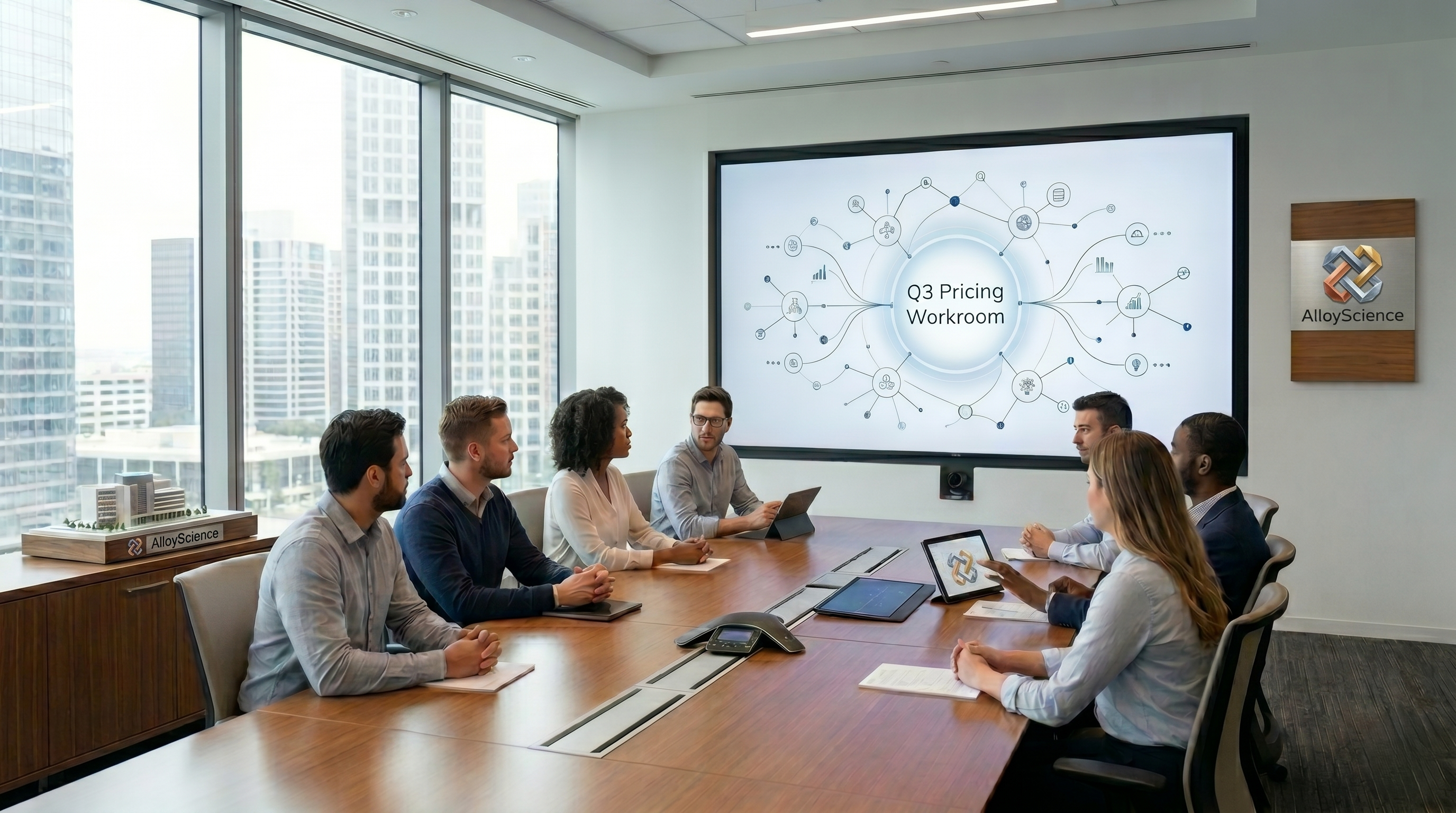
    Last week we introduced Workrooms: shared spaces where cross-functional teams collaborate with AI agents around a problem, project, or decision. Workrooms are where the governance challenge becomes most visible.

    When Legal and Marketing both participate in the same Workroom, the agent Legal brings should carry different controls than the agent Marketing brings. Legal’s agent can reach contracts; Marketing’s cannot. Engineering’s agent can access the code repository; Legal’s cannot. The Workroom inherits each participant’s scoped permissions, so collaboration does not blow open access boundaries.

    This is where role-level governance meets team-level collaboration. A shared workspace must let people work together without silently granting every participant’s agent access to every other participant’s resources. The control plane has to follow the work into the room.

    How Sentienta Addresses This

    Sentienta provides the governance layer that lets teams bring powerful agents into shared workspaces while keeping access, actions, and accountability under enterprise control.

    Enterprise Admin is the control plane, giving organizations a centralized surface for managing enterprise membership, trusted domains, roles, and service access. This is not just a per-user settings page. It is the organizational layer where admins decide which AI capabilities and connected services are available to different roles.

    Admin-governed service access: Sentienta lets administrators decide which connected services are available to enterprise agents and who can configure them. Instead of every user running their own uncontrolled desktop agent, an organization can provide approved agents with approved capabilities: for example, one agent may be configured for GitHub and Slack, another for document-oriented local file access, and another for governed desktop automation. These controls are applied through enterprise roles, admin settings, and agent-level service configuration.

    Workroom-aware enterprise boundaries: Workrooms are shared spaces, so governance has to account for who is in the room. Enterprise-connected agents and services are governed by the Workroom context. If outside participants join a Workroom, enterprise agents are turned off by default unless explicitly approved. This prevents accidental exposure of enterprise capabilities to external collaborators.

    Agent execution targets and the Enterprise Bridge: Agents can be configured for different execution paths, including cloud models, desktop automation, and enterprise-hosted bridge services. The Enterprise Bridge is especially important for enterprise agents that run against company-managed infrastructure rather than an employee’s unmanaged device. It gives admins a controlled way to expose approved services, such as OpenClaw, MCP-based tools, or Local File Services, to approved agents. It also gives the organization a clearer audit trail for what agents attempted to do and which bridge handled the work. Instead of relying only on unmanaged local automation, the organization can provide powerful agents through infrastructure it owns and governs.

    Human approval for consequential actions: Reading, reasoning, summarizing, and drafting should remain fluid. But when an agent is about to send, publish, modify, merge, or otherwise change external state, Sentienta can require human approval before the action executes. This gives organizations a review point where it matters without adding friction to every interaction.

    MCP as a governed service surface: MCP-based tools can be powerful because they let agents reach external systems. In Sentienta, MCP services can be exposed as part of the governed service layer, where admins decide which services are available and which roles may use them.

    Activity records and auditability: Sentienta records agent activity, service use, approvals, and Workroom context so organizations have a record of how agents were used. This does not magically solve every security or compliance problem, but it gives enterprises visibility they do not get from unmanaged agents running independently across laptops and personal toolchains.

    Governance Enables Capability

    AI governance is not the opposite of powerful AI. Governance is what lets companies adopt powerful AI responsibly.

    Without a control layer, the rational organizational response is caution: restrict what agents can do, limit who can use them, or look away and hope nothing goes wrong. With a control layer, the organization can say yes: yes to service-connected agents, yes to desktop automation through approved infrastructure, yes to GitHub and Slack integrations, yes to MCP tools, yes to shared Workrooms where people and agents work together. But yes with appropriate permissions, layered scoping, approval where it matters, and a record of what happened.

    That is the governed path. Sentienta gives organizations the confidence to let teams use more capable agents in the places where real work happens.

    * MCP support is currently available through a limited beta. Availability, supported providers, tools, and setup procedures vary by account. Contact Sentienta for access.

  • The AI Silo Effect

    Something counterintuitive is happening inside teams that have embraced AI.
    Your engineer resolved a dependency conflict in fifteen minutes that would have taken a morning of Stack Overflow. Your strategist pressure-tested three positioning options before the Monday meeting even started. Your designer explored forty layout variations instead of four. Individually, everyone is more capable than they were a year ago.

    But zoom out to the team level, and the picture inverts. Decisions aren’t arriving faster. Alignment meetings are multiplying, not shrinking. People are spending more time explaining conclusions to each other, conclusions their AI helped them reach days ago, in private, in a conversation no one else can see.

    There’s an emerging pattern here, and it might be called The AI Silo Effect: the quiet fragmentation that happens when every person on a team develops a private AI context that’s invisible to everyone else.

    It works like this. Each team member now has their own AI relationship, their own conversation history, their own prompts refined over weeks, their own accumulated context on the problem. Each is building a richer, more nuanced understanding with their AI. And none of it is visible to the person sitting next to them working on the same thing.

    The more each person uses AI, the faster the team diverges.

    Why It’s Structural, Not Personal

    You’ve probably been working around this without realizing it. The Slack message that starts with “FYI, I asked Claude about this and…” The doc where someone pastes an AI output and adds three bullets of context so it makes sense to the group. The moment you re-prompt from scratch because you can’t access the thread where your colleague already worked through the same problem on Tuesday.

    These workarounds feel normal. They are normal, because the tools left you no other option.

    Today’s AI is architected for a single user. Memory is per-person. Conversations are per-session. When your strategist spends Tuesday afternoon pressure-testing pricing models with her AI, that accumulated context (the dead ends, the surprising findings, the refined framing) lives in her account and nowhere else. There’s no mechanism for it to flow to your account, even though you’re making the same pricing decision together.

    It’s not that teams forgot how to collaborate. It’s that AI collaboration infrastructure doesn’t exist yet. The tools gave each person a private thinking partner and gave the team nothing.

    Consider the contrast: when your team works in a shared doc, everyone sees the same state. Edits are visible. Comments accumulate. You don’t need a meeting to find out what changed since yesterday. Now consider your team’s AI usage: each person’s most substantive thinking happens in a space that’s literally invisible to everyone else by default. The richest, most iterative work (the back-and-forth where real understanding forms) is the least shared work on your team.

    That’s not a habit to fix. That’s an architecture to replace.

    The Reconstruction Tax

    The AI Silo Effect has a cost, and it compounds quietly.

    Picture a Monday standup. Someone says, “Oh, I had my AI work through that over the weekend.” Ten minutes of re-explanation follow. The team listens, asks clarifying questions, tries to absorb in minutes what took hours of iterative conversation to build.

    But that’s not the real cost. The real cost is the three days between that weekend session and Monday where nothing compounded. The insight existed. It could have informed two other decisions. Instead it sat in a private chat window, inert, while teammates explored the same territory independently or made choices that contradicted a conclusion already reached.

    We call this The Reconstruction Tax: the time and effort spent manually bridging private AI work back into shared team understanding.

    The naive fix doesn’t work. “Just share your AI conversations” sounds reasonable until you try it. Giving someone read access to your forty-message thread doesn’t transfer understanding. It transfers a transcript no one will re-read. The unit of sharing can’t be the conversation. It has to be the distilled understanding that emerged from it.

    That’s why the tax persists. It grows with team size (more people means more private contexts to reconcile). It grows with AI adoption (the more each person uses AI, the more private context accumulates that the team can’t see). Which means your most AI-fluent teams are the ones most likely to feel misaligned. The tool that was supposed to reduce overhead is quietly creating a new category of it.

    The architecture has to change. Not a better way to forward chat logs. A fundamentally different structure for how distilled understanding accumulates across a team.

    What Solving This Actually Requires

    What’s needed is a space where the AI interaction is the team interaction from the start. Where your teammate’s Monday exploration is already in context when you open the space on Tuesday. Where the working state of the problem (what’s been decided, what’s been ruled out, what’s still open) persists across sessions and across people, without anyone having to reconstruct it.

    Not shared history. Shared state.

    History still matters, but only when the system can distill it into something usable: decisions, open questions, evidence, unresolved tensions, and reusable ideas.

    This is what Sentienta Workrooms is built to do. One persistent space where humans and their agents think together. Each person’s agents carry their specific expertise into the room, so the team gets amplified diversity of thought, not one generic AI flattening everyone to the same default.

    A Workroom is not a chat thread with better memory. It is a shared working room where people, their agents, and the evolving problem context stay together.

    Here’s what that actually feels like:

    Your strategist finishes her Tuesday pricing session. She doesn’t write a summary. She doesn’t post in Slack. She just closes the Workroom. When you open it Wednesday morning, your agents already know what was explored, what was ruled out, and why. You don’t start with “can you catch me up.” You pick up mid-thought, not mid-explanation. The dead ends she hit are already mapped. The framing she refined is already the starting point. You’re building on her thinking without her having to stop and package it for you.

    The compliance risk your legal advisor’s agent surfaced on Monday is just there when you arrive to work on the timeline. Nobody forwarded it. Nobody scheduled a meeting to discuss it. It accumulated into the shared state because the shared state is where the work happened in the first place.

    The Workroom holds what’s been decided, what’s open, and what’s ruled out, not a scrollback log you’d never re-read. Context compounds instead of evaporating. Every session starts where the last one ended, regardless of who was in the room.

    The silo disappears because there’s no longer a boundary between “my AI session” and “our team’s thinking.”

    Next in This Series

    A shared persistent space solves the silo. But it raises the obvious question: won’t it just become another channel you stop reading after a week?

    How does a Workroom stay useful on day eight without anyone having to summarize it manually? That’s what we’ll cover next.

    Start a Workroom Sentienta

  • Sentienta Home: Complex Questions, Pressure-Tested Answers

    Single-model chats give you one perspective. Multi-agent tools drown you in output. Sentienta Home gives you both depth and clarity.

    You know the moment. You open ChatGPT or Claude, or Copilot and type something real. Not “write me a limerick.” Something your team is actually stuck on:

    “Should we move from usage-based to seat-based pricing?”

    “What are the compliance risks if we expand into the EU before Q4?”

    “We’re choosing between three architectures — what are the trade-offs we’re not seeing?”

    You get an answer. It’s articulate. It sounds confident. And it’s one voice, one perspective, offering no pushback, surfacing no dissent, raising no trade-offs it wasn’t explicitly asked to raise. You read it and think: this is fine, but I wouldn’t make a decision off this alone.

    You know better, because real decisions don’t work that way. They require someone to push back. Someone to say “you’re ignoring the second-order effect.” Someone to ask “what happens when this assumption breaks?” In your actual work, the best decisions come from structured disagreement, not from the smartest person in the room monologuing.

    So you go looking for multi-agent tools. And you find them. CrewAI, AutoGen, custom GPT teams. They promise multiple perspectives. But they deliver a new problem: now you are the project manager. You configure agents. You read five separate responses. You reconcile contradictions yourself. You traded a blank text box for a reading assignment, and the synthesis is still your job.

    There’s a gap no one fills: the depth of multi-agent debate without the cognitive load of managing it.

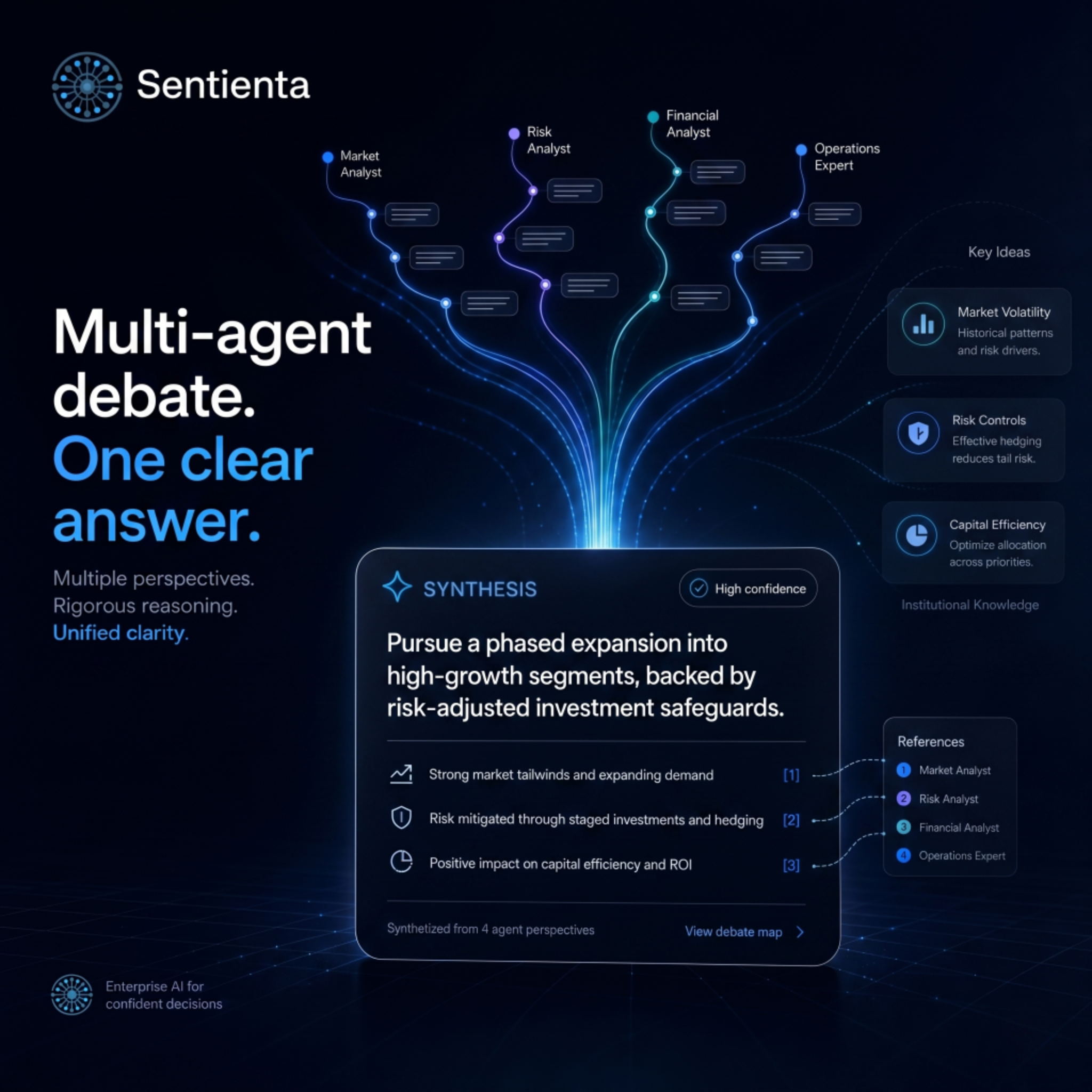
    That’s what Sentienta Home is built for. You ask one question. A structured debate happens. You get one answer, with the full reasoning behind it, accessible when you want it, invisible when you don’t.

    No team-building. No model selection. No prompt engineering. You start with the problem. Everything else is Sentienta’s job.

    Here’s what that actually looks like.

    One Question. A Team You Didn’t Have to Build.

    You asked one question. What came back wasn’t one answer, it was the result of a structured debate between specialists you never hired, configured, or knew you needed.

    That’s the first thing that feels different about Sentienta Home. The input is familiar: you type a question in plain language, the same way you would anywhere else. But what happens on the other side is not.

    Sentienta reads the complexity of what you asked and makes a decision for you. If it’s straightforward, such as “what’s the standard vesting schedule for a Series A hire?”, you get a direct answer. Fast, clear, done.

    But if your question carries real weight, with competing trade-offs, multiple stakeholders, judgment calls that depend on context you haven’t fully articulated, the system recognizes that. It assembles a team of specialized agents, each bringing a different lens to the problem, and initiates a structured debate. The result arrives as a single resolved position: not five opinions for you to reconcile, but one conclusion that survived challenge from multiple directions.

    You didn’t build that team. You didn’t know you needed it. You just asked a question worth asking.

    Why nothing else works this way:

    Today, when you ask a complex question in ChatGPT or Claude, you get one confident voice back. If the answer feels thin, and for hard questions, it usually does, your only option is to prompt again. “Now consider the opposite view.” “What am I missing?” “Play devil’s advocate.” You become the orchestrator of a debate the tool can’t hold on its own. The friction isn’t in typing your question — it’s in the follow-up labor required to get depth.

    Some chatbots get you sourced information, but they aggregate facts, not disagreement. When your question involves judgment and trade-offs rather than lookup, you hit a wall.

    And for the few who discover multi-agent frameworks, the developer tools that do let you run multiple AI perspectives, you don’t get to ask your question until you’ve built the thing that answers it. Define agents, assign roles, write system prompts. The question comes last. That’s a technical skill gate standing between you and the multi-perspective reasoning you actually wanted.

    Home removes all of that. The complexity of assembling the right team, running the debate, and resolving it into something clear is the system’s job. Your job is to have a question worth asking.

    And here’s the subtler thing that changes: when the tool can handle the hard version of your question, you stop pre-simplifying. You stop breaking complex problems into bite-sized prompts the AI can manage. You ask the real question — the one you’d ask if you had three smart people in a room who already understood your context. Home is built to deserve that question.

    Everything else follows from that.

    Watching a Team Think

    In ChatGPT, you go from your question to “Thinking”, and then to a wall of text. Eight hundred words arrive at once, undifferentiated, and now the cognitive work begins: parsing, prioritizing, figuring out what matters. The answer might be good, but you’re reading it cold. You have no framework for what’s important and what’s filler.

    Sentienta gives you that framework before the answer arrives.

    When your question triggers a multi-agent debate, you see status cards as the discussion unfolds. Each one is a conceptual landmark: “pricing risk identified,” “two agents disagree on timeline feasibility,” “convergence forming around option B.” They’re glanceable, not demanding. You absorb them the way you notice a colleague’s expression shift across the table.

    By the time the synthesis appears, you already know the shape of the problem. You know where the tensions lived. You know which angles were explored. The final answer doesn’t hit you as a wall of text requiring triage. It lands on scaffolding your mind already built.

    You never read the synthesis cold. That’s the difference.

    One Answer, Full Depth Behind It

    Here’s the contract Sentienta makes with you: you always read one thing first.

    Not five agent responses. Not a transcript of a debate. Not a choose-your-own-adventure menu of perspectives. One synthesis card: the conclusions, the recommendations, the trade-offs that matter most. Integrated, resolved, and readable in under two minutes.

    This matters because of what it’s not. It’s not a summary that says “Agent 1 argued for X while Agent 2 preferred Y.” That’s a meeting recap, not a conclusion. The synthesis card is an integrated position: it weighs the arguments, resolves the tensions, and tells you what survived scrutiny. It reads like the recommendation you’d get after a room full of experts argued it out on your behalf.

    The contrast with what you use today: In other frontier models, what you see is all there is. The response is the thinking. There’s nothing deeper behind it, no richer process that produced it. If the answer feels thin, that’s because it is thin. There’s no deeper layer to access.

    In Sentienta, the synthesis card sits on top of a full multi-agent debate. The depth is real and it’s there whenever you want it. Expand any section and you’re inside the deliberation: which agent pushed back, what counterargument was raised, how the final position earned its place. Collapse it and you’re back to the clean summary.

    This is the difference between a single take and a considered judgment. One is fast and uncontested. The other carries the weight of challenge, disagreement, and resolution. You get the resolution first. The challenge is always one click away.

    Verify Anything

    Every claim in a synthesis card is footnoted. Not as decoration. As a promise.

    Click any footnote and you land directly on the passage in the agent debate where that claim was argued, challenged, or substantiated. No scrolling through a transcript. No hunting for “which agent said that?” You go straight to the moment in the deliberation where the work happened.

    Why this exists: The synthesis card gives you a resolved position. But “resolved” doesn’t mean “take my word for it.” Enterprise teams making real decisions need provenance. When the synthesis says “the regulatory risk is manageable if you file before Q3,” someone at the table will ask: who argued that? What was the counterargument? How strong was it? Footnotes answer all three questions in one click.

    The contrast: With single model chat bots, if an answer makes a claim you want to verify, your only option is to ask a follow-up: “Why do you say that? What’s your reasoning?” You’re interrogating the model after the fact, hoping it can reconstruct its own logic. Often it can’t. It confabulates a justification that may or may not reflect how it actually arrived at the statement.

    In Sentienta, the reasoning already exists. It was produced in real time by agents who argued, pushed back, and resolved. The footnote doesn’t ask the system to explain itself. It points you to the actual work. The difference is the same as asking a colleague “why did you recommend this?” versus reading the analysis they wrote before the meeting. One is reconstruction. The other is the record.

    This is how you move from “I got an AI answer” to “I can defend this recommendation in a room.” Not because you blindly trust the system, but because you verified the parts that matter to you, in thirty seconds, without reading everything.

    The system doesn’t ask for your trust. It shows you how to check.

    Your AI Develops Institutional Knowledge

    Every AI tool now has memory. ChatGPT remembers things about you. Claude retains context across sessions. But here’s the problem: you can’t see what they remember. You can’t know which assumptions they’re silently applying to your current question. You can’t edit or retire conclusions that are no longer true. The memory is real, but it’s opaque. It works on you rather than with you.

    Sentienta agents have that kind of memory too. But the system does something additional: it derives Key Ideas from your deliberations. These are conceptual anchors, the meta-level themes and recurring principles that emerge as you work through complex problems. Think of them as what you’d get if you asked: “What are the key themes running through everything we’ve discussed today?”

    Key Ideas aren’t slow to develop. You don’t need days of history. Start a new problem in the morning, work through several related questions, and within hours the system identifies the principles that keep surfacing: “margin preservation matters more than growth rate,” “the compliance window closes in Q3,” “the team has rejected subscription pricing twice for specific reasons.” These emerge as soon as the pattern is evident, not after some arbitrary accumulation period.

    Here’s what makes them different from hidden memory: Key Ideas are visible, editable, and collaborative. They appear in your workspace. You can see exactly what the system considers established. You can confirm them, refine them, challenge them, or retire ones that no longer apply.

    When you ask a new question, relevant Key Ideas inform the debate. The agents don’t re-derive your strategic positions from scratch. But you always know which Key Ideas are active, because they’re right there. No silent assumptions. No wondering what the AI “thinks it knows” about you.

    The shift: Other tools accumulate knowledge about you invisibly and apply it without asking. Sentienta accumulates knowledge with you explicitly and applies it transparently. One is convenient but unaccountable. The other gives you a shared, evolving understanding you can inspect and govern.

    The value compounds fast. Every deliberation sharpens the system’s grasp of what your team has already resolved, and every Key Idea it surfaces gives you the chance to confirm or correct that understanding. We’ll go deeper on how you manage Key Ideas in a future post.

    What This Means for You

    Sentienta Home gives you four things no other tool combines:

    Multi-agent debate without configuration. You don’t define agents, assign roles, or write system prompts. You ask your question. The system decides what expertise the problem demands and assembles it.

    Multi-agent debate without the cognitive load of reading it. The debate happens. You get the resolved conclusion. You never have to read five competing perspectives and figure out which one wins.

    Synthesis fully referenced into the deliberation. Every claim in the synthesis is footnoted back to the exact moment in the debate where it was argued and tested. You verify what matters to you in seconds.

    Key Ideas that anchor the larger discussion. As themes and principles emerge across your work, the system surfaces them explicitly. Visible, editable, accountable. They carry forward into future questions so the system builds on what you’ve already resolved rather than starting fresh.

    These are not separate features. They are one integrated experience designed to make hard problems easier to solve and less expensive to think through. Sentienta absorbs the complexity so you can stay focused on the decision.

    Try it. Go to sentienta.ai. Ask something your team is actually working through. Watch the status cards. Read the synthesis. Click a footnote. Come back tomorrow and ask the next question.

    Next in this series: what happens when you want to keep that thinking alive, invite your team in, and let the context grow across people. That’s a different kind of product. We’ll show you what it looks like.

  • Sentienta + OpenClaw: Connecting Team Intelligence to the Desktop Ecosystem

    Sentienta has already redefined how teams of agents research, analyze, and reason through complex problems.
    With our latest release, those teams can now carry that work all the way through to completion.

    By integrating OpenClaw, Sentienta Teams can recruit specialized third-party agents to execute tasks directly in owner-controlled desktop environments—turning high-level strategy into finished, usable outputs without leaving the workflow.

    The Power of an Open Ecosystem

    This release isn’t just about a new feature—it changes how Sentienta grows.

    Sentienta’s strength has always been orchestration. With OpenClaw, that orchestration now extends to a rapidly evolving ecosystem of external agents.

    Whether it’s a dedicated web researcher or a document automation specialist, if it speaks OpenClaw, it can join your Sentienta Team.

    This means Sentienta can draw on a broader developer community building new agents, tools, and workflows—each of which can be brought directly into a team.

    As that ecosystem evolves, so does what Sentienta Teams can do.

    The Integrated Operational Workspace

    To support this shift, we’ve redesigned the Sentienta workspace to keep team configuration, monitoring, and outputs tightly integrated with the live workflow.

    • New Team Studio
      Manage agents and teams directly from the main workspace. Create agents, edit team compositions, and access the Agent Marketplace without losing session context.
    • Session Assist
      A persistent right-hand workspace for real-time coordination.
    • Team Artifacts
      Automatically summarizes findings and preserves structured outputs.
    • Pinned Ideas
      Keeps core requirements and decisions visible throughout the session.
    • The Monitor
      Provides operational visibility into agent activity and OpenClaw task states, so execution can be tracked alongside reasoning.

    End-to-End Example: The Strategic Acquisition Screen

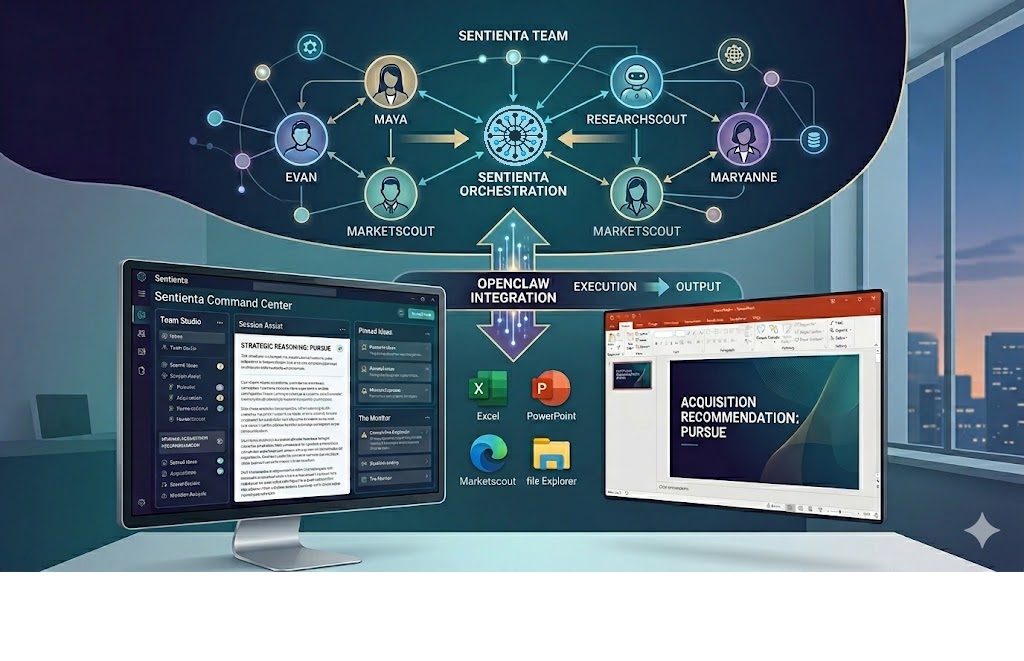
    To illustrate this model, we ran a full acquisition analysis workflow end-to-end using a Sentienta Team.

    Sentienta agents handled the strategic reasoning. OpenClaw agents operated in parallel to gather external data and produce final outputs.

    The result was not just analysis—it was a complete, decision-ready deliverable.

    • Parallel Execution
      ResearchScout and MarketScout (OpenClaw) gathered external intelligence while the rest of the team progressed in parallel.
    • Native Synthesis
      Maya and Evan (Sentienta) transformed that data into a clear “Pursue” recommendation with supporting rationale.
    • Direct Output
      MaryAnne (OpenClaw) converted that decision into a board-ready PowerPoint, returning the .pptx and slide images directly into the session.

    This is the key shift: work doesn’t stop at insight—it continues until it becomes executable artifacts.

    Secure, Owner-Controlled Action

    Execution happens within your environment.

    OpenClaw agents run inside your security perimeter, ensuring that as teams move from reasoning to output, your data remains fully under your control.

    From Insight to Outcome

    Sentienta remains the place where agent teams solve complex problems.

    Now, it is also the place where those solutions are carried through to completion.

    Not separate tools.
    Not disconnected steps.

    One system—from reasoning to result.

  • Beyond Chat: How OpenClaw and Sentienta Operationalize Multi‑Agent Work

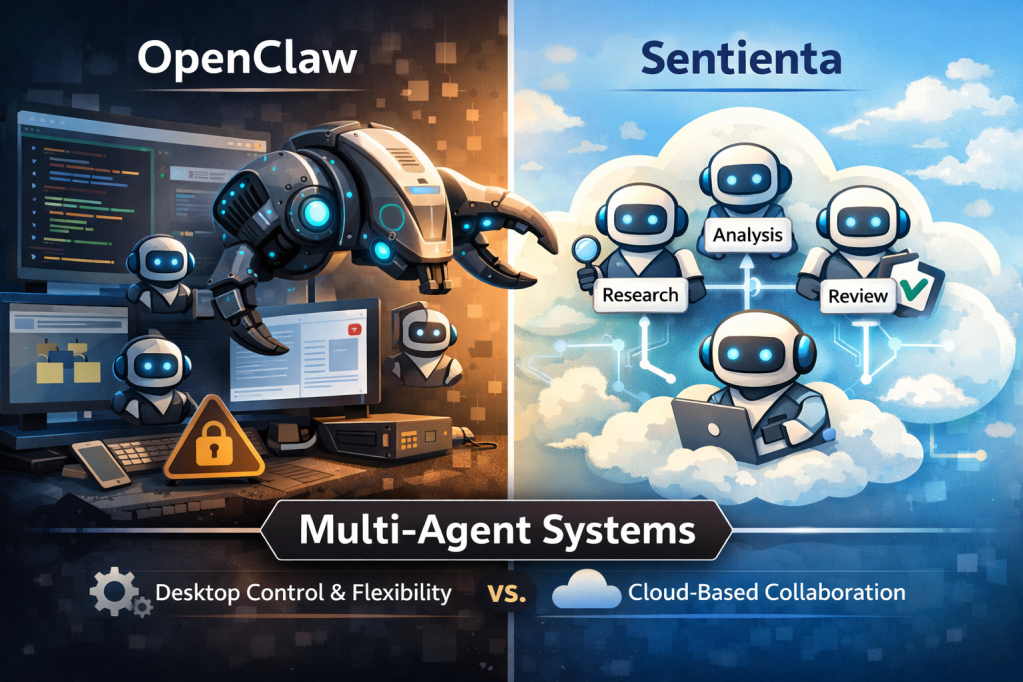
    OpenClaw is having a moment—and it’s easy to see why. In the developer community, “desktop agents” have become the newest proving ground for what AI can do when it’s allowed to take real actions: browsing, editing, running commands, coordinating tasks, and chaining workflows together. OpenClaw taps directly into that excitement: it’s open, fast-moving, and built for people who want to experiment, extend, and orchestrate agents with minimal constraints.

    At the same time, a different kind of question is showing up from business teams and Sentienta users: How does this compare to what we’re already doing in Sentienta? Not as a “which is better” culture-war, but as a practical evaluation: what’s the right platform for the kind of work we need to ship reliably?

    The most interesting part is that both worlds are converging on the same core insight: a single, standalone LLM is rarely the best operating model for real work. The trend is clearly moving toward teams of interacting agents, specialists that can collaborate, review each other’s work, and stay aligned in a shared context. In other words, the wider market is starting to validate a pattern Sentienta has been demonstrating for business outcomes for over a year: multi-agent dialog as the unit of work.

    In this post we’ll look at what OpenClaw is (and who it’s best for), then quickly re-ground what Sentienta is designed to do for business users. Finally, we’ll cover the operational tradeoffs, especially the security and governance realities that come with high-permission desktop agents and open extension ecosystems, so you can pick the approach that matches your needs for simplicity, security, and power.

    What OpenClaw is (and who it’s for)

    OpenClaw is best understood as an open ecosystem for building and running desktop agents – agents that live close to where work actually happens: your browser, your files, your terminal, and the everyday apps people use to get things done. Instead of being a single “one size fits all” assistant, OpenClaw is designed to be extended. Much of its momentum comes from a growing universe of third‑party skills/plugins that let agents take on new capabilities quickly, plus an emerging set of orchestration tools that make it easier to run multiple agents, track tasks, and coordinate workflows.

    That design naturally attracts a specific audience. Today, the strongest pull is among developers and tinkerers who want full control over behavior, tooling, and integrations, and who are comfortable treating agent operations as an engineering surface area. It also resonates with security-savvy teams who want to experiment with high-powered agent workflows, but are willing to own the operational requirements that come with it: environment isolation, permission discipline, plugin vetting, and ongoing maintenance as the ecosystem evolves.

    And that’s also why it’s exciting. OpenClaw is moving fast, and open ecosystems tend to compound: new skills appear, patterns get shared, and capabilities jump forward in days instead of quarters. Combine that pace with local-machine reach (the ability to work directly with desktop context) and you get a platform that feels unusually powerful for prototyping—especially for people who care more about flexibility and speed than a fully managed, “default-safe” operating model.

    It is worth noting the recent coverage that suggests OpenClaw’s rapid rise is being matched by very real security scrutiny: Bloomberg notes its security is work in progress, Business Insider has described hackers accessing private data in under 3 minutes, and noted researcher Gary Marcus has called it a “disaster waiting to happen“.

    A big part of the risk profile is architectural: desktop agents can be granted broad access to a user’s environment, so when something goes wrong (a vulnerable component, a malicious plugin/skill, or a successful hijack), the potential blast radius can be much larger than a typical “chat-only” assistant. Not all implementations have this risk, but misconfiguration can lead to an instance being exposed to the internet without proper authentication—effectively giving an attacker a path to the same high‑privilege access the agent has (files, sessions, and tools), turning a useful assistant into a fast route to data leakage or account compromise.

    How Does OpenClaw Compare to Sentienta?

    Sentienta is a cloud-based multi-agent platform built for business workflows, where the “unit of work” isn’t a single assistant in a single thread, but a team of agents collaborating in a shared dialog. In practice, that means you can assign clear roles (research, analysis, writing, checking, ops), keep everyone grounded in the same context, and run repeatable workflows without turning day-to-day operations into an engineering project.

    It’s worth emphasizing that OpenClaw and Sentienta are aligned on a key idea: multi-agent collaboration is where real leverage shows up. Both approaches lean into specialization: having distinct agents act as a researcher, analyst, reviewer, or operator, because it’s a practical way to improve quality, catch mistakes earlier, and produce outputs that hold up better under real business constraints.

    Where they differ is less about “who has the better idea” and more about how that idea is operationalized:

    Where agents run: OpenClaw commonly runs agents on the desktop, close to local apps and local context. Sentienta agents run in the cloud, which changes the default boundary: when local data is involved, it’s typically handled through explicit user upload (rather than agents broadly operating across a machine by default).

    Time-to-value: OpenClaw is naturally attractive to builders who want maximum flexibility and are comfortable iterating on tooling. Sentienta is designed to get business teams to a working baseline quickly: Quick Start is meant to spin up a functional team of agents in seconds, with minimal developer setup for typical use.

    Collaboration model: Sentienta’s multi-agent orchestration is native to the platform: agents collaborate as a team in the same dialog with roles and review loops designed in from the start. OpenClaw can orchestrate multiple agents as well, but its ecosystem often relies on add-ons and surrounding layers for how agents “meet,” coordinate, and share context at scale.

    Net: OpenClaw highlights what’s possible when desktop agents and open ecosystems move fast; Sentienta focuses on making multi-agent work repeatable, approachable, and business-ready, without losing the benefits that made multi-agent collaboration compelling in the first place.

    Conclusion

    The bigger takeaway here is that we’re leaving the era of “one prompt, one model, one answer” and entering a world where teams of agents do the work: specialists that can research, execute, review, and refine together. OpenClaw is an exciting proof point for that future—especially for developers who want maximum flexibility and don’t mind owning the operational details that come with desktop-level capability.

    For business teams, the decision is less about ideology and more about fit. If you need rapid experimentation, deep local-machine reach, and you have the security maturity to sandbox, vet plugins, and continuously monitor an open ecosystem, OpenClaw can be a powerful choice. If you need multi-agent collaboration that’s designed to be repeatable, approachable, and governed by default—with agents running in the cloud and local data crossing the boundary only when a user explicitly provides it—Sentienta is built for that operating model.

    Either way, the direction is clear: AI is moving from standalone assistants to operational systems of collaborating agents. The right platform is the one that matches your needs for simplicity, security, and power—not just in a demo, but in the way your team will run it every day.