Tag: AI Governance

  • Sentienta Connected Services

    Giving Every Agent the Access Its Role Requires
    A cross-functional team may work together on the same problem, but that does not mean every person, or every agent, should have access to the same information.

    As agents become part of everyday work, organizations are unlikely to rely on one universal assistant that knows everything and can access everything. Legal, engineering, sales, finance, and HR each work from different systems, different obligations, and different kinds of evidence.

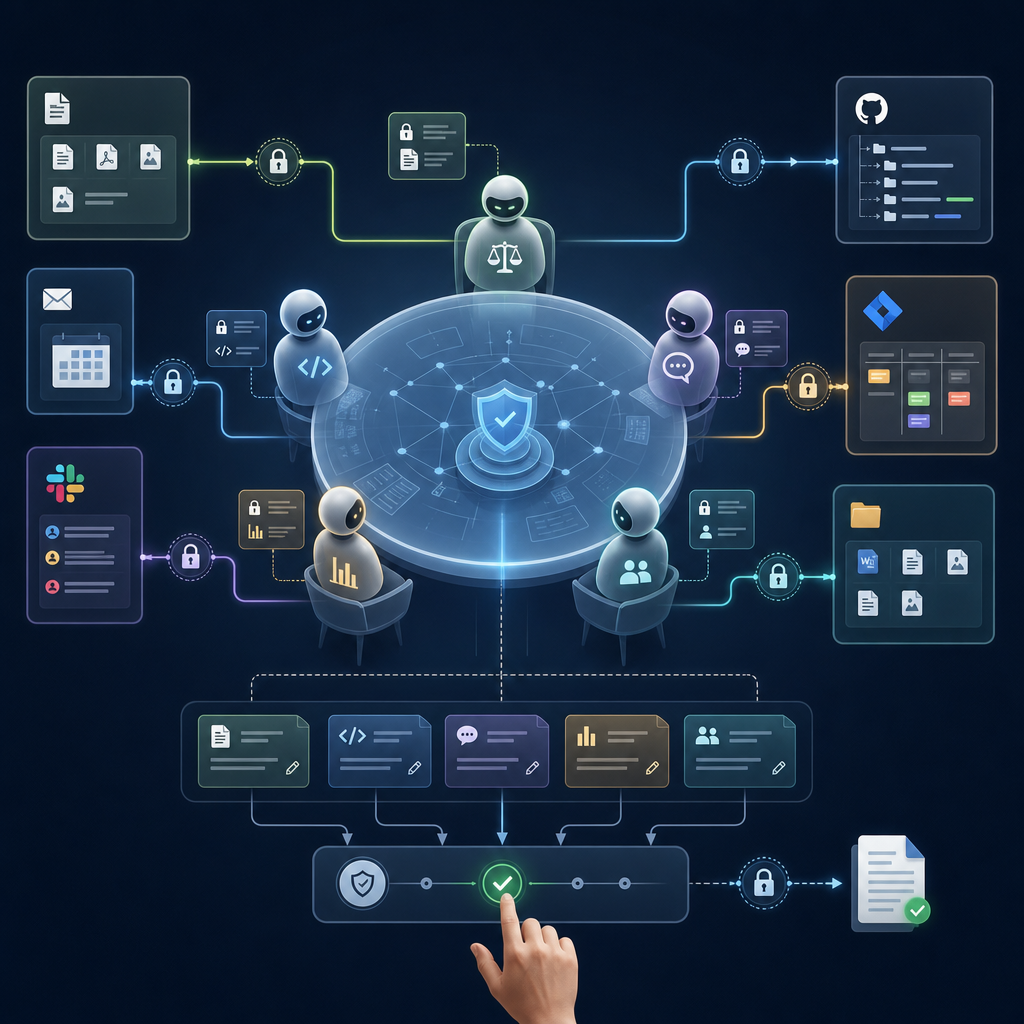
    Connected Services are Sentienta’s answer to that problem. They let users authorize agents to work with the systems where team knowledge already lives, including Google Drive, Gmail, Google Calendar, Slack, GitHub, Jira, and local resources through Sentienta Bridge, without turning that access into a universal permission for every agent in the Workroom.

    In Enterprise AI Needs a Governance Layer, we argued that agent governance begins with access: which agents can reach which organizational systems? In How Sentienta Governs Agent Actions, we described the governed path from a request to an external action.

    Connected Services put those ideas into practice. They allow teams to bring specialist agents and their knowledge sources into a shared Workroom while preserving boundaries around information, authority, and action.

    Access Should Follow Responsibility

    Connected Services let users authorize Sentienta to connect with the systems where their work already lives. The cloud services use supported authorization flows and service APIs. Sentienta Bridge provides a governed path to locally available capabilities such as OpenClaw and selected files.

    Connecting a service does not mean every agent gains access to it. Sentienta treats service access as an agent capability, not as a universal capability of the platform. A user connects a service and then determines which agents may use the relevant capabilities.

    For example, a legal agent might be enabled to access contracts in Google Drive, while an engineering agent is enabled to access GitHub and Jira. An HR agent may need personnel documents and scheduling information. These agents can participate in the same organization without inheriting one another’s access.

    This is a basic governance principle: access should follow responsibility. An agent should receive the capabilities required for its work without automatically inheriting access to every system its user or organization has connected.

    That makes the agent’s role easier to understand and limits the consequences of an incorrect request, an overly broad interpretation, or the accidental use of sensitive information outside its intended context.

    Collaboration Without Erasing Boundaries

    A Sentienta Workroom gives people and agents a shared place to work on a problem, project, or decision.

    Each agent can participate with its own instructions, context, enabled services, permitted operations, and approval requirements. Agents can respond to one another and contribute to the same discussion while their underlying service access remains separately governed.

    This distinction becomes especially important when an agent retrieves private information.

    Information retrieved from a user’s connected service is returned in a Private Workroom card. It is not automatically visible to other participants, other agents, or outside collaborators. The user can review the result and decide what, if anything, should be shared with the Workroom.

    The team can therefore share a relevant conclusion without exposing every contract, email, issue, file, or record that contributed to it.

    Consider a company deciding whether to make a significant product commitment to a customer.

    The Workroom includes agents representing sales, legal, engineering, and finance, along with the managers responsible for the decision. Sales can explain what the customer requested. Legal can clarify what the contract permits. Engineering can assess product readiness and implementation risk. Finance can describe the applicable budget constraint.

    Each contribution is informed by the systems suited to that role. The participants can compare their findings and reach a coordinated judgment without opening every underlying source to everyone in the Workroom.

    From Governed Access to Coordinated Action

    Connected Services do more than help agents retrieve information. They also allow the Workroom team to prepare and carry out follow-up work in the systems where that work belongs.

    In the customer commitment example, the engineering agent might review GitHub activity and related Jira issues. The legal agent might locate the applicable contract language in Drive. The sales agent might review customer correspondence and prepare a follow-up message. A project coordinator might prepare a meeting, while a communications agent prepares a summary for Slack.

    These are not necessarily the capabilities of one universal agent. Work is directed to the agent whose role and service permissions match the request. One agent may have several capabilities when its assignment requires them, but access is granted deliberately rather than assumed.

    The interaction remains natural. A user can ask Engineering whether a correction was deployed, ask Legal to find a contract provision, or ask the project coordinator to prepare a follow-up meeting. The appropriate agent uses its enabled services to retrieve information or prepare the requested action.

    Retrieval and analysis do not automatically authorize an external change.

    When a proposed action would send, post, create, update, or delete information, Sentienta can require the user to review what will change, which service and destination will be used, and which agent prepared the action.

    Approval applies to the proposed operation. It is not blanket authorization for unrelated future activity.

    The result is a layered governance path:

    1. The user authorizes a service connection.
    2. The user enables specific capabilities for specific agents.
    3. The user selects the agents participating in the Workroom.
    4. Each agent contributes from its permitted information sources.
    5. Retrieved private information remains private unless the user shares it.
    6. Consequential actions are handled according to the applicable authority and approval policy.
    7. The activity and outcome remain part of the operational record.

    Each layer answers a different governance question. Together, they allow a team to move from distributed evidence to a coordinated decision and then to accountable action.

    Governance Makes Greater Capability Possible

    Connected Services provide immediate practical value. They let Sentienta agents work with documents, communications, schedules, repositories, issues, and local resources without requiring users to carry information manually in and out of a chat window.

    Their larger importance, however, is how they prepare for a world of specialist agents.

    As departments develop agents around their own responsibilities and knowledge, those agents will need to collaborate across organizational boundaries. Collaboration cannot mean giving every agent access to every system. It must preserve meaningful distinctions among roles, information, and authority.

    Sentienta Workrooms provide the shared environment for that collaboration. Connected Services give individual agents bounded access to the knowledge and tools their work requires. Private cards support selective disclosure. Approval controls govern consequential actions.

    Governance is therefore not a restriction added after an agent has been made powerful. It is the structure that allows organizations to give agents meaningful capabilities safely.

    The future is not one agent with all of the company’s knowledge. It is a governed team of people and agents, each contributing the knowledge and capabilities appropriate to its responsibility.

  • How Sentienta Governs Agent Actions

    From governance principle to governance path

    Sentienta Governance

    A few weeks ago, we argued that enterprise AI needs a governance layer.

    That does not mean slowing adoption with more process. It means recognizing that AI is moving beyond individual experimentation. Employees are no longer using models only to summarize, draft, and analyze. They are beginning to work with agents that retrieve information, use tools, trigger workflows, post messages, create issues, and interact with the systems where company work happens.

    Once agents can act, governance becomes an operational question.

    It is no longer enough to ask whether a model produced a good answer. Organizations must also ask:

    • Was the agent authorized to use the service?
    • Was the requested action permitted?
    • Did it require human approval?
    • Which identity and credentials were used?
    • What happened when the action ran?
    • What record was preserved afterward?

    Over the past several weeks, we have introduced the capabilities announced with Sentienta V2, including collaborative Workrooms, governed agents, and controlled execution.

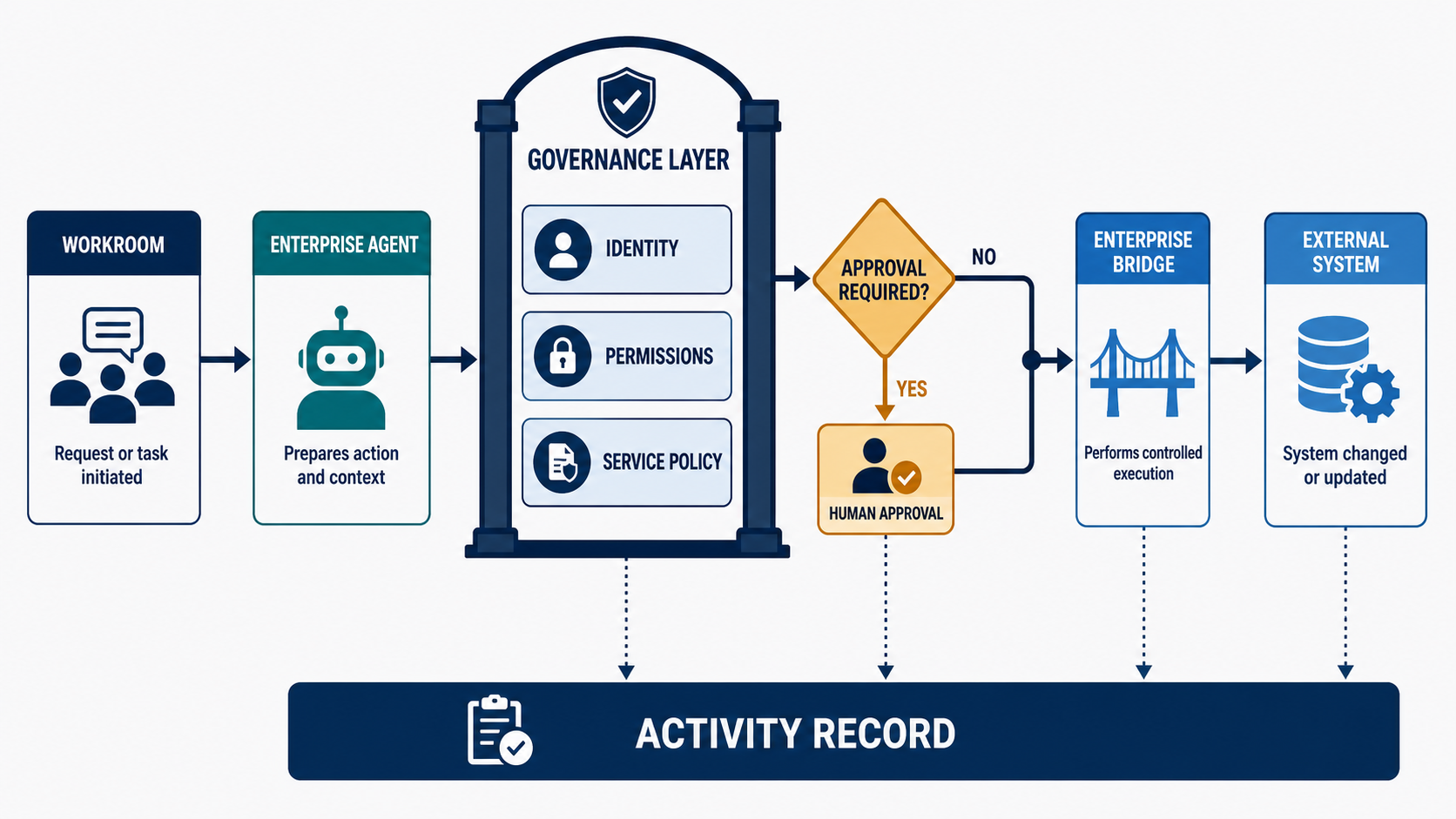
    This post looks at how those pieces work together. Agent work begins in a permissioned Workroom, moves through approved capabilities and controlled connections, pauses for human review when required, and leaves an activity record behind.

    The principle is straightforward: governance should not exist only in policy documents, administrative settings, or after-the-fact reviews. It should be built into how agent work is requested, authorized, executed, and recorded.

    That is what allows agents to move beyond conversation and participate safely in real organizational work.

    How Sentienta puts governance into the path of agent work

    Sentienta treats governance as part of the workflow—not as a policy document applied after the fact. Controls appear where work is requested, delegated, authorized, executed, and recorded.

    1. Workrooms establish the governed context

    A Workroom is more than a shared conversation. It provides the operating context for collaboration among people and agents: who is participating, which agents are present, who initiated a request, and who is permitted to manage or stop the work.

    Workroom permissions control who can join, contribute, invite participants, manage agents, and halt an active run. These controls establish the context used by Sentienta’s backend when it evaluates an agent request.

    Importantly, sharing a Workroom does not share a participant’s credentials, files, device access, or private services. Collaboration and authorization remain separate.

    2. Enterprise Agents turn individual experiments into organizational capabilities

    Many organizations begin using AI through individual experimentation. Employees create assistants, connect tools, and develop useful workflows—but the resulting capabilities may be difficult for the organization to understand, manage, or reproduce.

    Enterprise Agents provide a different model. They are organizational capabilities that can be made available to authorized users and Workrooms. Managers and teams can use approved agents without having to build and configure their own versions.

    This allows organizations to decide:

    • which Enterprise Agents are available
    • who may use and administer them
    • which services they may access
    • which execution environments they may use
    • and how their work is reviewed and recorded

    Enterprise Agents therefore turn agent capability from an individual configuration into a managed organizational resource.

    3. Roles and permissions separate use from administration

    Governance also requires control over who can configure the system. Sentienta distinguishes organization owners, administrators, and members.

    Owners and administrators manage organizational membership, Enterprise Agents, available services, and service policies. Members can use the capabilities made available to them without automatically gaining the ability to modify those capabilities or their underlying connections.

    This separation allows an organization to delegate useful agent capabilities broadly while keeping configuration and administrative authority appropriately limited.

    4. Brokered services mediate access to external systems

    When an agent needs to reach an external tool or organization-controlled system, Sentienta can place a governed service layer between the agent’s request and execution.

    The important question is not simply whether an agent can connect to a tool. It is whether the organization can control:

    • which services are available
    • which roles and agents may use them
    • which operations are permitted
    • where credentials remain
    • whether an action requires approval
    • and what activity is recorded afterward

    Permissions can distinguish among operations such as reading information, creating something new, updating an existing resource, sending a message, or deleting data. This avoids treating “access to a service” as a single all-or-nothing permission.

    5. The Enterprise Bridge creates a controlled execution boundary

    Some agent work must run in an environment controlled by the organization, for example, when it involves a private network, managed automation host, customer-held credential, internal service, or organization-operated connector.

    The Enterprise Bridge provides that execution boundary. It can advertise approved capabilities, receive authorized work, execute through controlled service connections, and return results to the Workroom.

    Credentials remain in the appropriate environment rather than being placed in an agent prompt or exposed to Workroom participants. If the required Bridge or service is unavailable, Sentienta can fail the request safely instead of silently choosing another user’s device, credentials, or connection.

    This creates a practical middle ground between powerless chatbots and unmanaged automation: agents can perform useful work, but execution follows a controlled organizational path.

    6. Approval gates preserve human control

    Not every agent contribution needs approval. Research, analysis, comparison, summarization, and drafting should remain fluid.

    Consequential actions are different. When an agent is preparing to change external state, such as posting information, creating a record, modifying a resource, or triggering another process, the applicable policy can require human approval before execution.

    The agent can prepare the proposed action and present it for review. An authorized person can approve or reject it before the external change occurs. This supports meaningful delegation without requiring the organization to accept unrestricted automation.

    7. Activity records make agent work reviewable

    A transcript shows what people and agents said, but governance also requires visibility into what the system did.

    Sentienta’s Activity records provide structured operational information about a run: the request, participating agents, important execution stages, service activity, approval events, outcomes, and failures. Enterprise governance records provide additional visibility into governed service actions and approval decisions.

    These records help managers understand how work progressed and investigate problems without presenting the transcript itself as a complete forensic audit.

    What this looks like in practice: posting a Slack update

    Imagine a product team using a Sentienta Workroom to coordinate a customer rollout. After resolving the open questions and agreeing on next steps, the manager wants to send a concise update to an internal Slack channel.

    An Enterprise Agent can summarize the discussion and draft the message. The governance question is what must happen before that message reaches Slack.

    1. The request begins in a Workroom

    The request starts where the team is already collaborating. The Workroom provides important context: who made the request, which Enterprise Agent is participating, what discussion led to the update, and who is permitted to manage the work.

    Workroom access does not automatically grant Slack access. It establishes the collaboration context that Sentienta carries into the authorization process.

    2. The Enterprise Agent prepares the action

    The manager asks the Enterprise Agent to draft an update. The agent reviews the relevant discussion, identifies the decisions and next steps, and prepares a proposed Slack message.

    Nothing has been posted yet. Drafting creates content inside the Workroom. Posting changes an external system, so it can be governed separately.

    3. Sentienta checks the service policy

    Before execution, Sentienta checks whether the organization has made Slack available through its governed service configuration.

    The system can evaluate whether:

    • the requester is an active organization member
    • the Enterprise Agent is allowed to use the service
    • the requester’s role permits the operation
    • the requested Slack channel is configured and allowed
    • and posting requires human approval

    The existence of a Slack connection is not enough. The specific agent, user, action, and destination must be permitted.

    4. An authorized person approves the post

    If policy requires approval, Sentienta pauses the action and presents the proposed message for review.

    The manager can confirm the content and destination, then approve or reject the request. If changes are needed, the request can be rejected and returned for revision. The external action occurs only after the required approval has been recorded.

    5. The Enterprise Bridge executes the approved action

    Once approved, the request is sent through the Enterprise Bridge. The Bridge uses the organization’s governed Slack connection, posts the approved message, and returns the result.

    Slack credentials remain in the controlled execution environment. They are not placed in the agent prompt, exposed in the Workroom transcript, or shared with participants.

    If the Bridge, service connection, or permitted destination is unavailable, the request fails safely rather than switching to an unmanaged connection.

    6. Governance activity records the outcome

    Sentienta records the relevant operational events, including the requested action, service and destination, approval decision, execution outcome, and any failure.

    The Workroom preserves the discussion that produced the update. The governance activity shows how the proposed action moved from drafting through authorization and execution.

    In an unmanaged workflow, “an agent posts to Slack” is merely a convenience feature. In a governed workflow, the agent accelerates the task while the organization retains control over authorization, approval, credentials, execution, and review.

    Agent actions do not bypass governance. They travel through it.

    Conclusion: managing agents that act

    The next era of enterprise AI is not only about producing better answers. It is about agents that can retrieve information, post updates, create records, trigger workflows, and interact with the systems where work happens.

    That creates a new management challenge. Organizations need to know which agents are trusted, which services they can use, what actions they may take, when human approval is required, how credentials are protected, and what record remains afterward.

    The goal is not to slow agents down. It is to give them a safe and accountable path from request to action.

    Agents will become useful at organizational scale only when companies can trust what happens beyond the chat window. Sentienta makes that work governed, visible, and manageable while still allowing people and agents to move quickly.

  • Enterprise AI Needs a Governance Layer

    Employees are no longer just chatting with AI models. They are beginning to work with agents that can act: connecting to services, operating browsers, reading documents, searching repositories, calling APIs, and using MCP* tools tied to external systems. Some can draft, retrieve, send, modify, or create information across the same systems where real company work happens.

    A chatbot answers a question. An agent participates in work. That is a meaningful shift, and it creates a governance problem that most organizations are only beginning to confront.

    The Access Problem

    Every employee needs powerful AI agents to do their work, but their needs differ.

    An engineer needs Slack and GitHub access through their agent. They don’t need access to the file server hosting IP documents and contracts. Legal needs that file server, but not GitHub. HR needs employee records on a company server, but not customer contracts. A DevOps lead may need write access to production infrastructure but a product manager does not.

    The access each person requires depends on their role, and the agents acting on their behalf should inherit exactly those boundaries and nothing more. Today, many companies face the opposite: a free-for-all of ungoverned agents operating with whatever access their users happen to have, or can reach through unmanaged local tools. No visibility. No boundaries. No institutional record of what happened.

    This is not a speculative concern. A January 2026 CIO report found that roughly half of employees are already using unsanctioned AI tools at work—with enterprise leaders themselves among the major culprits. And banning these tools does not solve the problem: a June 2026 study reported by TechRadar found that two in three office professionals used AI tools despite explicit policy restrictions. Prohibition drives usage underground; it does not eliminate the risk.

    Agents make company resources useful and employees more productive. But without a control plane, the organization has no reliable way to ensure that agent capabilities match role-appropriate access.

    Where Workrooms Change the Picture

    Last week we introduced Workrooms: shared spaces where cross-functional teams collaborate with AI agents around a problem, project, or decision. Workrooms are where the governance challenge becomes most visible.

    When Legal and Marketing both participate in the same Workroom, the agent Legal brings should carry different controls than the agent Marketing brings. Legal’s agent can reach contracts; Marketing’s cannot. Engineering’s agent can access the code repository; Legal’s cannot. The Workroom inherits each participant’s scoped permissions, so collaboration does not blow open access boundaries.

    This is where role-level governance meets team-level collaboration. A shared workspace must let people work together without silently granting every participant’s agent access to every other participant’s resources. The control plane has to follow the work into the room.

    How Sentienta Addresses This

    Sentienta provides the governance layer that lets teams bring powerful agents into shared workspaces while keeping access, actions, and accountability under enterprise control.

    Enterprise Admin is the control plane, giving organizations a centralized surface for managing enterprise membership, trusted domains, roles, and service access. This is not just a per-user settings page. It is the organizational layer where admins decide which AI capabilities and connected services are available to different roles.

    Admin-governed service access: Sentienta lets administrators decide which connected services are available to enterprise agents and who can configure them. Instead of every user running their own uncontrolled desktop agent, an organization can provide approved agents with approved capabilities: for example, one agent may be configured for GitHub and Slack, another for document-oriented local file access, and another for governed desktop automation. These controls are applied through enterprise roles, admin settings, and agent-level service configuration.

    Workroom-aware enterprise boundaries: Workrooms are shared spaces, so governance has to account for who is in the room. Enterprise-connected agents and services are governed by the Workroom context. If outside participants join a Workroom, enterprise agents are turned off by default unless explicitly approved. This prevents accidental exposure of enterprise capabilities to external collaborators.

    Agent execution targets and the Enterprise Bridge: Agents can be configured for different execution paths, including cloud models, desktop automation, and enterprise-hosted bridge services. The Enterprise Bridge is especially important for enterprise agents that run against company-managed infrastructure rather than an employee’s unmanaged device. It gives admins a controlled way to expose approved services, such as OpenClaw, MCP-based tools, or Local File Services, to approved agents. It also gives the organization a clearer audit trail for what agents attempted to do and which bridge handled the work. Instead of relying only on unmanaged local automation, the organization can provide powerful agents through infrastructure it owns and governs.

    Human approval for consequential actions: Reading, reasoning, summarizing, and drafting should remain fluid. But when an agent is about to send, publish, modify, merge, or otherwise change external state, Sentienta can require human approval before the action executes. This gives organizations a review point where it matters without adding friction to every interaction.

    MCP as a governed service surface: MCP-based tools can be powerful because they let agents reach external systems. In Sentienta, MCP services can be exposed as part of the governed service layer, where admins decide which services are available and which roles may use them.

    Activity records and auditability: Sentienta records agent activity, service use, approvals, and Workroom context so organizations have a record of how agents were used. This does not magically solve every security or compliance problem, but it gives enterprises visibility they do not get from unmanaged agents running independently across laptops and personal toolchains.

    Governance Enables Capability

    AI governance is not the opposite of powerful AI. Governance is what lets companies adopt powerful AI responsibly.

    Without a control layer, the rational organizational response is caution: restrict what agents can do, limit who can use them, or look away and hope nothing goes wrong. With a control layer, the organization can say yes: yes to service-connected agents, yes to desktop automation through approved infrastructure, yes to GitHub and Slack integrations, yes to MCP tools, yes to shared Workrooms where people and agents work together. But yes with appropriate permissions, layered scoping, approval where it matters, and a record of what happened.

    That is the governed path. Sentienta gives organizations the confidence to let teams use more capable agents in the places where real work happens.

    * MCP support is currently available through a limited beta. Availability, supported providers, tools, and setup procedures vary by account. Contact Sentienta for access.

  • The Control Collapse: How Open Models and Distributed Hosts Are Rewriting AI Risk

    In late 2025, we explored a provocative shift in AI development: full-stack openness, exemplified by Olmo 3, which grants users control over every stage of a model’s lifecycle, from training data to reward shaping. That evolution, we argued, dismantled traditional visibility boundaries and redistributed both creative power and liability. What we didn’t anticipate, at least not fully, was how fast the deployment landscape would unravel alongside it.

    New research from SentinelLabs reveals a second, equally disruptive force: the rapid decentralization of AI infrastructure via tools like Ollama. With little more than a configuration tweak, developer laptops and home servers have become persistent, public-facing AI endpoints that are fully tool-enabled, lightly secured, and difficult to trace centrally at scale.

    Together, these forces represent a fundamental shift: AI risk is no longer a function of model capability alone, it’s a question of where control lives and what surfaces remain governable. In this post, we chart how openness at both the model and infrastructure layer is collapsing traditional chokepoints, and what this means for security, compliance, and enterprise trust.

    A Risk Surface with No Chokepoints

    The evolving AI risk landscape isn’t defined by any one model or deployment choice, increasingly it’s defined by the disappearance of meaningful control boundaries across both. On one end, Olmo 3 marks a shift in model lifecycle transparency. Now individual developers and small teams don’t just have access to powerful models, they have a full recipe to build, customize, and reshape how those models learn, reason, and prioritize knowledge from the ground up. Complete ownership over data, training scripts, optimization paths, and reinforcement dynamics gives rise to deeply customized systems with few inherited safeguards and without centralized governance enforcement.

    On the infrastructure side, Ollama embodies simplicity: an open-source tool built to make running local LLMs effortless. But that ease of use cuts both ways. With one configuration change, a tool meant for small-scale development becomes a publicly exposed AI server. The SentinelLabs research found over 175,000 Ollama hosts reachable via the open internet, many from residential IPs. Critically, 48% of them support tool-calling APIs, meaning they can initiate actions, not just generate responses. This shifts their threat profile dramatically from passive risk to active execution surface, potentially transforming a lightweight dev utility, when misconfigured, into a sprawling and largely unmonitored edge network.

    Together, Olmo and Ollama illustrate a compounding risk dynamic: decentralized authorship meets decentralized execution. The former enables highly customized behavior with few inherited safeguards; the latter allows deployments that bypass traditional infrastructure checkpoints. Instead of a model governed by SaaS policies and API filtering, we now face a model built from scratch, hosted from a desktop, and callable by anyone on the internet.

    Based on these findings, this may represent an emerging baseline for decentralized deployment: the erosion of infrastructure chokepoints and the rise of AI systems that are both powerful and structurally ungoverned.

    Unbounded Risk: The Governance Gap

    The SentinelLabs report highlights what may be a structural gap in governance for locally deployed AI infrastructure. The risk isn’t that Ollama hosts are currently facilitating illegal uses, it’s that, in aggregate, they may form a substrate adversaries could exploit for untraceable compute. Unlike many proprietary LLM platforms, which enforce rate limits, conduct abuse monitoring, and maintain enforcement teams, Ollama deployments generally do not have these checks. This emerging pattern could unintentionally provide adversaries with access to distributed, low-cost compute resources.

    Where this becomes critical is in agency. Nearly half of public Ollama nodes support tool-calling, enabling models not only to generate content but to take actions: send requests, interact with APIs, trigger workflows. Combined with weak or missing access control, even basic prompt injection becomes high-severity: a well-crafted input can exploit Retrieval-Augmented Generation (RAG) setups, surfacing sensitive internal data through benign prompts like “list the project files” or “summarize the documentation.”

    What emerges is a decentralized compute layer vulnerable to misuse. Governance models built around centralized actors apply strict bounds:

    • Persistent accountability surfaces: audit logging, model instance IDs, traceable inference sessions.
    • Secured APIs by default: authenticated tool use, rate-limiting, and sandboxed interactions as first principles.
    • Shared oversight capacity: registries, configuration standards, and detection infrastructure spanning model hosts and dev platforms alike.

    Absent these guardrails, the open ecosystem may accelerate unattributed, distributed risks.

    What Needs to Change: Hard Questions in a Post-Control Ecosystem

    If anyone can build a model to bypass safeguards—and anyone can deploy it to hundreds of devices overnight—what exactly does governance mean?

    Two realities define the governance impasse we now face:

    1. Intentional risk creation is accessible by design.
    Open model development workflows give developers broad control over datasets, tuning objectives, and safety behavior, with no checkpoint for legality or malice. How do we govern actors that intend to remove rails, not accidentally stumble past them? What duty, if any do upstream hosts, model hubs, or toolmakers bear for enabling those pipelines?

    2. Exponential deployment has bypassed containment.
    When any machine becomes a public-facing inference node in moments, the result is an uncoordinated global mesh of potentially dangerous systems, each capable of interacting, escalating, or replicating threats. What governance model addresses scaling risk once it’s already in flight?

    These realities raise sharper questions current frameworks can’t yet answer:

    • Can creators be obligated to document foreseeable abuses, even if intention is misuse?
    • Should open-access pipelines include usage gating or audit registration for high-risk operations?
    • What technical tripwires could signal hostile deployment patterns across decentralized hosts?
    • Where do enforcement levers sit when both model intent and infrastructure control are externalized from traditional vendors and platforms?

    At this stage, effective governance may not mean prevention, it may mean building systemic reflexes: telemetry, alerts, shared signatures, and architectural defaults that assume risk, not deny it.

    The horse is out of the barn. Now the question is: do we build fences downstream, or keep relying on good behavior upstream?

    Conclusion: Accountability After Openness

    To be clear, neither Olmo nor Ollama are designed for malicious use. Both prioritize accessibility and developer empowerment. The risks described here emerge primarily from how open tools can be deployed in the wild, particularly when security controls are absent or misconfigured.

    This reflects systemic risk patterns observed in open ecosystems, not an assessment of any individual vendor’s intent or responsibility.

    The trajectory from Olmo 3 to Ollama reveals more than just new capabilities – it reveals a structural shift in how AI systems are built, deployed, and governed. Tools once confined to labs or private development contexts are now globalized by default. Creation has become composable, deployment frictionless, and with that, the traditional boundaries of accountability have dissolved.

    Olmo 3 democratizes access to model internals, a leap forward in transparency and trust-building. Ollama vastly simplifies running those models. These tools weren’t built to cause harm: Olmo 3 empowers creativity, Ollama simplifies access. But even well-intentioned progress can outpace its safeguards.

    As capabilities diffuse faster than controls, governance becomes everyone’s problem, and not just a regulatory one, but a design one. The challenge ahead isn’t to halt innovation, but to ensure it carries accountability wherever it goes.

    In this shifting landscape, one principle endures: whoever assumes power over an AI system must also hold a path to responsibility. Otherwise, we’re not just scaling intelligence, we’re scaling untraceable consequence. The time to decide how, and where, that responsibility lives is now.