Giving Every Agent the Access Its Role Requires
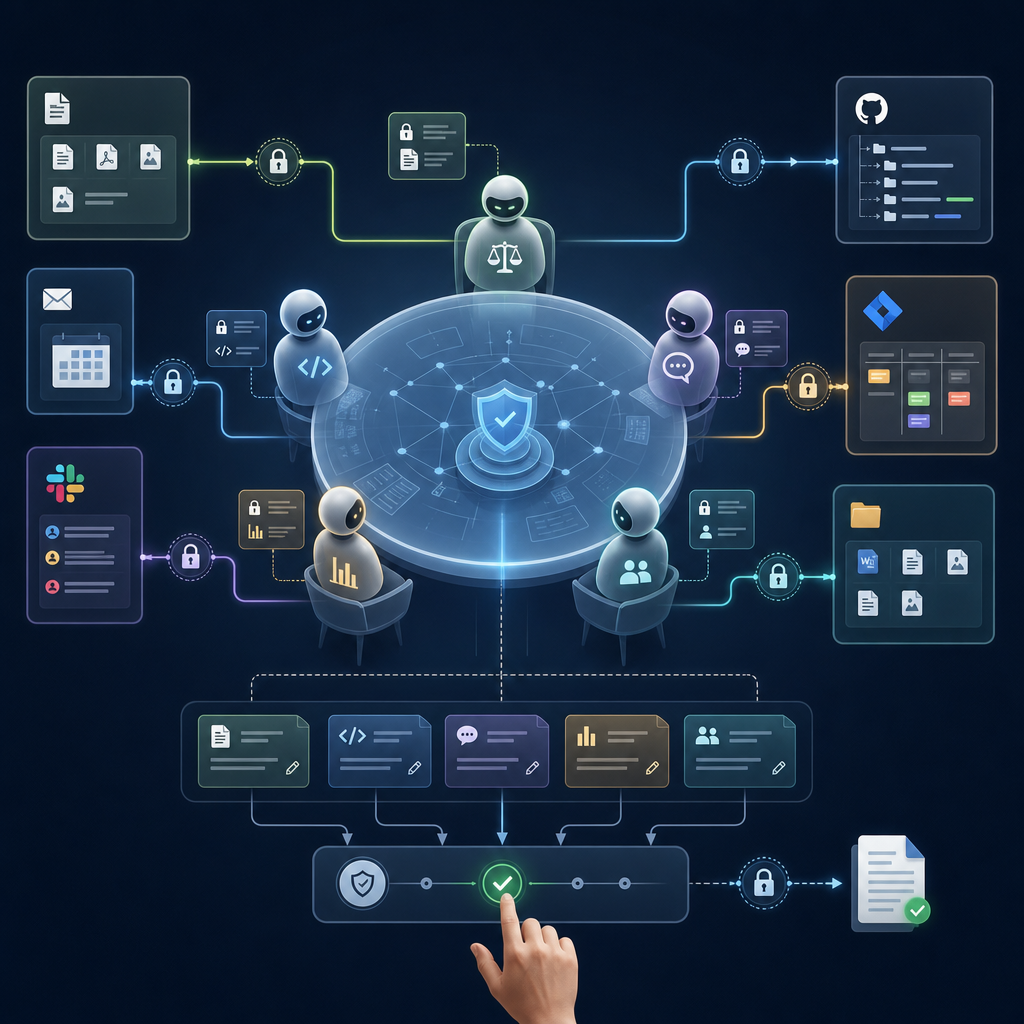
A cross-functional team may work together on the same problem, but that does not mean every person, or every agent, should have access to the same information.
As agents become part of everyday work, organizations are unlikely to rely on one universal assistant that knows everything and can access everything. Legal, engineering, sales, finance, and HR each work from different systems, different obligations, and different kinds of evidence.
Connected Services are Sentienta’s answer to that problem. They let users authorize agents to work with the systems where team knowledge already lives, including Google Drive, Gmail, Google Calendar, Slack, GitHub, Jira, and local resources through Sentienta Bridge, without turning that access into a universal permission for every agent in the Workroom.
In Enterprise AI Needs a Governance Layer, we argued that agent governance begins with access: which agents can reach which organizational systems? In How Sentienta Governs Agent Actions, we described the governed path from a request to an external action.
Connected Services put those ideas into practice. They allow teams to bring specialist agents and their knowledge sources into a shared Workroom while preserving boundaries around information, authority, and action.
Access Should Follow Responsibility
Connected Services let users authorize Sentienta to connect with the systems where their work already lives. The cloud services use supported authorization flows and service APIs. Sentienta Bridge provides a governed path to locally available capabilities such as OpenClaw and selected files.
Connecting a service does not mean every agent gains access to it. Sentienta treats service access as an agent capability, not as a universal capability of the platform. A user connects a service and then determines which agents may use the relevant capabilities.
For example, a legal agent might be enabled to access contracts in Google Drive, while an engineering agent is enabled to access GitHub and Jira. An HR agent may need personnel documents and scheduling information. These agents can participate in the same organization without inheriting one another’s access.
This is a basic governance principle: access should follow responsibility. An agent should receive the capabilities required for its work without automatically inheriting access to every system its user or organization has connected.
That makes the agent’s role easier to understand and limits the consequences of an incorrect request, an overly broad interpretation, or the accidental use of sensitive information outside its intended context.
Collaboration Without Erasing Boundaries
A Sentienta Workroom gives people and agents a shared place to work on a problem, project, or decision.
Each agent can participate with its own instructions, context, enabled services, permitted operations, and approval requirements. Agents can respond to one another and contribute to the same discussion while their underlying service access remains separately governed.
This distinction becomes especially important when an agent retrieves private information.
Information retrieved from a user’s connected service is returned in a Private Workroom card. It is not automatically visible to other participants, other agents, or outside collaborators. The user can review the result and decide what, if anything, should be shared with the Workroom.
The team can therefore share a relevant conclusion without exposing every contract, email, issue, file, or record that contributed to it.
Consider a company deciding whether to make a significant product commitment to a customer.
The Workroom includes agents representing sales, legal, engineering, and finance, along with the managers responsible for the decision. Sales can explain what the customer requested. Legal can clarify what the contract permits. Engineering can assess product readiness and implementation risk. Finance can describe the applicable budget constraint.
Each contribution is informed by the systems suited to that role. The participants can compare their findings and reach a coordinated judgment without opening every underlying source to everyone in the Workroom.
From Governed Access to Coordinated Action
Connected Services do more than help agents retrieve information. They also allow the Workroom team to prepare and carry out follow-up work in the systems where that work belongs.
In the customer commitment example, the engineering agent might review GitHub activity and related Jira issues. The legal agent might locate the applicable contract language in Drive. The sales agent might review customer correspondence and prepare a follow-up message. A project coordinator might prepare a meeting, while a communications agent prepares a summary for Slack.
These are not necessarily the capabilities of one universal agent. Work is directed to the agent whose role and service permissions match the request. One agent may have several capabilities when its assignment requires them, but access is granted deliberately rather than assumed.
The interaction remains natural. A user can ask Engineering whether a correction was deployed, ask Legal to find a contract provision, or ask the project coordinator to prepare a follow-up meeting. The appropriate agent uses its enabled services to retrieve information or prepare the requested action.
Retrieval and analysis do not automatically authorize an external change.
When a proposed action would send, post, create, update, or delete information, Sentienta can require the user to review what will change, which service and destination will be used, and which agent prepared the action.
Approval applies to the proposed operation. It is not blanket authorization for unrelated future activity.
The result is a layered governance path:
- The user authorizes a service connection.
- The user enables specific capabilities for specific agents.
- The user selects the agents participating in the Workroom.
- Each agent contributes from its permitted information sources.
- Retrieved private information remains private unless the user shares it.
- Consequential actions are handled according to the applicable authority and approval policy.
- The activity and outcome remain part of the operational record.
Each layer answers a different governance question. Together, they allow a team to move from distributed evidence to a coordinated decision and then to accountable action.
Governance Makes Greater Capability Possible
Connected Services provide immediate practical value. They let Sentienta agents work with documents, communications, schedules, repositories, issues, and local resources without requiring users to carry information manually in and out of a chat window.
Their larger importance, however, is how they prepare for a world of specialist agents.
As departments develop agents around their own responsibilities and knowledge, those agents will need to collaborate across organizational boundaries. Collaboration cannot mean giving every agent access to every system. It must preserve meaningful distinctions among roles, information, and authority.
Sentienta Workrooms provide the shared environment for that collaboration. Connected Services give individual agents bounded access to the knowledge and tools their work requires. Private cards support selective disclosure. Approval controls govern consequential actions.
Governance is therefore not a restriction added after an agent has been made powerful. It is the structure that allows organizations to give agents meaningful capabilities safely.
The future is not one agent with all of the company’s knowledge. It is a governed team of people and agents, each contributing the knowledge and capabilities appropriate to its responsibility.


Leave a Reply