Tag: OpenClaw

  • Sentienta Connected Services

    Giving Every Agent the Access Its Role Requires
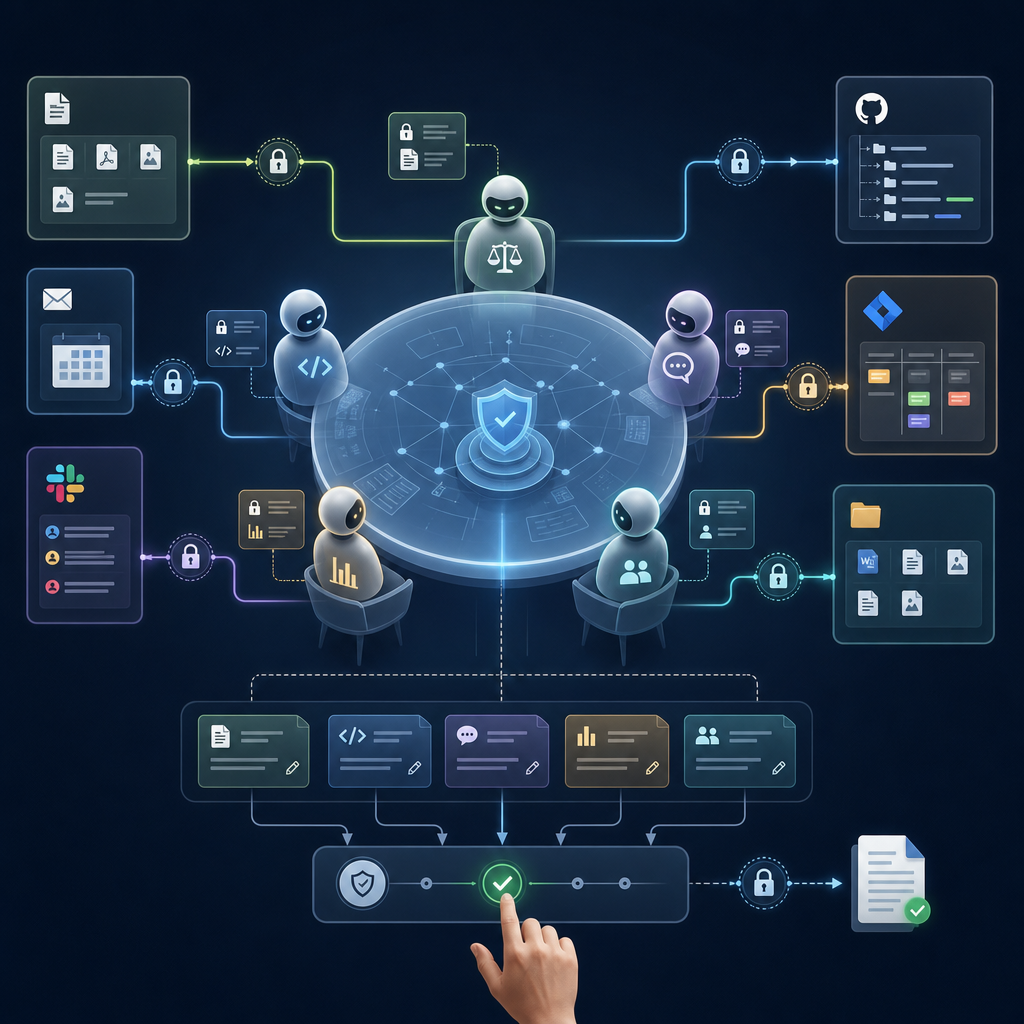
    A cross-functional team may work together on the same problem, but that does not mean every person, or every agent, should have access to the same information.

    As agents become part of everyday work, organizations are unlikely to rely on one universal assistant that knows everything and can access everything. Legal, engineering, sales, finance, and HR each work from different systems, different obligations, and different kinds of evidence.

    Connected Services are Sentienta’s answer to that problem. They let users authorize agents to work with the systems where team knowledge already lives, including Google Drive, Gmail, Google Calendar, Slack, GitHub, Jira, and local resources through Sentienta Bridge, without turning that access into a universal permission for every agent in the Workroom.

    In Enterprise AI Needs a Governance Layer, we argued that agent governance begins with access: which agents can reach which organizational systems? In How Sentienta Governs Agent Actions, we described the governed path from a request to an external action.

    Connected Services put those ideas into practice. They allow teams to bring specialist agents and their knowledge sources into a shared Workroom while preserving boundaries around information, authority, and action.

    Access Should Follow Responsibility

    Connected Services let users authorize Sentienta to connect with the systems where their work already lives. The cloud services use supported authorization flows and service APIs. Sentienta Bridge provides a governed path to locally available capabilities such as OpenClaw and selected files.

    Connecting a service does not mean every agent gains access to it. Sentienta treats service access as an agent capability, not as a universal capability of the platform. A user connects a service and then determines which agents may use the relevant capabilities.

    For example, a legal agent might be enabled to access contracts in Google Drive, while an engineering agent is enabled to access GitHub and Jira. An HR agent may need personnel documents and scheduling information. These agents can participate in the same organization without inheriting one another’s access.

    This is a basic governance principle: access should follow responsibility. An agent should receive the capabilities required for its work without automatically inheriting access to every system its user or organization has connected.

    That makes the agent’s role easier to understand and limits the consequences of an incorrect request, an overly broad interpretation, or the accidental use of sensitive information outside its intended context.

    Collaboration Without Erasing Boundaries

    A Sentienta Workroom gives people and agents a shared place to work on a problem, project, or decision.

    Each agent can participate with its own instructions, context, enabled services, permitted operations, and approval requirements. Agents can respond to one another and contribute to the same discussion while their underlying service access remains separately governed.

    This distinction becomes especially important when an agent retrieves private information.

    Information retrieved from a user’s connected service is returned in a Private Workroom card. It is not automatically visible to other participants, other agents, or outside collaborators. The user can review the result and decide what, if anything, should be shared with the Workroom.

    The team can therefore share a relevant conclusion without exposing every contract, email, issue, file, or record that contributed to it.

    Consider a company deciding whether to make a significant product commitment to a customer.

    The Workroom includes agents representing sales, legal, engineering, and finance, along with the managers responsible for the decision. Sales can explain what the customer requested. Legal can clarify what the contract permits. Engineering can assess product readiness and implementation risk. Finance can describe the applicable budget constraint.

    Each contribution is informed by the systems suited to that role. The participants can compare their findings and reach a coordinated judgment without opening every underlying source to everyone in the Workroom.

    From Governed Access to Coordinated Action

    Connected Services do more than help agents retrieve information. They also allow the Workroom team to prepare and carry out follow-up work in the systems where that work belongs.

    In the customer commitment example, the engineering agent might review GitHub activity and related Jira issues. The legal agent might locate the applicable contract language in Drive. The sales agent might review customer correspondence and prepare a follow-up message. A project coordinator might prepare a meeting, while a communications agent prepares a summary for Slack.

    These are not necessarily the capabilities of one universal agent. Work is directed to the agent whose role and service permissions match the request. One agent may have several capabilities when its assignment requires them, but access is granted deliberately rather than assumed.

    The interaction remains natural. A user can ask Engineering whether a correction was deployed, ask Legal to find a contract provision, or ask the project coordinator to prepare a follow-up meeting. The appropriate agent uses its enabled services to retrieve information or prepare the requested action.

    Retrieval and analysis do not automatically authorize an external change.

    When a proposed action would send, post, create, update, or delete information, Sentienta can require the user to review what will change, which service and destination will be used, and which agent prepared the action.

    Approval applies to the proposed operation. It is not blanket authorization for unrelated future activity.

    The result is a layered governance path:

    1. The user authorizes a service connection.
    2. The user enables specific capabilities for specific agents.
    3. The user selects the agents participating in the Workroom.
    4. Each agent contributes from its permitted information sources.
    5. Retrieved private information remains private unless the user shares it.
    6. Consequential actions are handled according to the applicable authority and approval policy.
    7. The activity and outcome remain part of the operational record.

    Each layer answers a different governance question. Together, they allow a team to move from distributed evidence to a coordinated decision and then to accountable action.

    Governance Makes Greater Capability Possible

    Connected Services provide immediate practical value. They let Sentienta agents work with documents, communications, schedules, repositories, issues, and local resources without requiring users to carry information manually in and out of a chat window.

    Their larger importance, however, is how they prepare for a world of specialist agents.

    As departments develop agents around their own responsibilities and knowledge, those agents will need to collaborate across organizational boundaries. Collaboration cannot mean giving every agent access to every system. It must preserve meaningful distinctions among roles, information, and authority.

    Sentienta Workrooms provide the shared environment for that collaboration. Connected Services give individual agents bounded access to the knowledge and tools their work requires. Private cards support selective disclosure. Approval controls govern consequential actions.

    Governance is therefore not a restriction added after an agent has been made powerful. It is the structure that allows organizations to give agents meaningful capabilities safely.

    The future is not one agent with all of the company’s knowledge. It is a governed team of people and agents, each contributing the knowledge and capabilities appropriate to its responsibility.
  • Sentienta + OpenClaw: Connecting Team Intelligence to the Desktop Ecosystem

    Sentienta has already redefined how teams of agents research, analyze, and reason through complex problems.
    With our latest release, those teams can now carry that work all the way through to completion.

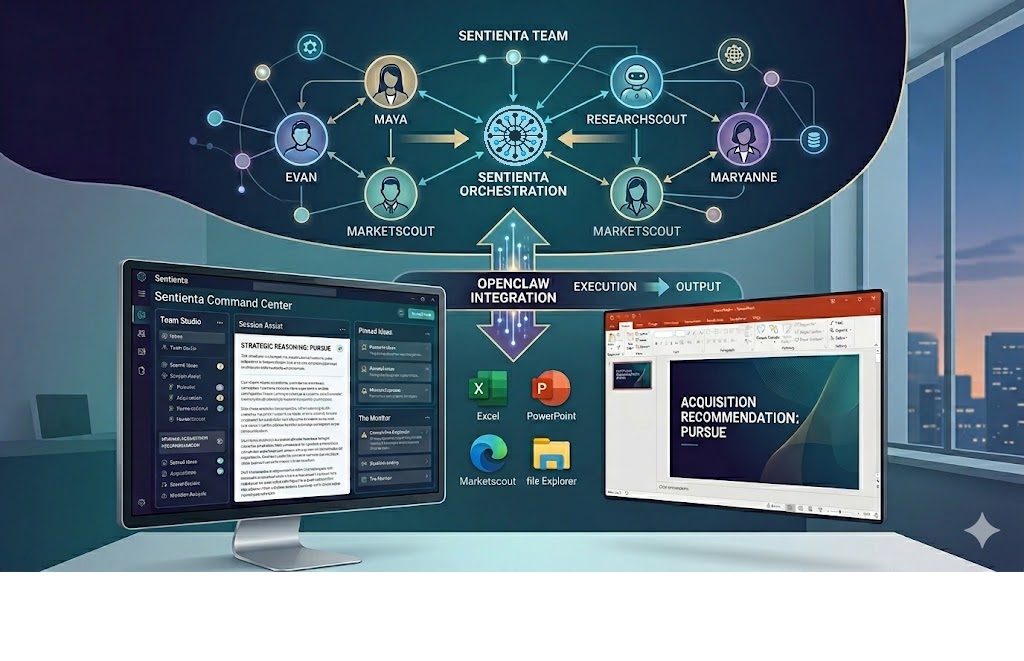
    By integrating OpenClaw, Sentienta Teams can recruit specialized third-party agents to execute tasks directly in owner-controlled desktop environments—turning high-level strategy into finished, usable outputs without leaving the workflow.

    The Power of an Open Ecosystem

    This release isn’t just about a new feature—it changes how Sentienta grows.

    Sentienta’s strength has always been orchestration. With OpenClaw, that orchestration now extends to a rapidly evolving ecosystem of external agents.

    Whether it’s a dedicated web researcher or a document automation specialist, if it speaks OpenClaw, it can join your Sentienta Team.

    This means Sentienta can draw on a broader developer community building new agents, tools, and workflows—each of which can be brought directly into a team.

    As that ecosystem evolves, so does what Sentienta Teams can do.

    The Integrated Operational Workspace

    To support this shift, we’ve redesigned the Sentienta workspace to keep team configuration, monitoring, and outputs tightly integrated with the live workflow.

    • New Team Studio
      Manage agents and teams directly from the main workspace. Create agents, edit team compositions, and access the Agent Marketplace without losing session context.
    • Session Assist
      A persistent right-hand workspace for real-time coordination.
    • Team Artifacts
      Automatically summarizes findings and preserves structured outputs.
    • Pinned Ideas
      Keeps core requirements and decisions visible throughout the session.
    • The Monitor
      Provides operational visibility into agent activity and OpenClaw task states, so execution can be tracked alongside reasoning.

    End-to-End Example: The Strategic Acquisition Screen

    To illustrate this model, we ran a full acquisition analysis workflow end-to-end using a Sentienta Team.

    Sentienta agents handled the strategic reasoning. OpenClaw agents operated in parallel to gather external data and produce final outputs.

    The result was not just analysis—it was a complete, decision-ready deliverable.

    • Parallel Execution
      ResearchScout and MarketScout (OpenClaw) gathered external intelligence while the rest of the team progressed in parallel.
    • Native Synthesis
      Maya and Evan (Sentienta) transformed that data into a clear “Pursue” recommendation with supporting rationale.
    • Direct Output
      MaryAnne (OpenClaw) converted that decision into a board-ready PowerPoint, returning the .pptx and slide images directly into the session.

    This is the key shift: work doesn’t stop at insight—it continues until it becomes executable artifacts.

    Secure, Owner-Controlled Action

    Execution happens within your environment.

    OpenClaw agents run inside your security perimeter, ensuring that as teams move from reasoning to output, your data remains fully under your control.

    From Insight to Outcome

    Sentienta remains the place where agent teams solve complex problems.

    Now, it is also the place where those solutions are carried through to completion.

    Not separate tools.
    Not disconnected steps.

    One system—from reasoning to result.

  • Beyond Chat: How OpenClaw and Sentienta Operationalize Multi‑Agent Work

    OpenClaw is having a moment—and it’s easy to see why. In the developer community, “desktop agents” have become the newest proving ground for what AI can do when it’s allowed to take real actions: browsing, editing, running commands, coordinating tasks, and chaining workflows together. OpenClaw taps directly into that excitement: it’s open, fast-moving, and built for people who want to experiment, extend, and orchestrate agents with minimal constraints.

    At the same time, a different kind of question is showing up from business teams and Sentienta users: How does this compare to what we’re already doing in Sentienta? Not as a “which is better” culture-war, but as a practical evaluation: what’s the right platform for the kind of work we need to ship reliably?

    The most interesting part is that both worlds are converging on the same core insight: a single, standalone LLM is rarely the best operating model for real work. The trend is clearly moving toward teams of interacting agents, specialists that can collaborate, review each other’s work, and stay aligned in a shared context. In other words, the wider market is starting to validate a pattern Sentienta has been demonstrating for business outcomes for over a year: multi-agent dialog as the unit of work.

    In this post we’ll look at what OpenClaw is (and who it’s best for), then quickly re-ground what Sentienta is designed to do for business users. Finally, we’ll cover the operational tradeoffs, especially the security and governance realities that come with high-permission desktop agents and open extension ecosystems, so you can pick the approach that matches your needs for simplicity, security, and power.

    What OpenClaw is (and who it’s for)

    OpenClaw is best understood as an open ecosystem for building and running desktop agents – agents that live close to where work actually happens: your browser, your files, your terminal, and the everyday apps people use to get things done. Instead of being a single “one size fits all” assistant, OpenClaw is designed to be extended. Much of its momentum comes from a growing universe of third‑party skills/plugins that let agents take on new capabilities quickly, plus an emerging set of orchestration tools that make it easier to run multiple agents, track tasks, and coordinate workflows.

    That design naturally attracts a specific audience. Today, the strongest pull is among developers and tinkerers who want full control over behavior, tooling, and integrations, and who are comfortable treating agent operations as an engineering surface area. It also resonates with security-savvy teams who want to experiment with high-powered agent workflows, but are willing to own the operational requirements that come with it: environment isolation, permission discipline, plugin vetting, and ongoing maintenance as the ecosystem evolves.

    And that’s also why it’s exciting. OpenClaw is moving fast, and open ecosystems tend to compound: new skills appear, patterns get shared, and capabilities jump forward in days instead of quarters. Combine that pace with local-machine reach (the ability to work directly with desktop context) and you get a platform that feels unusually powerful for prototyping—especially for people who care more about flexibility and speed than a fully managed, “default-safe” operating model.

    It is worth noting the recent coverage that suggests OpenClaw’s rapid rise is being matched by very real security scrutiny: Bloomberg notes its security is work in progress, Business Insider has described hackers accessing private data in under 3 minutes, and noted researcher Gary Marcus has called it a “disaster waiting to happen“.

    A big part of the risk profile is architectural: desktop agents can be granted broad access to a user’s environment, so when something goes wrong (a vulnerable component, a malicious plugin/skill, or a successful hijack), the potential blast radius can be much larger than a typical “chat-only” assistant. Not all implementations have this risk, but misconfiguration can lead to an instance being exposed to the internet without proper authentication—effectively giving an attacker a path to the same high‑privilege access the agent has (files, sessions, and tools), turning a useful assistant into a fast route to data leakage or account compromise.

    How Does OpenClaw Compare to Sentienta?

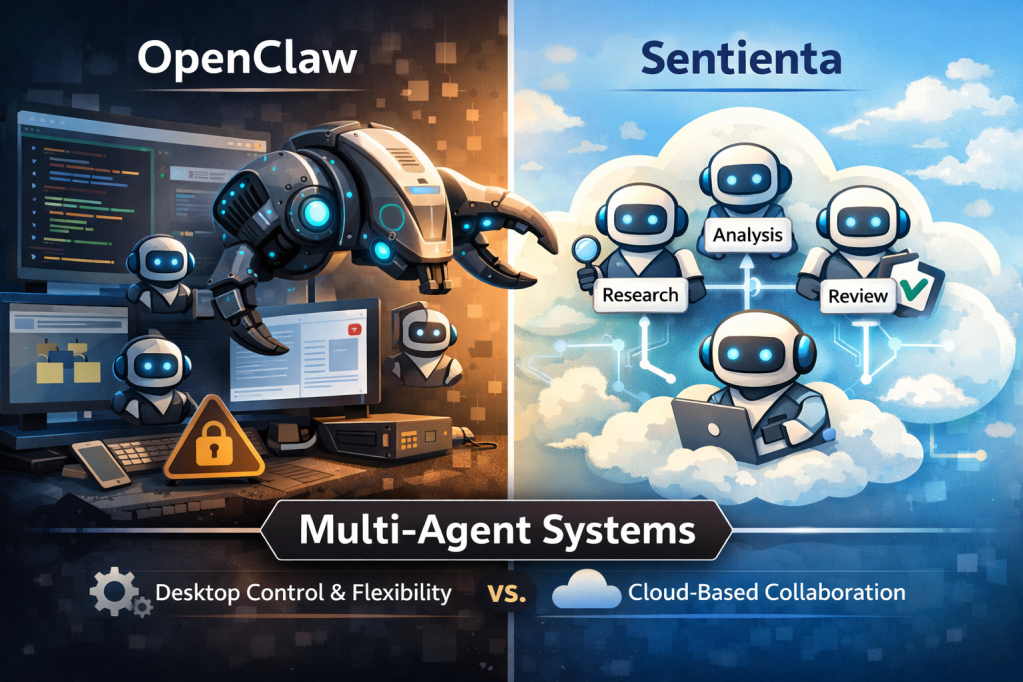
    Sentienta is a cloud-based multi-agent platform built for business workflows, where the “unit of work” isn’t a single assistant in a single thread, but a team of agents collaborating in a shared dialog. In practice, that means you can assign clear roles (research, analysis, writing, checking, ops), keep everyone grounded in the same context, and run repeatable workflows without turning day-to-day operations into an engineering project.

    It’s worth emphasizing that OpenClaw and Sentienta are aligned on a key idea: multi-agent collaboration is where real leverage shows up. Both approaches lean into specialization: having distinct agents act as a researcher, analyst, reviewer, or operator, because it’s a practical way to improve quality, catch mistakes earlier, and produce outputs that hold up better under real business constraints.

    Where they differ is less about “who has the better idea” and more about how that idea is operationalized:

    Where agents run: OpenClaw commonly runs agents on the desktop, close to local apps and local context. Sentienta agents run in the cloud, which changes the default boundary: when local data is involved, it’s typically handled through explicit user upload (rather than agents broadly operating across a machine by default).

    Time-to-value: OpenClaw is naturally attractive to builders who want maximum flexibility and are comfortable iterating on tooling. Sentienta is designed to get business teams to a working baseline quickly: Quick Start is meant to spin up a functional team of agents in seconds, with minimal developer setup for typical use.

    Collaboration model: Sentienta’s multi-agent orchestration is native to the platform: agents collaborate as a team in the same dialog with roles and review loops designed in from the start. OpenClaw can orchestrate multiple agents as well, but its ecosystem often relies on add-ons and surrounding layers for how agents “meet,” coordinate, and share context at scale.

    Net: OpenClaw highlights what’s possible when desktop agents and open ecosystems move fast; Sentienta focuses on making multi-agent work repeatable, approachable, and business-ready, without losing the benefits that made multi-agent collaboration compelling in the first place.

    Conclusion

    The bigger takeaway here is that we’re leaving the era of “one prompt, one model, one answer” and entering a world where teams of agents do the work: specialists that can research, execute, review, and refine together. OpenClaw is an exciting proof point for that future—especially for developers who want maximum flexibility and don’t mind owning the operational details that come with desktop-level capability.

    For business teams, the decision is less about ideology and more about fit. If you need rapid experimentation, deep local-machine reach, and you have the security maturity to sandbox, vet plugins, and continuously monitor an open ecosystem, OpenClaw can be a powerful choice. If you need multi-agent collaboration that’s designed to be repeatable, approachable, and governed by default—with agents running in the cloud and local data crossing the boundary only when a user explicitly provides it—Sentienta is built for that operating model.

    Either way, the direction is clear: AI is moving from standalone assistants to operational systems of collaborating agents. The right platform is the one that matches your needs for simplicity, security, and power—not just in a demo, but in the way your team will run it every day.