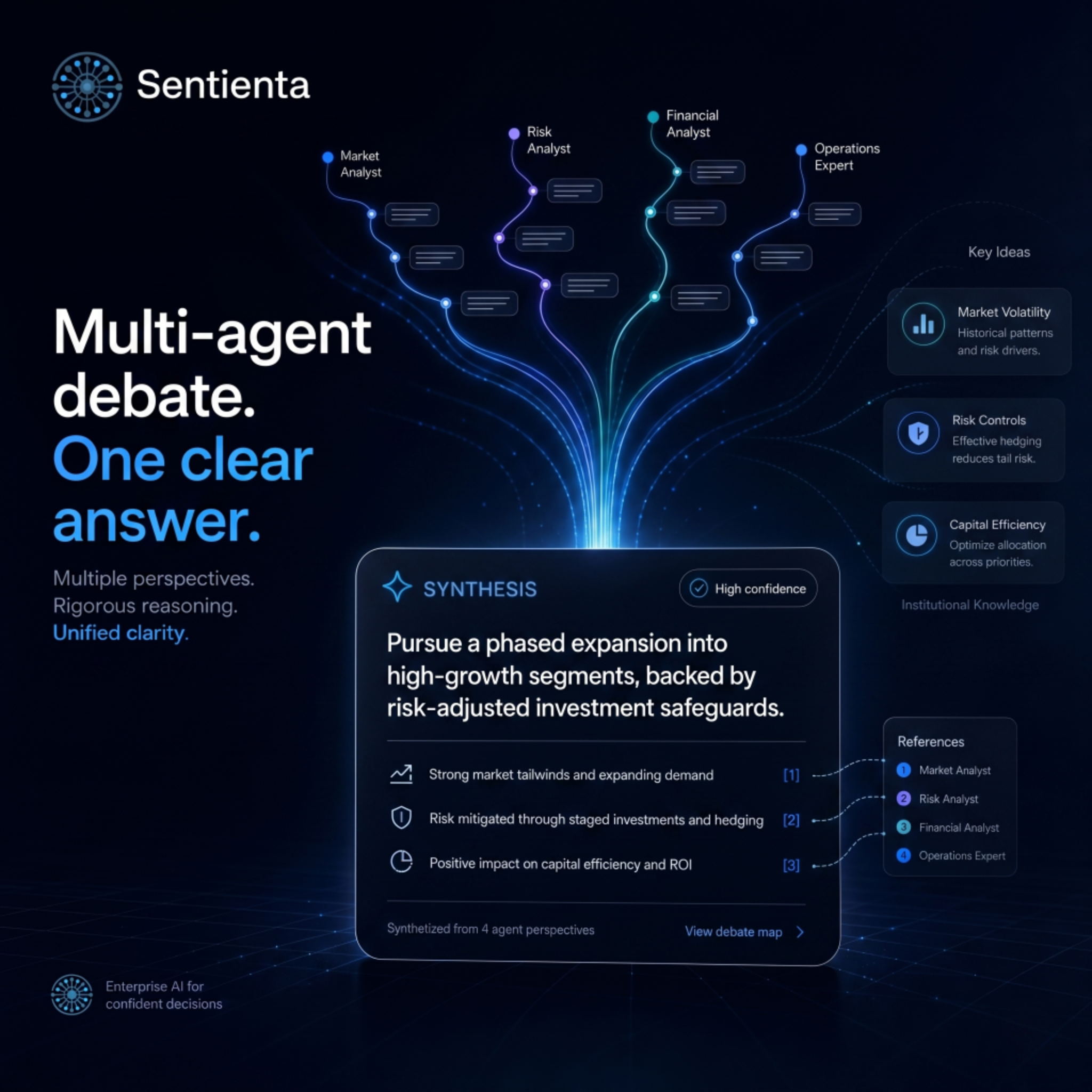
Single-model chats give you one perspective. Multi-agent tools drown you in output. Sentienta Home gives you both depth and clarity.
You know the moment. You open ChatGPT or Claude, or Copilot and type something real. Not “write me a limerick.” Something your team is actually stuck on:
“Should we move from usage-based to seat-based pricing?”
“What are the compliance risks if we expand into the EU before Q4?”
“We’re choosing between three architectures — what are the trade-offs we’re not seeing?”
You get an answer. It’s articulate. It sounds confident. And it’s one voice, one perspective, offering no pushback, surfacing no dissent, raising no trade-offs it wasn’t explicitly asked to raise. You read it and think: this is fine, but I wouldn’t make a decision off this alone.
You know better, because real decisions don’t work that way. They require someone to push back. Someone to say “you’re ignoring the second-order effect.” Someone to ask “what happens when this assumption breaks?” In your actual work, the best decisions come from structured disagreement, not from the smartest person in the room monologuing.
So you go looking for multi-agent tools. And you find them. CrewAI, AutoGen, custom GPT teams. They promise multiple perspectives. But they deliver a new problem: now you are the project manager. You configure agents. You read five separate responses. You reconcile contradictions yourself. You traded a blank text box for a reading assignment, and the synthesis is still your job.
There’s a gap no one fills: the depth of multi-agent debate without the cognitive load of managing it.
That’s what Sentienta Home is built for. You ask one question. A structured debate happens. You get one answer, with the full reasoning behind it, accessible when you want it, invisible when you don’t.
No team-building. No model selection. No prompt engineering. You start with the problem. Everything else is Sentienta’s job.
Here’s what that actually looks like.
One Question. A Team You Didn’t Have to Build.
You asked one question. What came back wasn’t one answer, it was the result of a structured debate between specialists you never hired, configured, or knew you needed.
That’s the first thing that feels different about Sentienta Home. The input is familiar: you type a question in plain language, the same way you would anywhere else. But what happens on the other side is not.
Sentienta reads the complexity of what you asked and makes a decision for you. If it’s straightforward, such as “what’s the standard vesting schedule for a Series A hire?”, you get a direct answer. Fast, clear, done.
But if your question carries real weight, with competing trade-offs, multiple stakeholders, judgment calls that depend on context you haven’t fully articulated, the system recognizes that. It assembles a team of specialized agents, each bringing a different lens to the problem, and initiates a structured debate. The result arrives as a single resolved position: not five opinions for you to reconcile, but one conclusion that survived challenge from multiple directions.
You didn’t build that team. You didn’t know you needed it. You just asked a question worth asking.
Why nothing else works this way:
Today, when you ask a complex question in ChatGPT or Claude, you get one confident voice back. If the answer feels thin, and for hard questions, it usually does, your only option is to prompt again. “Now consider the opposite view.” “What am I missing?” “Play devil’s advocate.” You become the orchestrator of a debate the tool can’t hold on its own. The friction isn’t in typing your question — it’s in the follow-up labor required to get depth.
Some chatbots get you sourced information, but they aggregate facts, not disagreement. When your question involves judgment and trade-offs rather than lookup, you hit a wall.
And for the few who discover multi-agent frameworks, the developer tools that do let you run multiple AI perspectives, you don’t get to ask your question until you’ve built the thing that answers it. Define agents, assign roles, write system prompts. The question comes last. That’s a technical skill gate standing between you and the multi-perspective reasoning you actually wanted.
Home removes all of that. The complexity of assembling the right team, running the debate, and resolving it into something clear is the system’s job. Your job is to have a question worth asking.
And here’s the subtler thing that changes: when the tool can handle the hard version of your question, you stop pre-simplifying. You stop breaking complex problems into bite-sized prompts the AI can manage. You ask the real question — the one you’d ask if you had three smart people in a room who already understood your context. Home is built to deserve that question.
Everything else follows from that.
Watching a Team Think
In ChatGPT, you go from your question to “Thinking”, and then to a wall of text. Eight hundred words arrive at once, undifferentiated, and now the cognitive work begins: parsing, prioritizing, figuring out what matters. The answer might be good, but you’re reading it cold. You have no framework for what’s important and what’s filler.
Sentienta gives you that framework before the answer arrives.
When your question triggers a multi-agent debate, you see status cards as the discussion unfolds. Each one is a conceptual landmark: “pricing risk identified,” “two agents disagree on timeline feasibility,” “convergence forming around option B.” They’re glanceable, not demanding. You absorb them the way you notice a colleague’s expression shift across the table.
By the time the synthesis appears, you already know the shape of the problem. You know where the tensions lived. You know which angles were explored. The final answer doesn’t hit you as a wall of text requiring triage. It lands on scaffolding your mind already built.
You never read the synthesis cold. That’s the difference.
One Answer, Full Depth Behind It
Here’s the contract Sentienta makes with you: you always read one thing first.
Not five agent responses. Not a transcript of a debate. Not a choose-your-own-adventure menu of perspectives. One synthesis card: the conclusions, the recommendations, the trade-offs that matter most. Integrated, resolved, and readable in under two minutes.
This matters because of what it’s not. It’s not a summary that says “Agent 1 argued for X while Agent 2 preferred Y.” That’s a meeting recap, not a conclusion. The synthesis card is an integrated position: it weighs the arguments, resolves the tensions, and tells you what survived scrutiny. It reads like the recommendation you’d get after a room full of experts argued it out on your behalf.
The contrast with what you use today: In other frontier models, what you see is all there is. The response is the thinking. There’s nothing deeper behind it, no richer process that produced it. If the answer feels thin, that’s because it is thin. There’s no deeper layer to access.
In Sentienta, the synthesis card sits on top of a full multi-agent debate. The depth is real and it’s there whenever you want it. Expand any section and you’re inside the deliberation: which agent pushed back, what counterargument was raised, how the final position earned its place. Collapse it and you’re back to the clean summary.
This is the difference between a single take and a considered judgment. One is fast and uncontested. The other carries the weight of challenge, disagreement, and resolution. You get the resolution first. The challenge is always one click away.
Verify Anything
Every claim in a synthesis card is footnoted. Not as decoration. As a promise.
Click any footnote and you land directly on the passage in the agent debate where that claim was argued, challenged, or substantiated. No scrolling through a transcript. No hunting for “which agent said that?” You go straight to the moment in the deliberation where the work happened.
Why this exists: The synthesis card gives you a resolved position. But “resolved” doesn’t mean “take my word for it.” Enterprise teams making real decisions need provenance. When the synthesis says “the regulatory risk is manageable if you file before Q3,” someone at the table will ask: who argued that? What was the counterargument? How strong was it? Footnotes answer all three questions in one click.
The contrast: With single model chat bots, if an answer makes a claim you want to verify, your only option is to ask a follow-up: “Why do you say that? What’s your reasoning?” You’re interrogating the model after the fact, hoping it can reconstruct its own logic. Often it can’t. It confabulates a justification that may or may not reflect how it actually arrived at the statement.
In Sentienta, the reasoning already exists. It was produced in real time by agents who argued, pushed back, and resolved. The footnote doesn’t ask the system to explain itself. It points you to the actual work. The difference is the same as asking a colleague “why did you recommend this?” versus reading the analysis they wrote before the meeting. One is reconstruction. The other is the record.
This is how you move from “I got an AI answer” to “I can defend this recommendation in a room.” Not because you blindly trust the system, but because you verified the parts that matter to you, in thirty seconds, without reading everything.
The system doesn’t ask for your trust. It shows you how to check.
Your AI Develops Institutional Knowledge
Every AI tool now has memory. ChatGPT remembers things about you. Claude retains context across sessions. But here’s the problem: you can’t see what they remember. You can’t know which assumptions they’re silently applying to your current question. You can’t edit or retire conclusions that are no longer true. The memory is real, but it’s opaque. It works on you rather than with you.
Sentienta agents have that kind of memory too. But the system does something additional: it derives Key Ideas from your deliberations. These are conceptual anchors, the meta-level themes and recurring principles that emerge as you work through complex problems. Think of them as what you’d get if you asked: “What are the key themes running through everything we’ve discussed today?”
Key Ideas aren’t slow to develop. You don’t need days of history. Start a new problem in the morning, work through several related questions, and within hours the system identifies the principles that keep surfacing: “margin preservation matters more than growth rate,” “the compliance window closes in Q3,” “the team has rejected subscription pricing twice for specific reasons.” These emerge as soon as the pattern is evident, not after some arbitrary accumulation period.
Here’s what makes them different from hidden memory: Key Ideas are visible, editable, and collaborative. They appear in your workspace. You can see exactly what the system considers established. You can confirm them, refine them, challenge them, or retire ones that no longer apply.
When you ask a new question, relevant Key Ideas inform the debate. The agents don’t re-derive your strategic positions from scratch. But you always know which Key Ideas are active, because they’re right there. No silent assumptions. No wondering what the AI “thinks it knows” about you.
The shift: Other tools accumulate knowledge about you invisibly and apply it without asking. Sentienta accumulates knowledge with you explicitly and applies it transparently. One is convenient but unaccountable. The other gives you a shared, evolving understanding you can inspect and govern.
The value compounds fast. Every deliberation sharpens the system’s grasp of what your team has already resolved, and every Key Idea it surfaces gives you the chance to confirm or correct that understanding. We’ll go deeper on how you manage Key Ideas in a future post.
What This Means for You
Sentienta Home gives you four things no other tool combines:
Multi-agent debate without configuration. You don’t define agents, assign roles, or write system prompts. You ask your question. The system decides what expertise the problem demands and assembles it.
Multi-agent debate without the cognitive load of reading it. The debate happens. You get the resolved conclusion. You never have to read five competing perspectives and figure out which one wins.
Synthesis fully referenced into the deliberation. Every claim in the synthesis is footnoted back to the exact moment in the debate where it was argued and tested. You verify what matters to you in seconds.
Key Ideas that anchor the larger discussion. As themes and principles emerge across your work, the system surfaces them explicitly. Visible, editable, accountable. They carry forward into future questions so the system builds on what you’ve already resolved rather than starting fresh.
These are not separate features. They are one integrated experience designed to make hard problems easier to solve and less expensive to think through. Sentienta absorbs the complexity so you can stay focused on the decision.
Try it. Go to sentienta.ai. Ask something your team is actually working through. Watch the status cards. Read the synthesis. Click a footnote. Come back tomorrow and ask the next question.
Next in this series: what happens when you want to keep that thinking alive, invite your team in, and let the context grow across people. That’s a different kind of product. We’ll show you what it looks like.


Leave a Reply